Nobody expects a revolution from a film called Raksha Bandhan. As I walked into a cinema hall, despite having raised eyebrows at its trailer, I silently hoped the makers might tone down the quotient of regression. Alas, I was in for no luck as they conjure up a Hindi-language film that is the worst I’ve watched since Roohi (which contained nothing offensive) in 2021.
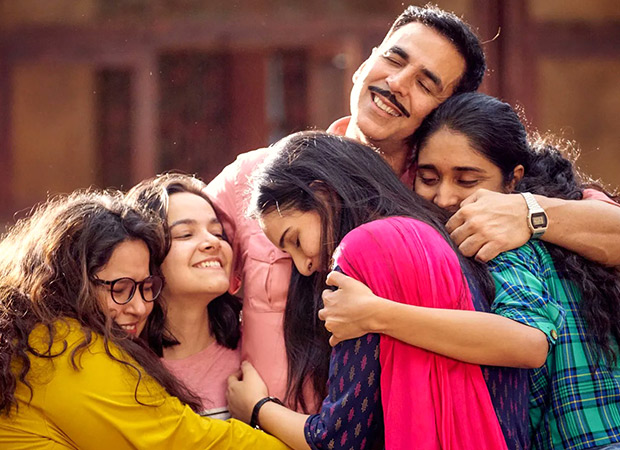
There are regressive Bollywood films, and then there are those that normalize family setups like the one in Raksha Bandhan. Lala Kedarnath (an aged Akshay Kumar with a fake moustache) is the elder male sibling and, hence, the provider to his sisters. Each sister has a defining characteristic. The eldest one is an angelic beauty with a halo over her head. The others are overweight, dusky, and androgynous (mockingly referred to as a double-decker bus, amavas ki raat, and Chhota Shakeel, respectively). None of them seems to have had notable education or worthwhile ambitions. They look forward to getting married as their brother struggles to amass a dowry for each. Another significant leg in the film is Lala’s childhood (what?) sweetheart Sapna (Bhumi Pednekar). Her father (Neeraj Sood) is understandably frustrated by our leading man’s bizarre promise to his deceased mother. Lala wouldn’t marry before his siblings are packed off.
Nothing makes sense in Raksha Bandhan. The sisters are the most clueless bunch of women you would ever come across in a contemporary film. Their lack of personality and integrity makes us seethe with anger. Known to share an amicable relationship with Sapna, the women, at no point, try to convince their brother to get over the godawful promise that affects so many lives, including his.
ALSO READ: ‘Atrangi Re’ review – Aanand L. Rai’s love story is twisted, not in a good way
Written by Kanika Dhillon and Himanshu Sharma, the film shockingly normalizes dowry. There is an elaborate scene staged in a public place where a sarcastic Akshay Kumar silences an activist who tries to raise awareness against it. He offers sermons on the need to eliminate dowry while explaining why women should have identities. By the time it happens, it’s all too late in the film.
Raksha Bandhan would offend any sensible person when the leading man (casually) sells his kidney for a hefty sum to marry off the girl. No, this isn’t Hera Pheri’s Raju finally acting upon his plans 22 years hence. Lala’s day job is to sit at a snack shop where he sells some sort of holy gol gappas that would bless them with male children. Women are constantly projected as housekeepers with no dreams or careers. Rai’s film tries to undo each of its vices, but with no genuine intent. By the time the brief climactic monologue erupts, its problematic messages have already sunk deep.
Among the things that Raksha Bandhan refuses to fix is its horrifying lack of compassion. It’s annoying to see a film in 2022 that uses stammering as a tool for comic relief. Not to forget, the film mindlessly shames its second leads for their weight, skin color, and sartorial choices (which would extend to sexuality in a broader sense). The hero’s ideals, after a harrowing incident (not the one where he sells a kidney), take a turnaround, and he decides to invest in his sisters’ education. The women, in an utterly laughable scene, pile up UPSC texts and blurt out, “Aaj se kutton ki tarah padhai karenge” (roughly translated as “let’s study our arses off from today”). I haven’t seen worse writing (and acting) in a Hindi film in ages. The women do turn enterprising but they never ask their brother to get a life for himself. The man waits and waits, only so that he could do a geriatric marriage, previously seen in Bharat (which is a mini-classic in comparison).
If its values date back to colonial times, the film’s aesthetics and technical merits are nowhere behind. Shot entirely on a scrappy set that has been made to look like Delhi’s Chandni Chowk, the film underuses the abilities of its DOP K.U. Mohanan. If Himesh Reshammiya’s songs sound like ’90s leftovers, Ishaan Chhabra’s original score puts extra soap on the soppy mess that Raksha Bandhan is.
The biggest irony in Aanand L. Rai’s film is that it never humanizes the siblings. The brother treats his sisters as if they were pieces of land waiting to be confiscated by the government. Lala’s relationship with Sapna (Bhumi Pednekar is the film’s sole ray of sunshine) is explored in depth, but it gets mundane in no time. The woman wants to get married, but the man doesn’t. There are about five confrontations staged around the same duel, resulting in gallons of tears and zero solutions. It was particularly upsetting to watch Pednekar (who starred in Dum Laga Ke Haisha and Bala) in a film that espouses a dangerous worldview.
Everything feels so horribly offensive in Raksha Bandhan that similar films from the ‘70s, such as Tapasya and Aaina, look way more honest and time-appropriate. Not only is it the worst solo-hero film in Akshay Kumar’s career, but it is also the lowest low for its filmmaker and writers, who have delivered sensitive films in the past.
Rating: ★
Raksha Bandhan is now streaming on Zee5.