In cinema, or in the worlds that inspire it, some concepts are inherently dated. One such relic is dacoity. What do you picture when you hear of a film titled Dacoit? I go straight to the Chambal Valley, or maybe think of a Veerappan type, clad in camouflage, sporting a handlebar moustache, clutching hunting guns with a bullet rack slung diagonally across the torso. Given the dubious ways of Telugu cinema, I would at least expect one of those routine one-man battles against the system to protect mothers and sisters.
Shaneil Deo’s film, however, delivers none of that. Instead, Dacoit tries to be everything else, none of which resembles a dacoit.
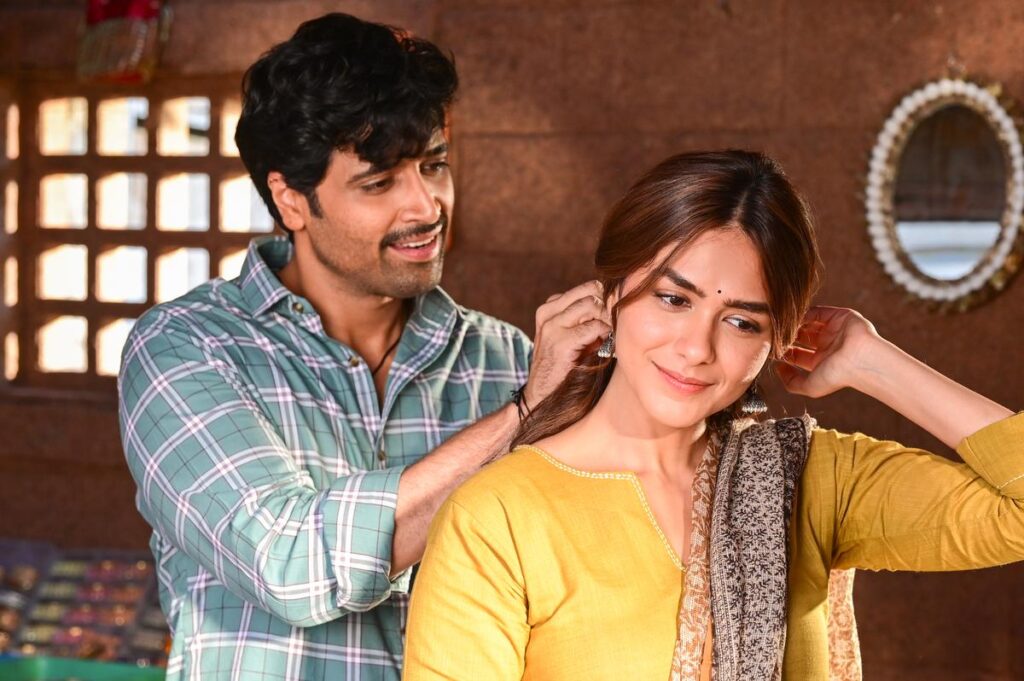
Dacoit is a love story. More specifically, one written by someone who seems to have never landed a date themselves. The result is a romance that gives you both an ick and an itch. The lover boy Hari (Adivi Sesh) calls his ladylove Saraswathi (Mrunal Thakur) “Juliet.” The film wants us to believe the duo is all of 18 when we first see them together. In their peak hormonal years, the couple is unbelievably asexual. If they were to see flowers, they’d probably watch them pollinate with moral discomfort but never get intimate themselves. It’s that kind of cinema.
Also, they never fight. Not once. This is a relationship set in the era of costly SMS packs, unlimited talktime, and slow dial-up internet, and yet, there is zero conflict. Even Orkut scraps had more friction.
Dacoit is also a revenge story with nonstop action. After spending 13 years in jail for no fault of his, Hari’s anger is at its peak. That’s when everything begins to fall into place conveniently. A key appears in a bowl of gajar ka halwa, a one-way ticket to a foreign nation is handed out, and we see lakhs thrown around like pocket change. Guns of every imaginable model fire endlessly, and at some point, the film turns into a bizarre road trip cum hospital invasion mission.
Which brings us to the next genre: medical drama.
The writers’ understanding of healthcare is as hilarious as their grasp on romance. Sure, it’s a masala film, but somebody should tell them that you cannot just walk into a hospital with a random person and arrange a heart transplant like you’re ordering from Swiggy. If you have a severe heart condition, you generally avoid high-speed chases and gunfights. Hospitals, shockingly, have security, and ICUs are not public parks you can stroll into. And imagine, the whole thing is set during COVID.

Dacoit is also a grand melodrama with sacrifices, secrets, and suffering. Tears flow in buckets, but we feel nothing. There is also a kid mixed into this situation, reciting lines from a drama she most likely performed in school. The film cries so loudly, aided by a persistently bizarre background score, that you almost feel like joining in. But what comes out instead is laughter.
If there’s anything consistently entertaining about Dacoit, it is the dialogues. The film is utterly serious from start to end, with no room for humour, which makes every unintentionally funny line land even harder. I watched the Hindi version where a severely wounded Hari is worried about his shirt: “Brand wala shirt kharab kardiya tune. Itne chhed hai rafoo bhi nahi kar sakta.” Can you believe that?
Dacoit also wants to be several other things: a caste critique, a rape vigilante drama, a heist film. It dabbles in everything and commits to nothing. Its understanding of caste violence is basic and painfully black-and-white, while its stance on women’s safety is worse. The film’s educated and supposedly powerful women are glorified damsels in distress. It is liberal enough to depict a young, unmarried man and woman sharing a house, but feminism is its limit.
At its core, Dacoit is still very much steeped in the outdated Telugu cinema formula. The heroine is so virginal that you suspect divine intervention in her childbirth. Saraswathi is present in almost every frame, yet has zero agency. If not running around in sarees that seem to require extra yardage or casually flying cars wearing XXL hoodies, she’s either panting or shedding copious tears for reasons best known to the screenplay.
And yes, the film does not miss the mandatory navel show. Right when our hero breaks out of prison, he must visit a local bar to shimmy with a woman who has absolutely no business being in this film. But then again, neither does logic.
ALSO READ: ‘The Girlfriend’ review – Taming the toxic alpha male
I walked in because of the cast, but none of their characters make sense. Atul Kulkarni seems fully aware of what film he has signed, and the nonchalance shows on his face. He fulfills his tasks and exits without any fuss. Prakash Raj looks just as happy to have finished his schedule quickly, giving a look here and a growl there. The best people in the film are his on-hire goons who risk their lives chasing fast vehicles with money that’s not even theirs. Anurag Kashyap appears to pretend that this is a meaningful addition to his filmography. That confidence is more fun than the act itself.
The leads are listless, largely because of the writing. Mrunal Thakur cries, whimpers, and suffers in a poorly conceived character that proves more screen time does not equal substance. The casting brief might as well have read: must appear to know F1-level driving, must cry on cue, being beautiful is a bonus. Adivi Sesh, one of Telugu cinema’s better actors, finds himself trapped in a template that feels four decades too late.
In short, Dacoit never works. The blame lies with an industry that thinks too highly of itself and too little of its audience’s functioning brain cells. Shaneil Deo’s film neither follows a structure nor has a beating heart. It has impulses. After every heavy scene, a random idea or a bizarre punch line pops up to keep things entertaining.
Watching Anurag Kashyap here reminded me of Luck By Chance, where his character, a screenwriter, is told off by those commercial cinema gatekeepers, “Picture dull nahi honi chahiye.” In trying so desperately not to be dull, Dacoit becomes exactly that. A gigantic, occasionally hilarious, borefest.
VERDICT: ★