Few Indian films have had their very existence validated so completely by the forces they are fighting. Honey Trehan’s Satluj (formerly Panjab ’95) concerns a man who bravely sought to expose state-sanctioned cover-ups and justice for the victims’ families. It then languished for years, awaiting CBFC approval, before being released on an OTT platform without any fanfare. The irony is brutal. Even before the first frame rolls, the film’s own painful journey to our screens is a mirror to the very silence it is trying to break.
Trehan’s 1995-set film is a somber and unsettling alternative to popular Indian cinema obsessed with hyper-masculine, uniformed heroes who shoot first and ask questions later (and sometimes never do). It gives up chest-thumping folklore for documented history and dives into a bleeding chapter of Punjab’s past that mainstream conversation has spent decades trying to forget. Satluj does not try to exploit the tragedy to create a cheap spectacle, but rather concentrates on the lives lost without explanation and the one man who refused to let them be statistics.
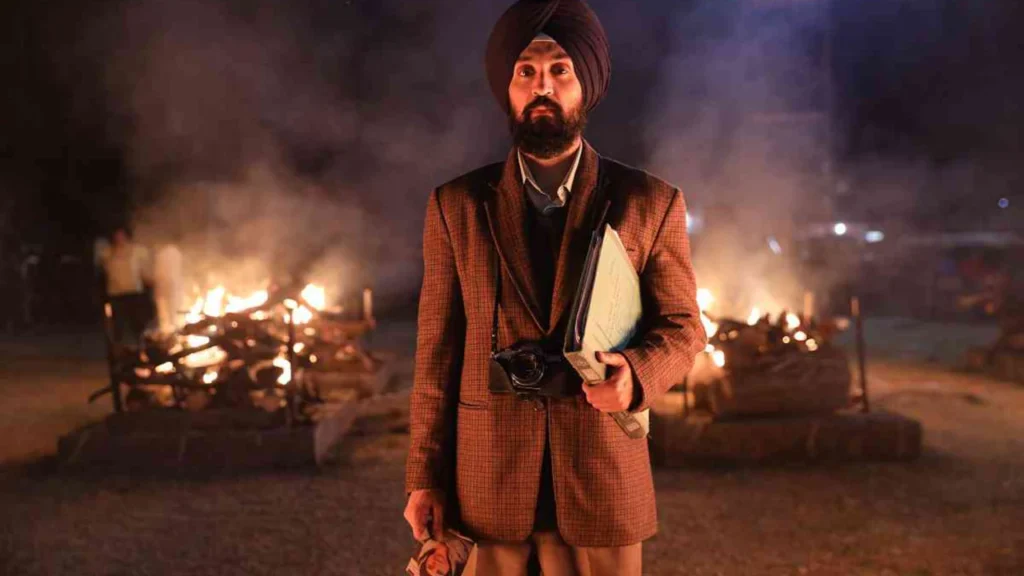
When we meet Jaswant Singh Khalra (Diljit Dosanjh), he’s an ordinary bank employee with a wife and two school-going kids. He isn’t a born revolutionary looking for a fight. Following the disappearance of a friend and his mother, Khalra begins to pull a thread that ultimately leads him to municipal cremation records. What he finds is horrifying: thousands of unidentified bodies burnt as “unclaimed.” His real courage, in a society paralyzed by fear and conditioned to look away, was not to pick up a weapon. It was not to blink.
Even when offered political asylum during a conference in Canada, he comes back. He knows that if he runs to safety, the truth dies with him, and the disappeared remain anonymous entries in official records forever.
One of Satluj‘s greatest strengths is that it never mistakes restraint for weakness. In an era where everyday conversations around justice have turned incredibly bloodthirsty, with people on social media routinely celebrating instant “encounter” justice, Trehan’s film quietly asks the questions that actually matter. Do the police have the moral authority to play God? It looks at how institutions meant to protect citizens can become tools of complete terror.
This way, it is striking how quiet Satluj is, given the heavy subject matter. Trehan seldom uses violence for shock value. He knows that true horror is found in the buildup and the aftermath. Take the sequence where the police show up at Satnam Singh’s house. Saurabh Sachdeva (who is surprisingly absent from the credits) gets no dialogue, yet the minutes that follow brim with narrative tension. Writers Niren Bhatt, Utsav Maitra, and Trehan exhibit such absolute mastery over their craft here that even a modest bowl of saag will strike terror into your guts.
Because of the era it revisits, Satluj will inevitably be hit with accusations of being purely political. But that misses the point. Politics isn’t something forced onto the narrative; it’s the very reason this story exists. Khalra’s investigation, the court battles in the last act, and the timeline are all matters of public record. Trehan isn’t inventing a hero out of thin air. He is reclaiming one whom history nearly allowed us to forget.
Editor A. Sreekar Prasad completely resists the urge to manufacture fake adrenaline, allowing the grief to settle and pile up organically. K. U. Mohanan’s moody camera works in perfect sync with this pacing. In Satluj, Punjab isn’t framed like a pretty tourism postcard or a chaotic war zone, but as a landscape haunted by ghosts. The stillness of the empty fields and quiet streets feels heavier than actual blood on screen.
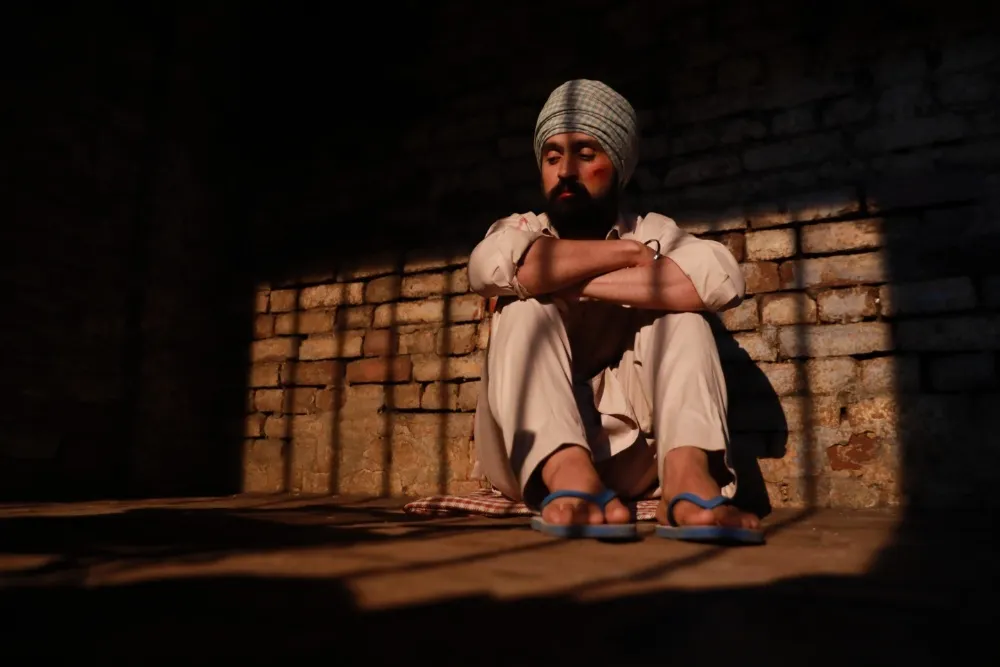
Honestly, it’s hard to overstate how good Diljit Dosanjh is here, specifically because he does not attempt to play “hero” in Satluj. He operates entirely in a minor key. There are no big, loud Filmfare-clip scenes or grand speeches demanding your applause. He just sits in the silence of the character. As the danger mounts, you don’t get an explosive transformation. You watch his eyes harden while his demeanour stays incredibly gentle. By the time the credits roll, you forget you’re watching a global superstar.
ALSO READ: ‘Main Vaapas Aaunga’ review – Imtiaz Ali’s moving elegy for a divided homeland
Trehan’s screenplay gives equal weight to the people operating in Khalra’s orbit, trading archetype for pure friction. Look at how Geetika Vidya Ohlyan refuses to let Khalra’s wife slide into the background as a passive, suffering bystander. She infuses her with a sharp, defensive dignity that peaks in a phenomenal, skin-crawling standoff with Suvinder Vicky’s Sugga. Vicky plays the cop not as a theatrical antagonist, but with a bureaucratic casualness. For him, violence is just another day at work. Even late arrivals like Arjun Rampal’s CBI investigator register instantly, capturing the precise exhaustion of a man caught between his own conscience and a compromised machine.
Kanwaljit Singh is stunningly icy as the top cop, Bitta. It is the second time recently that the veteran actor has casually pulled off a feat like this, following his similarly unsettling turn in Mrs. A grounded ensemble, consisting of Varun Badola, Jyoti Dogra, Geeta Aggarwal Sharma and Jagjeet Sandhu, populates Trehan’s film with familiar human reflexes rather than mere plot devices.
In the end, Satluj leaves us with a chilling reminder of how fragile public memory actually is. You can’t separate the story on screen from the film’s own messy reality with the censor board. There is a dark poetry to the fact that Satluj became a victim of the exact institutional silencing it was trying to expose, its own suppression serving as the final proof of its thesis. Trehan hasn’t built a standard historical drama here. Instead, Satluj is a confrontation. It asks whether our everyday habit of looking away makes us accomplices in the erasure.
VERDICT: ★★★★ 1/2
For more reviews of Satluj, head to the Film Critics Guild.