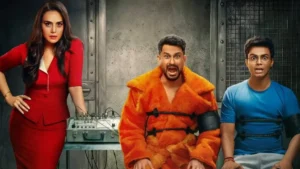
It’s a different kind of reality check to battle the Mumbai monsoons to watch a film, only for the film to remind you that the very same showers might well have taken your life. In Baby Do Die Do, director Nachiket Samant imagines a world where Mumbaikars do not die by falling into manholes or getting swept away in man-made floods. Instead, the season’s biggest accessory – an umbrella – becomes the murder weapon.
In an angle that strangely reminded me of Johnny Lever’s Chhota Chhatri in Awara Paagal Deewana, it isn’t just the weapon that adds spice to this dark comedy. Nor is it the fact that Samant’s protagonist is a woman. The third layer – that she is deaf and mute – gives the film the extra quirk it needs.
Baby Do Die Do opens with a flashback sequence where a pair of identical twins (Samaira and Shanaya Vijay) stroll around a five-star hotel lobby. They are enamoured by the rooms and the sheer sense of space, something they never had the privilege of experiencing in their cramped 10×10 shanty. Mumbai’s housing crisis has famously been documented in films like Piya Ka Ghar, Gharaonda and Love Per Square Foot, to name a few. But here, the crisis is never light-hearted. It hits you straight in the gut.
There is a point in Baby Do Die Do where Zafar aka ZK (Sikandar Kher) pauses to sniff a blanket inside a shack he later sets on fire. It carries a familiar smell, one he grew up with. Like many Mumbai success stories, he lived out the classic ghetto-to-high-rise dream. And what if several lives had to be sacrificed as he climbed up the real estate ladder? Samant’s film underlines how life in the Maximum City, often romanticized as the ‘Spirit of Mumbai’, is ultimately about the survival of the fittest, where the only invincible forces are those still striving and those who already have everything laid out on their platter.
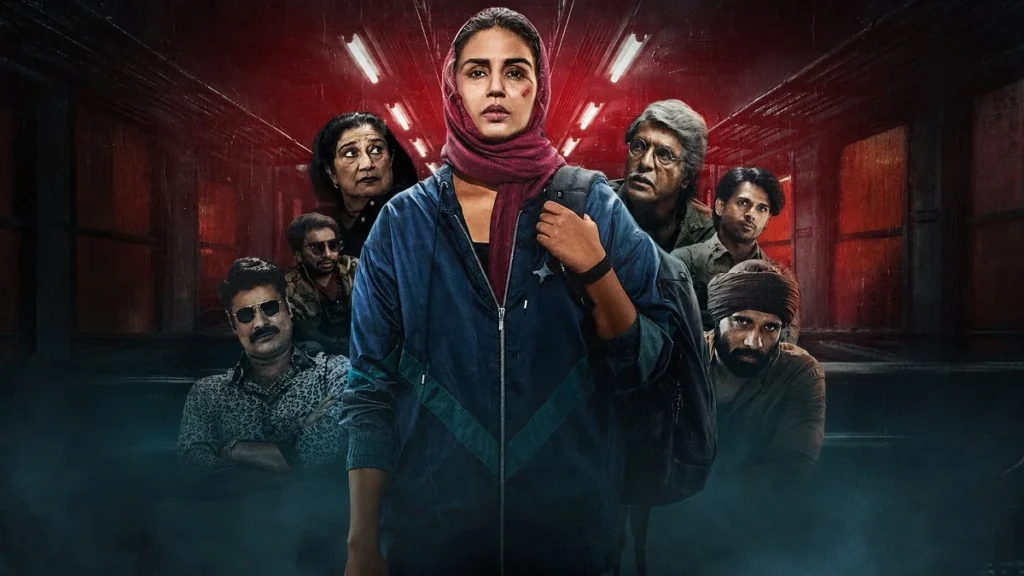
In what is a chilling yet never surprising exposé on the city’s real estate mafia, Baby Do Die Do centres on Baby (Huma Qureshi). Haunted by her sister’s brutal murder on a fateful night at Hotel Centaur, Baby’s wounds refuse to heal. Baby’s mother believes she works in real estate (which, technically, she does) but has no idea what the job actually entails. This certainly isn’t work Baby can bring home on a rainy day.
Backed only by an elderly father figure, PM Jain (Chunky Panday), and lacking any real support system, Baby is driven by vivid hallucinations of her dead sister. Revenge must be sought. But how will she track down the masked man who tore her life apart? And does Baby have a secret of her own?

There’s only one person in Baby Do Die Do who doesn’t carry a single stain on his conscience. He is the golden-hearted sardar Siddhu (Rachit Singh), who falls head over heels for Baby the day she buys him a bus ticket.
He too dreams of escaping the MHADA life and upgrading to a 1BHK. He wants Baby to run that home, though his love for her never stems from sympathy. I kept waiting to spot a halo over his head, but Siddhu represents a sizeable section of Mumbai’s immigrant class that arrives from nowhere, only to find happiness in the very same stagnation and insufficiency that residents like Zafar escaped years ago. In a classic Mumbai struggler move, he gives up on his dream of becoming a singer and settles for life as a music teacher. Siddhu isn’t the fittest, and survival for people like him often comes down to sheer luck.
Speaking of luck, Zafar’s lucky charm is his younger brother, Lucky (Arun Kushwah). The sibling bond nearly mirrors Baby’s love for her unnamed sister. After all, there is an entire high-rise named after the short-statured man. Baby Do Die Do shines brightest when constructing these relationships, lending the film a broader emotional arc while touching upon several fragments of Mumbai’s rougher, less-privileged life. A particularly realistic one is the equation between Baby and her mother (Mangala Kenkre), the latter even lamenting to God for taking away the wrong child.
In this way, Baby Do Die Do is generous to its individual characters. No one exists in a silo. Another superb arc is that of Baby’s co-conspirator Manu (Marudhar Shekhawat), a man whose success rate is practically nil and who constantly lives under Baby’s shadow. Call it bruised ego or pure hormones at play, but it is marvelous to watch his conscience evolve. In one stretch, we see him at a gay bar where a seductive Saqib Saleem gyrates to Bollywood’s ‘Rathipushpam‘ equivalent that goes ‘Alpha Q’ (a cheeky dig on YRF’s Alpha which releases on the same day). Manu stares agape, perhaps confronting parts of himself he never had the freedom to explore before.
With Faisu, DCP Anjum Khan, or Manju Murjhani brimming with mystery and potential, Samant weaves together so many mini-stories that there is room for multiple spin-offs and sequels, whichever direction the film chooses to pursue. It’s only a pity that a few of its compelling figures get bumped off a bit too soon.
Among other things, Baby Do Die Do is neither interested in blaming the system for its inequalities nor the police for their brutality. They are all part of the same nexus, and the less privileged are fully aware of both their choices and the consequences that follow. In Samant’s world, no one accidentally stumbles into a life of crime. You know Baby is in the wrong profession. We desire a better life for her, perhaps more than she desires it for herself. We also want her to track down her sister’s killer, even as she casually kills dozens.
Needless to add, it is a classic writing masterstroke (Jasmeet K Reen, Parveez Shaikh, Gaurav Sharma, Nachiket Samant) to constantly keep us on Baby’s side. The film’s moral comparison is between an innocent girl and a bunch of ruffians, or the obscenely wealthy, with almost nothing about them worth caring for.
ALSO READ: ‘Main Vaapas Aaunga’ review – Imtiaz Ali’s moving elegy for a divided homeland
Baby Do Die Do is surprisingly splendid in its music department, with the songs and score (Arjun Iyer) hitting all the right notes. Even a conventional romantic number never feels out of place in a film of this genre, and the last time I witnessed that kind of miracle was in Andhadhun. Vikram Dahiya’s action choreography deserves a special pat on the back as it rarely looks performative.
While the editing (Nikhil Parihar, Ashish Tripathi) is sharp in terms of pacing, there are glaring continuity glitches, such as a mangalsutra mysteriously slipping in and out of Baby’s t-shirt in adjacent shots. Tojo Xavier’s camera captures Mumbai with the same rawness that Tushar Kanti Ray brought to Dhobi Ghat, and what Anay Goswamy achieved with Delhi in No One Killed Jessica.
The crowning glory of Baby Do Die Do is its principal cast (Anmol Ahuja via Casting Bay). Huma Qureshi is pitch-perfect in a role that demands years of trauma be internalized rather than outwardly performed. You see the reason why she picked up this screenplay and aced it as always.
Chunky Panday breaks away from his comic image to do something that genuinely suits him. Sikandar Kher as Zafar is the kind of man you would fear casually interacting with. The unmistakable Mumbai texture embedded in the character is etched so sharply that the actor extracts every ounce out of it.
Rachit Singh gets substantial screen time and is sunshine personified. He’s just so good at playing the good guy, I’d hate to see him play a baddie down the road. And while Seema Pahwa might not look like your typical movie cop, the veteran actress surprises us yet again with just how good she is, especially in her interaction with a couple of roadside romeos. Rupesh Bane and Marudhar Shekhawat are both capable performers, and the tiny connection the film establishes between the duo, through a brief scene near a spotted mirror, is priceless. Arun Kushwah, Kailash Waghmare, Himanshu Malik and Vidya Malvade all shine in key supporting roles.
When Baby Do Die Do ends while clearly leaving room for a sequel, all I could think of was how Baby’s origin story alone gives us a roadmap to the average ghetto life in Mumbai, which has everything from rap to romance to crime. The sparkling skylines and giant builder hoardings tower over their diminutive dwellings to reveal the city’s dual personality. Between Baby staring at happy couples and casually killing men in crowded spaces, it is left to us to decide whether to see her as a victim or a vigilante.
Baby Do Die Do is not a film where you immerse yourself in any one character. You could do that in Gully Boy. You could do that in Talaash: The Answer Lies Within. Both Bombay stories, one about hustle and the other about grief. Here, you observe every move Baby makes, wish her well, and yet remain at a safe distance. Make of that what you will.
VERDICT: ★★★★
To read more reviews of Baby Do Die Do, head to the Film Critics Guild.