79 years have passed, and it is evident that India and Pakistan still bear the scars of the Partition. While the rare surviving victims and their descendants have somehow learned the quiet dignity of forgiving, a parallel political machinery remains ever-ready to weaponize the tragedy with convenient, revisionist theories. Against this polarized backdrop, Imtiaz Ali arrives with Main Vaapas Aaunga – a remarkably neutral, almost defiantly apolitical look at one of the subcontinent’s defining horrors. It is a film that approaches Partition not as a political failure but as a deeply personal one, choosing to focus on the people who were uprooted, separated, and left waiting for promises that would never be fulfilled.
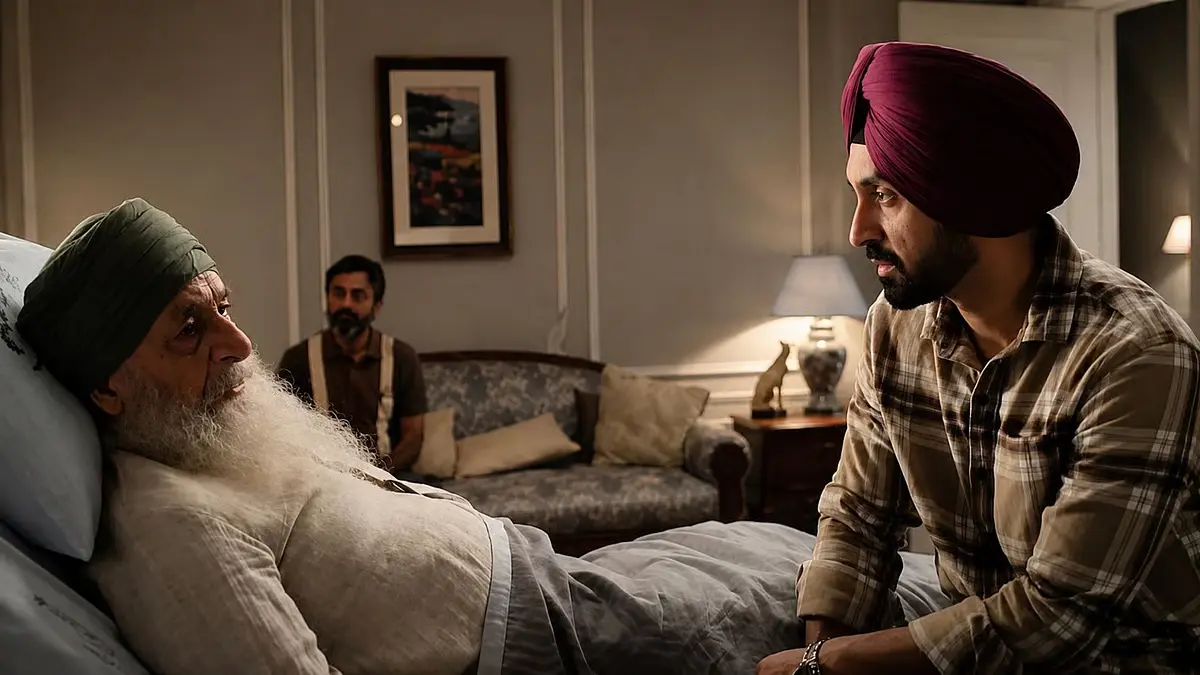
Main Vaapas Aaunga opens with an old man named Ishar Singh Grewal (Naseeruddin Shah) casually hopping into a cab in India’s Punjab and heading towards Pakistan. The concept of an international border does not exist for the man suffering from dementia, we soon learn. In comes Nirvair (Diljit Dosanjh), Grewal’s London-bound grandson, whose passion for stand-up comedy never really clicks with his audience.
Like many Imtiaz Ali protagonists before him, he quits his full-time job and finds himself drifting through a relationship with the far more practical Kaveri (Banita Sandhu). These are two familiar Imtiaz Ali worlds that are destined to collide.
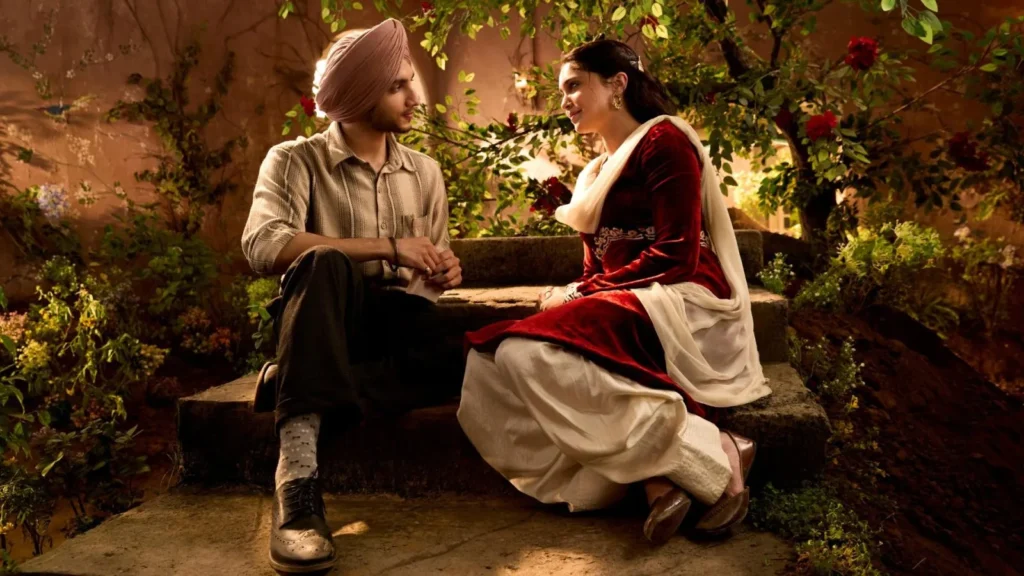
It is through the fracturing mirror of Ishar’s fading memory that the film transports us back to 1947. Here, a young Ishar, then called Keenu (Vedang Raina), falls for Afsana alias Jiya (Sharvari). Belonging to different faiths, their families embody the syncretic, secular fabric of an undivided India. They exchange letters, compose poetry, and inhabit the kind of romantic universe Ali has spent two decades perfecting. As supporters of the Progressive Writers’ Movement, the young couple dreams of a kinder tomorrow – far away from barriers set by extremist elements.
In a telling scene, one of them laughs off the ridiculous rumour of an overnight Partition, unable to comprehend a Radcliffe Line drawn arbitrarily across their lives. The optimism feels tragic in hindsight.
Having said that, by filtering the oncoming madness through a localized, radical faction led by Afzal (Danish Pandor), Ali and co-writer Nayanika Mahtani end up stripping the event of its actual historical gravity. Partition was the outcome of selfish political decisions and ideological clashes that the movie barely touches upon.
This human-centric perspective isn’t exactly flawed. Main Vaapas Aaunga is hugely affecting whenever it isolates the human cost of the migration. It isn’t entertaining in the conventional sense, but you watch it with interest (and moist eyes), almost like a particularly moving History TV18 episode. These chapters – and even the film’s overall intent – seem like an antidote to Dhurandhar in its portrayal of Indo-Pak relations. But in its quest for neutrality, the film sometimes mistakes complexity for equivalence.
The bigger problem lies elsewhere. For a filmmaker whose best work has often relied on the transformative power of love, Imtiaz surprisingly settles for familiarity here. We already believed in Keenu and Jiya before the film had even begun. What we wait for is a reason to become invested in them beyond the tragedy surrounding them. Main Vaapas Aaunga never quite provides that. It does the bare minimum, and as a result, we buy the troubles they endure but are never mesmerized by their chemistry despite the ethereal camerawork (Sylvester Fonseca) surrounding them.
Main Vaapas Aaunga draws its bigger moments from history. The exact stretch where it reaches its emotional peak is when Keenu boards a train to pursue his lost family, backed by a haunting score by A. R. Rahman and the horrifying violence he sees along the way. There’s another devastating moment involving a fiery Dolly Ahluvalia. The scene is nothing particularly fresh for Bollywood standards, but it arrives at the right moment in the right film. Between these aching moments, editor Aarti Bajaj has a field day. She has a perfect sense of when to come back to the present and, more importantly, when not to.
The actors try their best, with Sharvari looking luminous and delivering exactly what was expected of her. Vedang Raina, however, feels too contemporary and timid to anchor a 1947 timeline. His sudden, dramatic outbursts in Punjabi feel so heavily rehearsed that you can see the effort behind every syllable. The actor does better in the intense moments.
This leaves Diljit Dosanjh to stroll through what must be the easiest, most unchallenging role of his recent career. The script treats him as a glorified placeholder — a part any actor worth his salt (save for perhaps Arjun Kapoor in Sardar Ka Grandson) could have performed in his sleep. There’s Banita Sanghu, too, as his London-bound girlfriend, undergoing quintessential Imtiaz Ali migraines. The supporting cast actually holds their own, be it Rajat Kapoor, Manish Chaudhari or Anjana Sukhani.
The real anchor in Main Vaapas Aaunga, undoubtedly, is Naseeruddin Shah. As the older Ishar, he steals the show without needing any massive, dramatic speeches or extreme theatrics. For sure, the man is occasionally loud, but never once does the performance feel overwrought. He makes us genuinely root for the man, and we wish for his suffering to finally end. We never fully buy the romance when Ishar is still Keenu, but once Shah takes over, the longing becomes tangible. By the time the film reaches its last act, our hearts reach out to him not out of sympathy but because Shah convinces us that this unresolved chapter has defined an entire lifetime.
Main Vaapas Aaunga goes delightfully meta at times, most notably when Keenu and Jiya pretend to run away and then hide somewhere for a quiet, life-changing chat à la Jab We Met. It’s all intentional and sweetly done. Even as the lovers lack the kind of gravitas that Geet and Aditya had, it’s a difficult film to reject their emotions. Because this time, Imtiaz Ali has nothing radically new to say about love. It reminds us that the wounds of Partition are not historical artefacts. They reside in memories, absences, and promises that outlived the people who made them.
VERDICT: ★★★ 1/2
Read the reviews of Main Vaapas Aaunga by the Film Critics Guild HERE.