Do you ever think of being correct, but not politically correct? That is, saying something aloud through any medium that might offend the majority despite being right in your stand. Anurag Kashyap’s Bandar spends its entire 2-hour odd runtime walking this dangerously slippery slope. It tells the story of a man wronged in the era of #MeToo, a movement that has rightfully brought justice to a lifetime of denial for countless survivors. The gender reversal makes the story a tad uncomfortable to endorse, though never difficult to empathize with.
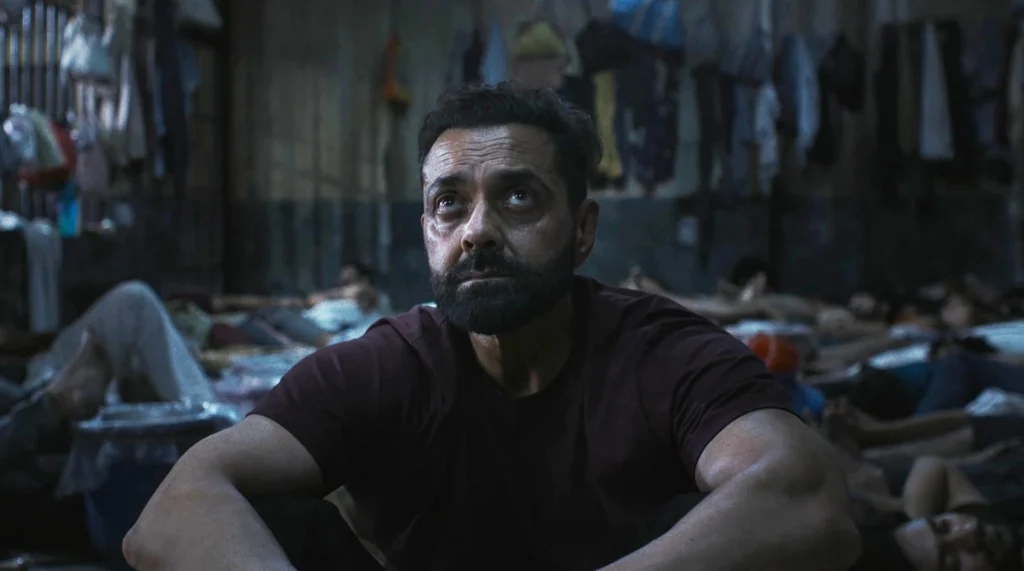
In a plot that is a goldmine for the Right-Wing, it’s a mammoth task for Kashyap (and co-director Sakshi Mehta Lau) to not make Bandar come off as anything remotely anti-women. “I didn’t handle it right,” confesses Samar (Bobby Deol) to his sister Suhani (Sanya Malhotra) and a lawyer. He is speaking from behind the grill of a horrifying undertrial prison. Gayatri (Sapna Pabbi), a former love interest turned stalker, has landed him there following a rape allegation that Samar firmly denies. No one knows how to handle Samar, nor can they help him easily. The man is crying his eyes out in a crowded cell amongst people he would never have met if it weren’t for this.
Bandar wastes no time in showing us what he is going through. Early in the narrative, Samar is performing at a function on the strength of what remains his claim to fame, a song that goes “Come on Baby, Dil Kisko Degi”. The organiser is unhappy with the lack of “performance” in what he has put together. Once a star, Samar now finds that the paparazzi would rather hound Sunny Leone and Daniel Weber than spare him a glance. He chooses to portray a fake sense of achievement on social media from what was, in reality, an insulting experience.
The 50-plus man is the poster boy of a failed star. Samar isn’t fading. He has already faded. At the same time, the writers (Sudip Sharma, Abhishek Banerjee) do not paint him with simple strokes. Samar scoffs at the idea of marriage. He dates Khushi (Saba Azad), who is much younger than him and is never fully honest with her. To quote the man himself, Samar isn’t handling things well with her either. There is an unpaid housekeeper, EMI notices, expired health insurance, and a rapidly depleting bank account. You know the man is in trouble long before the knock on the door changes his life overnight.
Samar lands in jail, and his charge sheet is filled with flirty chats and an image of his genitals, a rather unusual thing to send as a casual text to a stranger – even for a tech-noob middle-aged man. In short, you clearly see where he has gone wrong.
Bandar is at its most authentic when it treads the uncomfortable path of Samar and Gayatri’s relationship. They meet. They get intimate. She is interested. He isn’t. What now? Through them, albeit briefly, Kashyap discusses consent in modern times. How do you establish it? You assume something is a hint from the other person’s side. What if it wasn’t? And what about the spontaneity we’ve grown up watching in films and romanticising in books? Bandar underlines how sparks don’t simply fly anymore. They can burn your reputation, future, and bank balance to ashes if not validated with evidence.
In a classic Kashyap-coded sequence, a top cop references Amitabh Bachchan’s famous punchline from Pink: “No means no.” As a matter of fact, Samar never says no to Gayatri. Not when he matches with her by accident on a dating app. Not when she accesses his house without permission. Not when she repeatedly texts him. If there is evidence to prove otherwise, we are not told.
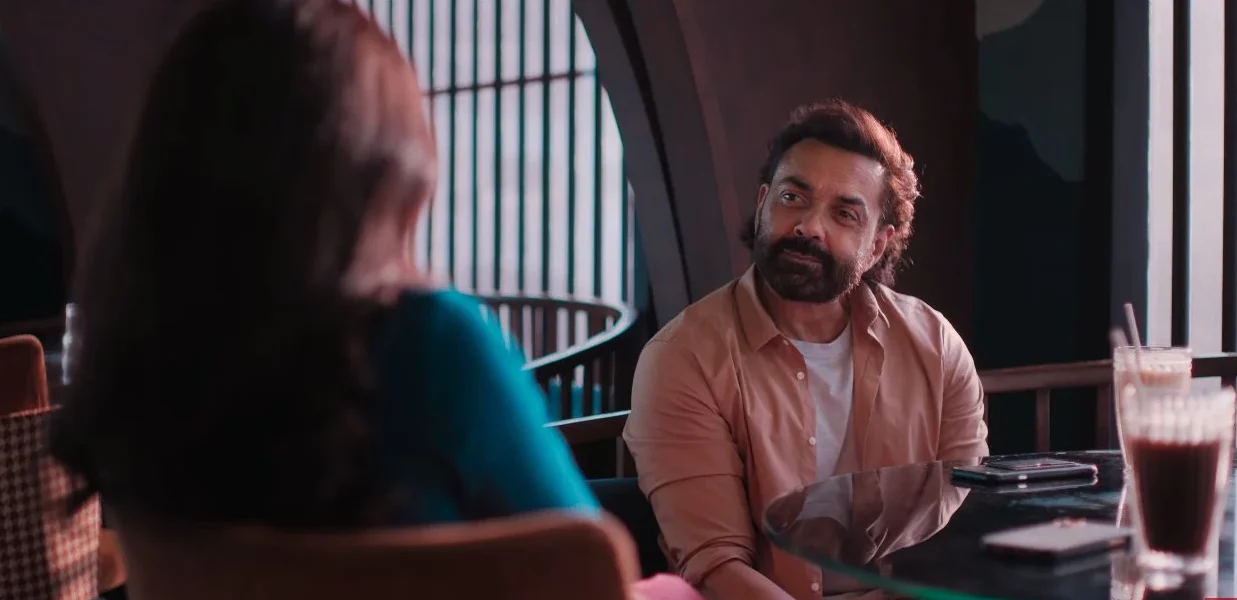
It also does not help Samar’s case that he is a quiet man, made even more dazed by everything suddenly thrust upon him. We rue the fact that he hasn’t shared enough information with his lawyer (a spirited Riddhi Sen). Yet, for a man like him, how would he know what details are vital? “Maine kuch nahi kiya hai” is a phrase he repeats. Is he capable of proving it before a judge who conflates the casting couch with being a ‘couch potato’?
Meshed with these complexities, Bandar builds a riveting narrative in the first half. If you subtract the songs (from both halves) and ignore minor tonal shifts, you are fully immersed in Samar’s trauma. In the second hour, through sporadic flashbacks, we learn more about Gayatri’s obsessive ways, but not much about her. This is what derails Bandar structurally, as it moves from becoming a character study to something much more unilateral.
Dressed in chic sarees, matching jewellery, and twin-coloured bindis, Gayatri is a healer. One of the Malayali characters translates it as ‘manthravadam,’ which means sorcery. Right from her dubious profession and history of self-harm to her obsession with Samar, Bandar decisively places the ball in Samar’s court. Not once do we hear the woman speak in court.
In a stray moment, we see Gayatri looking at Samar’s mother, perhaps with a hint of regret. The scene ends there, and we never get her perspective. By completely shutting her out of the primary discourse, the film avoids any real psychological friction. We are left with a clinical villain rather than a complex antagonist, which slightly dulls the weight of the film’s overarching argument.
Aside from that, a good chunk of Bandar unfolds inside the undertrial prison, where events play out like a reality show (read Big Boss). While the staging of gang politics and the filth of that intimidating space is authentic, the setting lacks the dramatic meat required to sustain its runtime. The secondary characters inside – barring one co-convict with a semblance of an arc – are largely insignificant despite earnest efforts from actors like Indrajith and Ankush Gedam. Bandar picks up only when Samar steps out to meet his sister or when Kashyap shifts the narrative back to the world outside.
ALSO READ: ‘Bandar’ | TIFF 2025 review – Is a man permitted to be a victim?
Fortunately, Kashyap’s storytelling keeps us hooked even in these mildly repetitive patches, thanks to the razor-sharp editing (Aarti Bajaj). We keep hoping for Samar to manage a Gupt-like breakthrough inside the cells. The atmosphere works well, too, and that’s primarily due to two things.
One is Bobby Deol’s powerful central act, which fuels a difficult story with vulnerability and unexpected humanity. It is gutting to see him sob, apologise to a cop over a slip of the tongue, and smile dryly with a broken front tooth. The second is Kashyap’s delicious humour aimed at the law-and-order machinery. It doesn’t evoke big laughs, but it does fire a steady stream of chuckles, with the conversations flowing between Hindi and other languages. The Subhash Ghai-Trimurti line is something that would make any Bollywood buff flash a smile.
Bandar can also be viewed through the eyes of its “good” women. The one who comes across as the most wronged is Samar’s present girlfriend, Khushi, played by a lovely Saba Azad. The film makes it crystal-clear that he isn’t the right man for the 35-year-old woman. Still, she turns up and tries to process a whole load of information that’s thrown at her.
You would feel equally bad for Suhani (Sanya Malhotra, superb), who grows frustrated with her irresponsible brother’s silence and demands. Samar wasn’t great to either of them. Nor did he end Gayatri’s chapter with maturity. Was he accountable for these actions? Yes. Was his punishment too harsh? Also, yes.
When a co-inmate tells Samar that a mere rape accusation renders a man guilty in everyone’s eyes, Bandar pushes you to analyse the very design of society. As a result, when Samar cries out in distress, “I am not a rapist, I am a murderer,” you do heave a sigh of sympathy. What Kashyap’s film tries to deliver is perhaps a cautionary message, without explicitly advocating legal reform. It urges men to reconsider what they think consent is, and the dangers of assuming it exists, however unromantic this may be.
In Bandar, the filmmaker’s anger, the leading man’s sincerity, and the crew’s enthusiasm to tell a distressing and cyclic story are all palpable. Frequently in the film, Samar is shown seated in a monkey-like pose inside the cell. It is an imagery that tightens the film’s title metaphor. He is an actor confined in a cage that doesn’t have a mirror — an object that is crucial in a profession that forces one to become a narcissist.
Yes, the film does vilify the woman without giving much insight into her psyche, but one understands the particular narrative pocket it is working in. There are manipulative and destructive women, too, and their stories deserve a canvas. Then again, if its message is misinterpreted as a plea for men’s rights in a world where women continue to be mistreated every minute, the purpose of its existence is lost.