Why would anyone name a cat Azaadi? Perhaps every time you call your companion animal by that name, you give voice to an ache to break free. At the heart of the Nepali-language film Shape of Momo is Bishnu’s (Gaumaya Gurung) tabby cat, named exactly that. Aazadi isn’t an animal protagonist so much as a metaphor for the film’s politics of gender. The family rues that they should have liked a tomcat instead because a female cat would keep having litters. While it’s a perfectly practical concern in a domestic setting, Tribeny Rai’s debut feature is also about a generational belief that a family is somehow incomplete without a son.
Bishnu is a writer returning to her village in Sikkim after a stint in New Delhi. Life in and around her quaint house – filled with women of three generations – is not alien to her because she grew up there. What slowly and steadily disturbs her is a mismatch in ideas with every member of the family, and sometimes outside of it.
At one of its early, startling moments, Bishnu is assertive with a poor orchard worker over the price of oranges. While logically (and perhaps legally) her demand is fully reasonable, a certain lack of empathy becomes apparent against the stark economic disparity visible in the frame. The scene ends with the worker’s school-dropout son angrily agreeing to her demand. This recurring subplot in Shape of Momo reminds us that Bishnu’s annoyance does not automatically place her on the moral high ground.
Different Women, Same Trap
Bishnu’s sister Junu (Shyama Shree Sherpa) is pregnant and is in the care of her mother (Pashupati Rai). While the girls bond initially, Bishnu soon disapproves of her sister’s hasty career decisions and passive agreement to the patriarchal setup they are in. Shape of Momo repeatedly explores the beliefs and superstitions surrounding pregnancy, all rooted in the desire for a male heir. On a routine visit to the gynecologist, the mother asks whether there’s any “good news” – something that we presume is unlikely for a woman of her age.
It is this very setup, where equality remains elusive, that unsettles Bishnu. A chance encounter with Gyan (Rahul Mukhiya), a local politician’s architect son, hints at a possible bridge between Bishnu and a place she no longer fully understands. Affable, educated, and gentle, Gyan is someone who understands what might be going on in her head, but the film chooses not to focus on his journey into Bishnu’s mind. Instead, Shape of Momo prefers to expose societal expectations.
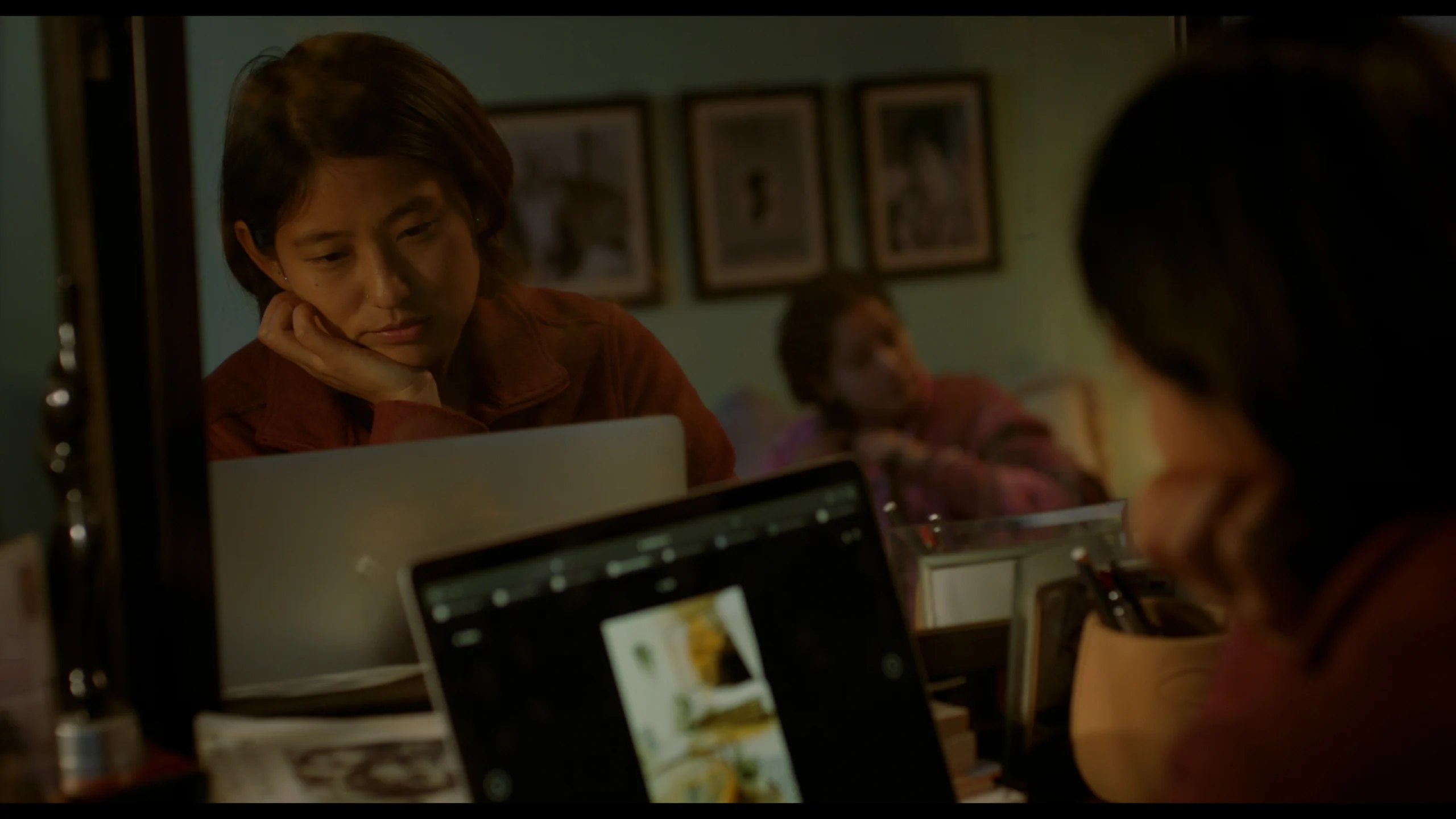
The film tells us how the mere existence of a family in a mountain village like theirs is dictated by systems designed by society – you have to go by the rules. A girl cannot alienate the male housekeeper even at the cost of doing his job herself. If a woman receives a crank call, a male voice is a must to give the stranger the final word. Only then will you not receive that call again. For a second, I thought on behalf of the caller. Would that person be convinced if a woman were to tell them off? Judging by the social fabric of the place, maybe not.
The Shape of Belonging
The plot in Shape of Momo brews like tea in an earthen pot. It takes its time, allowing observations, contradictions, and exasperations to steep into something affecting. Another motif, one that brought to mind the humanist storytelling of Hirokazu Koreeda, revolves around momos, the region’s beloved delicacy. Bishnu makes delicious momos, but they are constantly out of shape. So, what happens when a single dumpling in a pan of many standard-looking pieces looks out of shape, however tasty it may be? Does the shape matter so much? The writing (Kislay, Tribeny Rai) never underlines the metaphor, which is precisely why it works.
ALSO READ: ‘Avihitham’ review – Secrets and scandals in sleepy Kanhangad
Set in a quaint Sikkimese village, Shape of Momo is also a mini photographic marvel. The narrative is silent, yet never dull. DOP Archana Ghangrekar fills the film with compositions that amplify its themes without ever going overboard with the lighting and scale. The canvas is picturesque without ever having to scream from a mountain top. Likewise, the frame selection complements the cinematography beautifully. The film’s unhurried pace (Anil Aalayam, Kislay) is one of its biggest wins, with every side-chapter and each character’s motivation landing to the exact degree that they must.
Flawed People, Stellar Acts
Shape of Momo treads carefully around its ideas. The film never portrays its people as wrong, even as it exposes their conservative beliefs. The mother, at one point, insists that Bishnu summon a helicopter – a decision that would uphold the goodwill of many. In the context of the film, you don’t laugh at her. Her world is not dystopian. It is uncomfortably familiar.
Gaumaya Gurung shoulders the difficult responsibility of bringing a largely internal character to life. With little scope for theatrics, she relies on subtle shifts in expression and temperament to chart Bishnu’s emotional journey. We understand Bishnu’s frustrations. We sense her helplessness. And still, we recognise the blind spots that prevent her from seeing the full picture.
Pashupati Rai puts in a stunning show, making us think of what her upbringing must have been like and the values she was probably taught. Shyama Shree Sherpa gets her share of moments, too, offering a young woman’s point of view that differs from Bishnu’s yet remains real and socially accepted. The charming Rahul Mukhia lights up every scene he enters, even in a film that is hardly about him.
Between Staying and Leaving
Speaking of that, Shape of Momo is centered in a world that is pro-male. Instead of preaching, Tribeny Rai’s film dives into the internal conflicts of a woman who is now an outsider in a place that had once given her so much. Should she and her peers retreat into the comforts of distance, or stay back and confront the systems that shape their lives? Shape of Momo has no intention of offering answers. The film leaves that task to us.