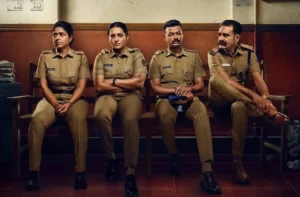
Senna Hegde’s Avihitham opens with the tagline “Made in Kanhangad.” Where is Kanhangad? And what makes anything made there special, let alone a film? For those who discovered Malayalam cinema during the lockdown, the state might seem like a uniform patchwork of modern ideas and shared sensibilities. Avihitham, which examines adultery, is steeped in its local dialect, landscape, and cultural texture. It can very much amuse someone from Kerala’s Kottayam or Kollam despite never being a utopia. What remains universal here, though, is the social morality that thrives on exposing a “fallen woman,” teaching her a lesson, and eventually discarding her.
The film begins with a lively chatter among men in the Northern Kerala countryside about their escapades with women, a privileged lot basking in the liberties their gender grants them. Yet there is always an undercurrent of fear: “What if my wife…?” In a hilarious scene, Venu (Unni Raja) faces his wife’s fury for ditching their movie plan. The thought suddenly strikes him, and he rushes out, flinging one of his unfinished blouses at the jobless Prakashan (Ranji Kankol).
Prakashan becomes the root of the community-wide commotion that soon erupts in their sleepy village. One night, he spots the unmarried and handsome mill worker Vinod (Vineeth Vasudevan) sneaking into the local carpenter’s house to secretly meet a woman.
But who is the woman? “It can’t be the mother,” asserts one. Confident in his tailoring skills and familiar with the woman’s measurements, Venu announces, “It’s Nirmala. Mukundan’s wife.” Scandalised, the men inform Murali, Mukundan’s younger brother, from whom the news spreads to their father, Madhavan. And thus, the narrative snowballs.
When we finally meet Nirmala, Avihitham appears to contradict its title, which means “an illicit affair.” She is the ideal homemaker – the poster woman of homeliness, where she dotes on and longs for her husband, who works away from home. Mukundan, a devoted husband himself, is shaken to the core when the rumours reach him. He picks up a cigarette butt and retreats to the toilet – a relief routine, in ways more than one.
The conflict then shifts to us, the viewers: how could a woman so “honourable” indulge in an affair? But that is how quickly we measure a woman’s morality, through her manner and attire. Can she not harbour a secret? Can she not remain a good wife and mother despite a forbidden escapade? After all, as the opening sequence told us, the rules for men are very different.
The rest of Avihitham plays like a taut suspense drama. The investigators are many, and so are the questions. Why would Nirmala betray her husband? Why would she ruin their happy family unit, where the men and the women have their duties predefined?
Hegde’s film walks a delicate line, portraying the fragile moral tightrope women are forced to tread. One misstep, and she is branded “characterless.” Men, meanwhile, can be anything they please, even bachelors by choice, without consequence. A woman’s agency is limited to what colour saree she may wear or which TV serial she can watch, Parijatham or Jwalayayi.
The brilliance of Avihitham lies in how it quietly exposes this double standard. It does not shout for women’s rights; instead, it subtly frames its men, all standing with their heads lowered in shame. The final reveal lands exactly as intended, with the family matriarch’s reaction alone propelling the film to greatness.
The film works best because of its precise writing and believable characters. They resemble people you might meet in any Kerala village. DOPs Ramesh Mathews and Sreeraj Raveendran shoot the story with restraint, letting the mood take shape naturally. Much of it unfolds in still corners and late-night watchfulness. Editor Sanath Sivaraj shapes it with precision, ensuring the film lands every moment with quiet impact.
ALSO READ: ‘Theatre: The Myth of Reality’ review – Between solitude, superstition and survival
The ensemble cast, featuring Unni Raja, Dhanesh Koliyat, Ranji Kankol, Vrinda Menon, Ammini Chandralayam, Vijisha Nileshwar, Rakesh Ushar, and Vineeth Vasudevan, breathe life into Hegde’s universe. Each performer gets moments to shine, contributing to the film’s authenticity.
Familiar with his milieu, Senna Hegde once again scores full marks for world-building. Avihitham is as real as the soil it springs from. The filmmaker extracts every ounce of organic quirk from his setting while presenting a witty, unflinching, and insightful take on relationships and moral hypocrisy. The film ultimately asks if we truly understand women before measuring their busts, reading their lips, and deciding to “protect” or “elevate” them in society.
Where moral policing passes off as virtue, Avihitham shows how easily whispers can rewrite a woman’s life. Hegde’s film is a mirror to our collective double standards and compartmentalization of women based on our perceived moralities, forcing us to confront exactly what we choose to overlook.
Rating: ★★★★