At one point around its midpoint, Bhooth Bangla drops a romantic song without any context. People walk out as if their bladders would burst if they stayed a minute longer. I could almost feel my eardrums burst from a song so grating, paired with a couple that shares negative screen chemistry. Yet that is not why I felt bad for the half of the crowd that did not return. Ironically, that is exactly where the film becomes a wee bit tolerable. Do not expect much, but the least the Priyadarshan film manages in its second half is to stop being annoying.
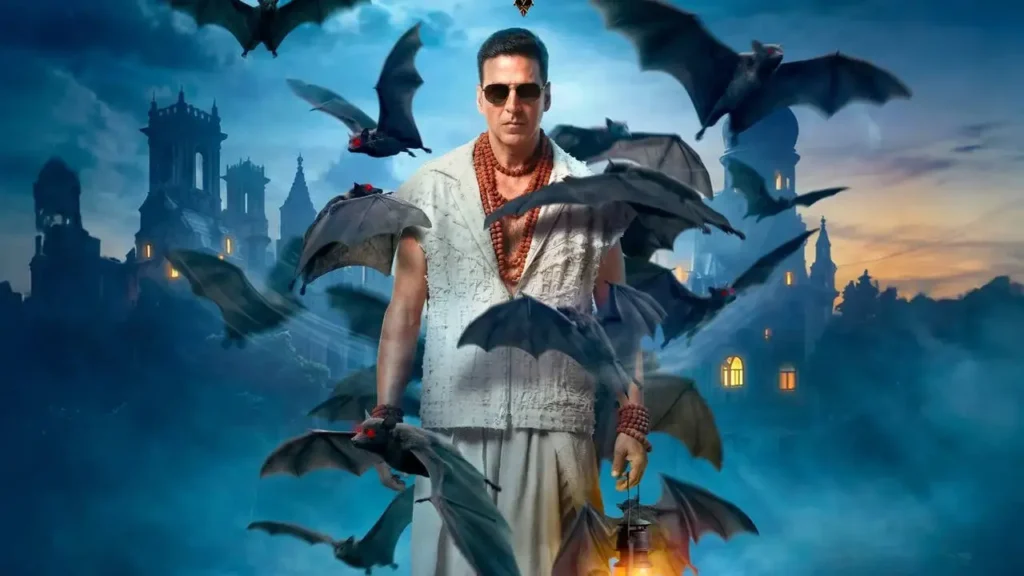
Bhooth Bangla opens with a group of youths in the village of Mangalpur, en route home after attending their friend’s wedding. They are caught in a relentless downpour. Soon, they bump into an old man who is ever ready to narrate the history of the village, totally out of context. It is through this flashback that we are introduced to Arjun (Akshay Kumar), the film’s central character, whose journey eventually leads him to the haunted mansion. The only reason for a narrative device to go into a flashback is Priyadarshan and the writer’s inability to understand today’s cinema, especially what Gen Z and below consume.
It is amusing how every horror-comedy now aspires to be Stree. That cannot be achieved with boomer jokes, forced characters and age-old commercial tropes. Bhooth Bangla, as we know, is about a haunted house and has a hard time getting its NRI lead character to the mansion. The village where the house is located is surrounded by a creature that feels like a long-lost cousin of Akshay Kumar’s own Pakshirajan from 2.0. Priyadarshan fills the story with nonstop yelling, screaming, and migraine-inducing characterisations as the movie follows a familiar ghost story template in a filmmaking style that has not evolved since 2004.
Then comes the expected ensemble of Priyadarshan’s favourite actors: the late Asrani, Paresh Rawal, Rajpal Yadav, Bhavna Pani, and Manoj Joshi. They are all good actors, but are wasted in inconsequential roles that add nothing to the central plot.
Bhooth Bangla’s women, unsurprisingly, get no authority. While her brother, Arjun, makes complex plans to trap the creature, Meera (Mithila Palkar) is left completely in the dark about her family history. It is even stated that Arjun will inform her when it is time for her to learn. On top of that, Priya (Wamiqa Gabbi), who is supposedly writing a book, looks even more confused. There is a minor twist with her, but by the time it arrives, it is too little, too late.
Lastly, Tabu appears in a flashback scene with a highly clichéd love triangle in which the wronged party turns villain. While this section of Bhooth Bangla does not grate on your nerves, it does project the film’s dated sensibilities. It is also this chapter that reminds us that the average age of the film’s characters is 50. Yes, it is perfectly fine to marry at any age, but we are speaking of a flashback within a flashback where men – who look well into their 40s – are competing to marry Tabu.
Bhooth Bangla is cluttered with references to religious practices, most of which add little value. The bizarre horoscope angle, which becomes the basis for putting everyone at risk, only worsens things. What does work, however, is the visual texture. The motifs inspired by Indian classical art add interest to the proceedings. The special effects (Siddharth Priyadarshan) have a very sharp look, particularly during the car chase scene set in a storm.
Pritam’s music is probably one of the least inspired pieces in a long time, and the lyrics (Kumaar and Yatindra Mishra) are so generic that they render the compositions all the more pedestrian. It is unfortunate that a song situation with the potential for recall, like ‘Mere Dholna’, fades away without making an impact.
Bhooth Bangla merely passes on the acting front. Akshay Kumar is at his best in the third act, when he is given almost no lengthy lines and, hence, no teleprompter. For the rest, his shouting and inconsistent behaviour add little to an already weak film. Jisshu Sengupta gets the next best role and does a fair job. But it is particularly odd to hear Kumar address the much younger Sengupta as “Papa.” Mithila Palkar’s only contribution is her existence, which is crucial to the story, while Wamiqa Gabbi is not even afforded that much.
As Bhooth Bangla ends on a grim note, without any euphoria, memorable scare, or lingering chill, I am reminded of Priyadarshan’s own words in an interview, where he quoted a Malayalam proverb about knowing when to step away while still in good form. That thought leads me to his last good films, and the most recent ones I can recall are from the 90s. So what is the fix if the audience gradually loses respect for a filmmaker once considered reliable? Your guess is as good as mine.
VERDICT: ★★