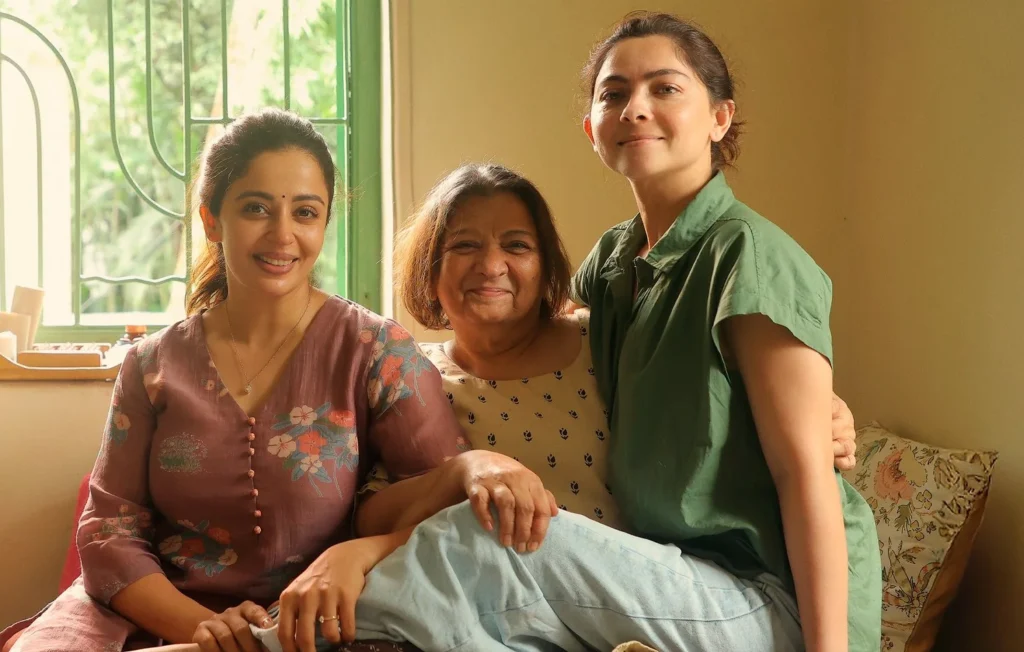
The many permutations of human relationships, and the stereotypes tied to them, feel particularly puzzling today. Can’t two sisters ever be mature and jealousy-free? Will a single mother not be an adequate provider to her daughters? Are all daughters really “daddy’s little girls”? Can’t sons find their best friends in their fathers? Tighee, directed by Jeejivisha Kale, suggests that all of this is possible today. It simply depends on the circumstances people find themselves in. The film’s philosophy is more along the lines of what I would call ‘unity in adversity’.
The narrative tension is established early as we find Swati (Nehha Pendse) navigating a precarious professional landscape, dealing with a lewd boss (Jaimini Pathak) to whom she owes a significant sum. Her marriage to Malhar (Pushkaraj Chirputkar) appears fragile, but her most pressing weight is her estranged mother, Hemlata (Bharti Achrekar), who is battling advanced cancer.
As is the template of this drama sub-genre, we meet Sarika (Sonalee Kulkarni), Swati’s younger sister, on the other end of the spectrum. The sisters display believable, often contrasting traits of adult daughters raised by a single mother.
At the heart of Kale’s film lies a family secret: the suspicious death of their father. Even the mention of it unsettles Hemlata. Among the two, Swati seeks closure with greater urgency as opposed to Sarika, who is not oblivious to the unanswered question either. Around this central thread, the writers (Prajakt Deshmukh, Nikhil Mahajan) spin other life issues: modern marriages, sexual harassment at work, career confusions, and the inevitable onset of old age.
That said, Tighee is a film that’s in a hurry to arrive at certain resolutions. It is not as though Kale overloads the narrative with themes, but a few ambiguities or open ends might have strengthened the storytelling. The film’s relatively simple solutions never become an obstacle to empathizing with its characters, largely because of Kale’s highly visual craft. Her staging of arguments, often unfolding in the house’s kitchen or bedroom, is clean and precise. The production design by Amit Waghchaure adds to the authenticity of the spaces, even through small details like utensils and a floor lamp.
ALSO READ: ‘Tango Malhar’ review – Indian heart in an Argentinian dance
Milind Jog’s cinematography is particularly effective when the film slows down to let us sit with its characters. One of the best moments in Tighee is a long-take monologue delivered by Hemlata from her hospital bed. What begins as a mid-shot slowly moves closer, drawing us into tighter close-ups as the character breaks down. The film’s pastel-heavy colour palette is impressive, as it never dulls the frames while successfully reflecting emotional strain without trading away its innate femininity.
While Tighee largely operates on a problem-to-solution structure, its world is still very authentic. The only narrative choice that didn’t fully convince me was Sarika’s dilemma over a job in the US and a local entrepreneurship opportunity. Between Gandharva’s (Nipun Dharmadhikari) puppy-saving kindness and an anonymous opportunity promising security, the direction of her choice feels somewhat predictable.
Kale extracts strong performances from the entire cast. Bharti Achrekar is a standout, displaying a massive emotional range even when navigating familiar beats. The aforementioned monologue alone is a testimony to her time-tested skills. If Nehha Pendse lands the quieter, more internal part, Sonalee Kulkarni’s externalization and occasional rage create a wonderful contrast.
Watching Tighee also made me wonder whether these women had any friends outside their immediate circle. Sarika, in particular, seems to lack a visible support system. Swati’s marriage, however, offers a few memorable moments. One scene stands out where her husband asks something to the effect of, “Does asking you for money make my love any less?”
By the time Tighee reaches its conclusion, I found myself happy for its characters. I could understand many of the choices they made. Its visual and musical grammar kept me engaged despite the film’s modest scale and intimate setting. This way, Jeejivisha Kale’s film remains a thoughtful portrait of three women who struggle with their own burdens, often without realizing what the others are going through.
VERDICT: ★★★ 1/2
Read more reviews of Tighee by the Film Critics Guild HERE.