“It’s a culture that you see in the cities. You know, it’s something the rich people are into. It’s a disease.” You’ve probably heard these lines from people dismissing queer life as a mere lifestyle choice for the wealthy. Director Rohan Parashuram Kanawade’s Marathi-language film Sabar Bonda laughs at these judgments. At one point, in the wee hours, we see a strange man hop over to Balya’s house on a bike. His parents wonder why the guy never shows up during the day. He promises they’ll wrap it up quickly, and when Balya denies, he speeds away like it never mattered. It’s easy to see why this is a very real experience for many queer people in rural India.
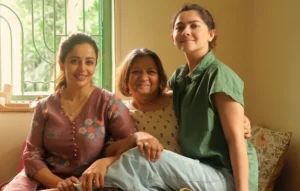
Sabar Bonda is not about Balya (Suraaj Suman). It’s about Anand (Bhushaan Manoj), a gay man, who visits his paternal village for 10 days after his father dies in Mumbai. Giving him company is his quiet, understanding mother (Jayshri Jagtap). Now, if you’re in the Indian subcontinent, irrespective of one’s sexuality or social standing, prying relatives won’t give you any respite. They, and even their dogs, will have an opinion about you and how you should live your life. Anand’s situation plunges him into a swamp of intrusion. Must he come out the way the man did in Badhaai Do? Will the humiliation that follows scar him for life?
Kanawade’s protagonist mirrors the psyche of an average urban or semi-urban viewer. It’s an alien world whose inhabitants wouldn’t understand why a man with a decent job isn’t married at 30. The filmmaker’s lens on Anand’s interactions with peripheral characters makes the physical and emotional distance between them painfully obvious.
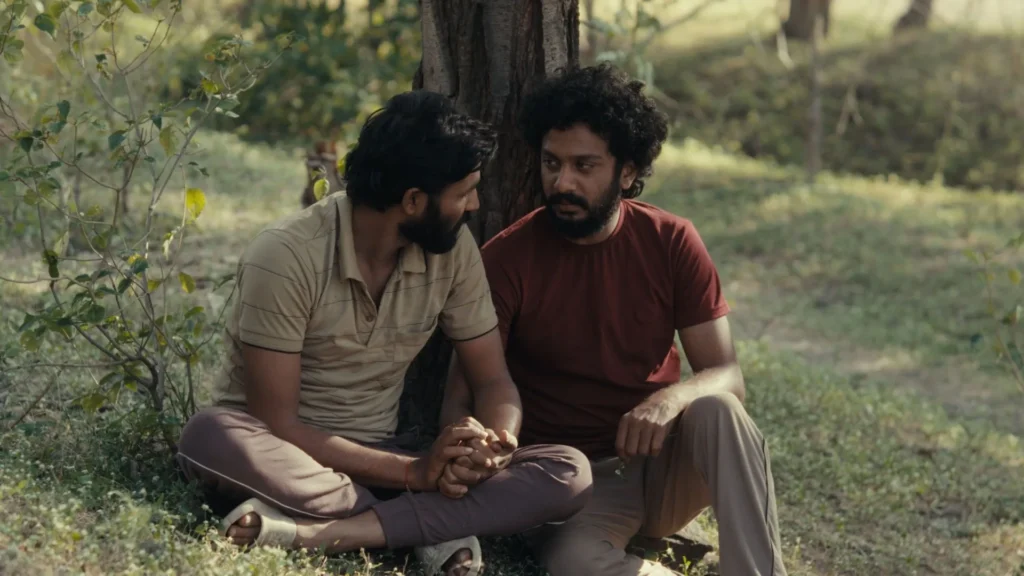
Enter Balya. He’s anything but a storm that topples Anand like a manic pixie dream boy would in a generic gay romance. Balya, rather, is a whiff of fresh air that Anand badly needs in the village. We get to breathe it when the men go goat grazing in the region’s semi-barren grasslands. No, this isn’t exactly Maharashtra’s answer to Brokeback Mountain. The turbulence is never of the magnitude that Ang Lee sets. Yet the nature-bound frames where two men interact, far away from prying eyes, allow us a rare glimpse into their intimate world. It’s a quiet, gorgeous world that’s rarely sexual.
Kanawade’s frames in Sabar Bonda treat us to Wes Anderson-like symmetry (cinematography by Vikas Urs). The temples, the houses, the trees, all of it feels handpicked. In glorious wide shots, we see the men sit in the shade of large trees with their foliage flowing in the wind. Here, a mere stroke on the head has a balmy effect on us. No spa music runs in the background here, only world-class sound design (Anirban Borthakur, Naren Chandavarkar). For a fact, Sabar Bonda comes without an original score.
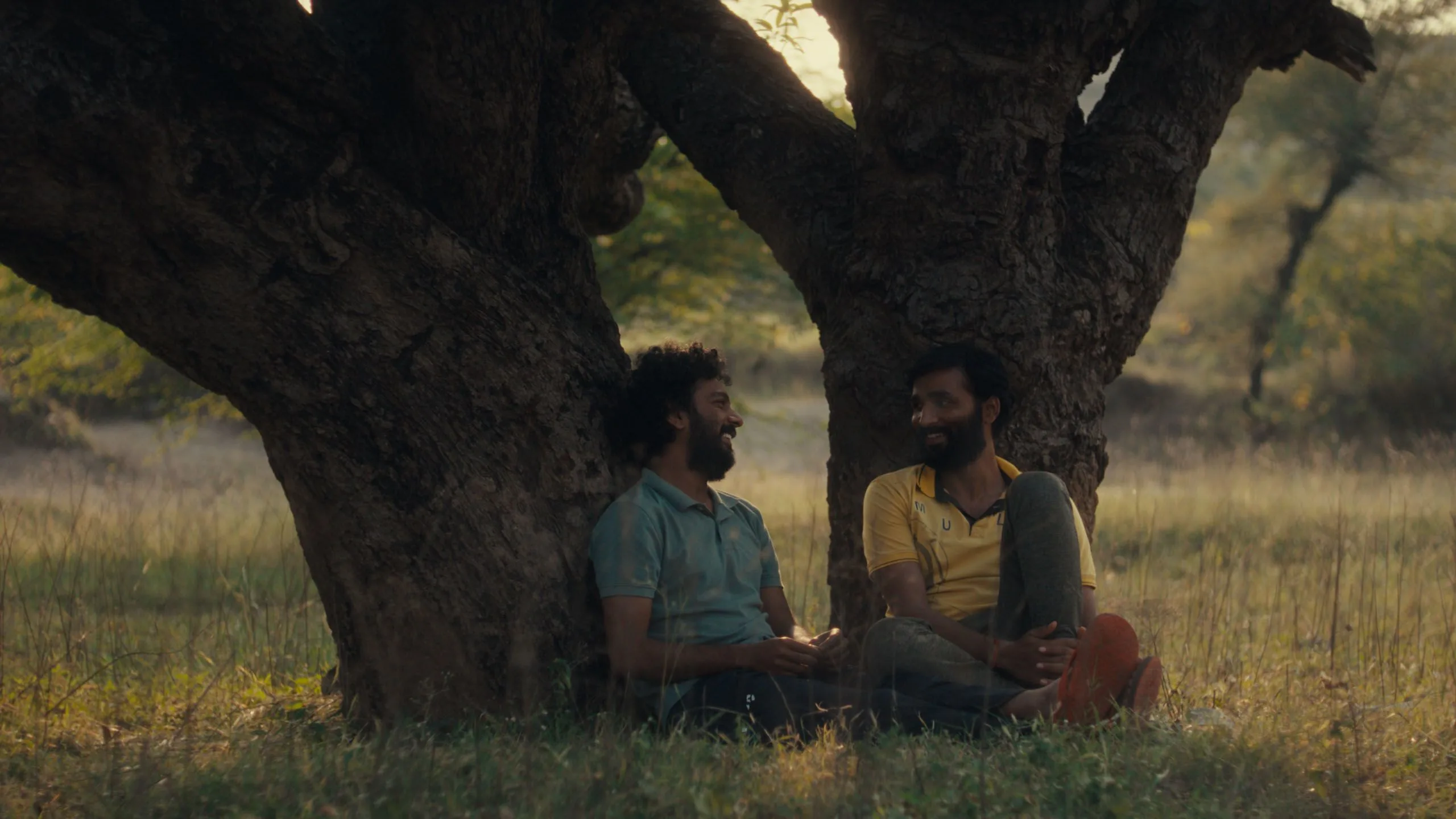
Among the most fascinating lines we hear in Sabar Bonda is Balya asking Anand whether he has a ‘special friend’ (‘khaas mitra‘ in Marathi) in Mumbai. Perhaps drawing from a heartbreak we’re told about, Anand replies that such friendships do not stick. Despite the gentleman caller speeding past his doorstep, we know Balya didn’t have a ‘special friend’ either. Do the childhood friends wish to be that person for each other?
Sabar Bonda keeps its narrative graph steady. Despite Anand and Balya’s shared sexuality and familiarity, Kanawade never lets the story devolve into something carnal or gender-agnostic. At one point, Balya confides how unusual it is for him to sit peacefully and talk like this. One can imagine his ‘meet-cutes’ forever being quick encounters with no emotional connection.
Secondly, the film specifically explores issues unique to gay men and how sexuality shapes their rural and lower-class lives. Between them, there are no instant sparks that fly, and no hypothetical fragrance fills the air to give them an ambience to come closer. Balya’s constant, functional presence gradually gives Anand the safe space he needs in an otherwise suffocating environment. The duo is often seen in or around each other’s homes, trying to build an easy equation with the parents (especially the moms), just as you would see in a straight love story.
At one point, Anand’s maternal grandfather recalls how he didn’t let go of an alliance with a ‘city boy’. Now, we know he was simply referring to a boy who lived in a city. It doesn’t matter if he toiled in a ghetto or drove a taxi. To him and his daughter, it’s an instant step up from producing children destined to burn their skin in the fields.
Anand, too, isn’t a city boy if we imagine him as someone with good money, a posh home, or a vibrant social media circle. Though educationally ahead, economically, he’s no better than his father. Limited by societal and psychological constraints, he perhaps lacks his dad’s wisdom, but Anand has surely inherited his mother’s quiet strength and compassion.
ALSO READ: ‘Badhaai Do’ review – A fabulously acted small-town queer drama
It’s a slow film, not the boring variety, but the kind you might have seen Hirokazu Koreeda make. Sabar Bonda is a lot more vast in its canvas, as it provides large spaces for its protagonists to interact. The film doesn’t rely on metaphors in its dialogue; rather, the dysfunctionality that hangs in the air feels societal and unfixable. The cactus pears that become a shared delight between the two men are a wonderful parallel. Their sweetness survives the dry landscape and the thorny plant they bear on. It’s perhaps more symbolic than the peach in Luca Guadagnino’s Call Me By Your Name.
Kanawade’s casting choices are refreshing because the actors don’t feel hired to act. We believe in Anand the moment he corrects his mother, saying his t-shirt isn’t black, it’s grey. His character arc involves deep internalization, which Bhushaan Manoj executes with mastery. In a short emotional scene between Anand and his mother, Sabar Bonda makes our hearts ache for him, for what he has lost and for what his future may hold.
Suraaj Suman as Balya brings a different energy. Though a village farmer, his lightly tanned, handsome face wouldn’t look out of place in a metro city. Aside from his resistance to marriage, Sabar Bonda doesn’t delve deep into his past or personal struggles. This is fair, as the film allows Balya to be the catalyst that helps Anand evolve while also transforming himself in the process. Jayshri Jagtap lends dignity to the plot as she walks the tightrope between a mother’s empathy and the diktats of a conservative society.
As the end credits rolled, Kanawade’s Sundance-winning film left me with a unique aftertaste. Because Sabar Bonda, despite its quiet demeanor, is an accurate portrayal of gay life in this part of the world. Sometimes, it’s important to explore cinema through the lenses of culture, class, and caste, some of which Kanawade effectively addresses. I wouldn’t stereotype the film as bold because it doesn’t aim to shock or drop jaws. Instead, it presents a rare blend of softness, hope, and endurance as it breathes life into a story that is partly self-referenced by the filmmaker, and is hence a beautiful labour of love. For all its authenticity, Sabar Bonda will stay with you long after it’s over.
Rating: ★★★★ 1/2