There’s a point in Tango Malhar where it stops feeling like a promotional piece for the Argentinian dance form it’s named after. That moment arrives when siblings Malhar (Nitesh Kamble) and Rani (Kriti Vishwanathan) are secretly filmed while passionately practicing tango in a secluded building. In Saya Date’s film, this scandalous act carries the potential to ignite controversy, challenging the sanctity of familial bonds. Where will the story go from here? That question becomes the film’s most compelling suspense.
Tango Malhar opens with Malhar, a 20-something autorickshaw driver, grooving to Indian hip-hop on his earphones. He lives with his widowed mother and school-going younger sister in a cramped city home. Early in the film, we see Rani’s love for dance and her brother’s latent rhythm. A man of few words, Malhar is still searching for purpose when tango unexpectedly enters his life.
Meanwhile, Malhar’s friends are prepping for a Ramayana play to be staged during the upcoming Ram Navami celebrations. The brash Santosh (Akshay Gaikwad) leads this group of seemingly unemployed men who thrive on alcohol and cigarettes. Their camaraderie turns bitter when Malhar’s growing obsession with tango distances him from the group.
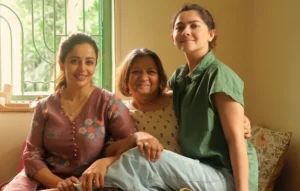
The film’s first victory is when Saya Date and Manish Dharmani’s screenplay succeeds in presenting tango as an accessible and democratic art form. It made me even briefly read up about Carlos di Sarli’s legacy. Secondly, it spends enough time sketching Rani, who is almost a parallel lead, and lets her come alive as a person of her own. Their mother, distraught by the ways of her deceased musician husband and unable to bear more from her children, is a stark portrait of reality in Tango Malhar. Together, the trio forms a believable family unit, and their issues and impulses are atypical of India’s middle class.

Diving deeper, the film also gets its protagonist just right. In Malhar’s first tango session, his hands tremble as he holds his partner. In another scene, he awkwardly questions a dancer about touching strangers. By shaping Malhar as an average Indian conditioned by social stigma, Date argues that dance need not be filtered through moral panic. Tango Malhar subtly reminds us of India’s own legacy of sensual literature (Kama Sutra) and erotic architecture (Khajuraho). Date neither sanitizes nor sensationalizes society – she presents the discomfort honestly. At one point where applause feels inevitable, we hear none.
An element in the film that falters is Santosh, whose grey shades and bond with Malhar fail to make sense. Why is he invested in Malhar? Why does he misbehave with his friend’s family? What triggers his sudden shift in behaviour? A film needs conflict, and someone to ignite it – but Santosh never convinces. The writers build him up as a potential catalyst, only for it to fizzle out and weaken the film’s otherwise uplifting tone.
Visually, Tango Malhar impresses well beyond its modest scale. The cinematography, particularly the top-angle shots capturing Malhar and Rani’s shared bedroom space, helps in bringing alive their bond. Even mundane moments, like Rani making tea for a dejected Malhar, are framed with care. The absence of grand stage events doesn’t hinder creativity, but it allows the filmmaker to sharpen her focus. The original score, filled with tango rhythms, is soothing, and the climactic Marathi number is instantly memorable.
ALSO READ: ‘Aatmapamphlet’ review – A warm satire set in simpler times
Date and Dharmani’s writing cleverly bridges the foreignness of tango with the rhythms of everyday Maharashtrian life. Yet, Tango Malhar hesitates to fully explore its boldness. It would rather play it safe and hurt no communities and sentiments.
That said, the cast transforms modest material into something highly tasteful. Nitesh Kamble (who is reminiscent of Siddharth Suryanarayan) has eloquent eyes that emote as gracefully as his agile feet. Malhar’s wide-eyed stares mirror the audience’s own discovery of the dance form. As Rani, Kriti Vishwanathan delivers a nuanced performance, and her chemistry with her on-screen brother is first-rate. Indian cinema needs more of her uninhibited smile and the innate ability to command the screen. Seema S. Vartak, as the duo’s mother, fully earns our empathy in a short yet well-etched part. Akshay Gaikwad is an able actor, but the film gives him very little material to work with.
As the end credits rolled, Tango Malhar had me flashing a wide smile, as it did for most of its runtime. Saya Date’s film is a love letter to the idea that a foreign art form can cut through an otherwise progressive society, still plagued by moral policing and false conditioning. At times, it borders on indulgence, but that’s forgivable given the warmth it generates. Date’s storytelling makes you tense and sad, yet, above all, gives you hope. Who wouldn’t root for an underdog tale filled with fresh struggles and a rapturous final dance?
Rating: ★★★ 1/2