The very thought of the future, in any given year, is frightening. If we are currently standing at the edge of AI taking over, our predecessors once witnessed the Y2K scare and the rise of machines replacing human labour, each threatening to upend human life. And they did, yet we found ways to slip through largely unscathed. In Krishand’s Masthishka Maranam, we encounter a dystopian future set in the not-so-distant year of 2046. In a world equally ruined by technology, advertising, and toxic habits, the film shows a society that has descended into an abyss of crime, grief, and economic disparity.
At the centre of Masthishka Maranam is Bimal (Niranj Maniyanpilla Raju), a young father grieving his daughter’s death by immersing himself in experiential VR games that simulate near-death experiences. These games are drawn from memories borrowed from others and can now be experienced by thrill-seekers like Bimal. On a “break” from his wife, Anindya (Ann Jameela Saleem), who has been clinically erased of all memories of their daughter, the couple still meet occasionally. If technology is unknowingly doing its bit to wound Bimal, there are also the ever-prying TV channels and paparazzi, hungrier for numbers than ever before.
Enter Frida Soman (Rajisha Vijayan), a rare human starlet in an industry dominated by AI superstars. Selling like hot cakes in a seedy corner of the internet that resembles Discord is a “game”, Simon’s Memories, which allegedly features a sensual encounter with her. Hoping for a saucy distraction that might lift his spirits, Bimal logs in, only to experience something entirely different. He ends up committing twin murders alongside Frida.

What follows in Masthishka Maranam is an invigorating ride through the anxieties of modern living. While the exaggeration of its timeline throws up a clutch of technological quirks, the film’s politics and its impulse to expose societal hypocrisy feel hilariously contemporary.
Krishand’s film does not present itself as a grand time-travel spectacle. Yes, there are flying automobiles and an abundance of futuristic gadgets and jargon. Yet Masthishka Maranam remains firmly invested in the mindscape of a miserable man. It reminds us that while our environment and occupations may change, we remain human, and so do our aches.
The humour, rooted in a notably Malayali grammar with local idiosyncrasies at play, introduces a gallery of edgy characters. My favourite is Alpha, the Manic-Pixie-Toxic-Boy in Anindya’s life, who seems to be eating all the time. There are ideas of sexuality and fidelity that are beautifully woven into the narrative, leading to a series of effortless laughs.
ALSO READ: ‘Happy Patel’ review – A collection of gags dressed up as a film
Despite its dystopian setting, Masthishka Maranam works best through its editing, which remains sharp and slick in Krishand’s cut. While budgetary limits likely prevented elaborate world-building, the spaces the characters inhabit feel textured and convincing (DOP: Prayag Mukundan). Even better is its trippy original score (Varkey), which stays consistent throughout, immersing us in the odyssey of absurdist events that unfold.
Therefore, it is to nobody’s surprise that the screenplay does the heaviest lifting in Masthishka Maranam, particularly the crackling dialogues (Krishand), peppered with classic Malayali reflexes and pop culture nods that subtitles could never fully capture.
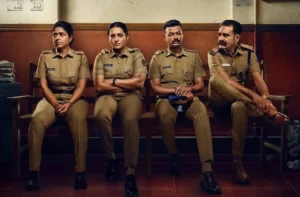
The film reaches the apex of its cat-and-mouse tension when Frida, Bimal, and another key suspect are arrested towards the finale. Frida, dressed à la Rani Mukerji from Kabhi Alvida Naa Kehna for filmmaker Tharan Johar’s Rani Titlibai, is a vision to behold in the glass prison where a major conspiracy unfolds.

Masthishka Maranam‘s final act, oscillating between prison and courtroom, is the film’s wildest stretch, packed with electric dialogue and equally sensational performances. Divya Prabha aces comedy with a Urvashi-esque flair and gusto, while Vishnu Agasthya is a riot as Bimal’s loud-mouthed lawyer. Veterans like Jagadeesh, Suresh Krishna, and Nandhu deliver knockout turns that shed all traces of routine, while Rahul Rajagopal, Jain Andrews, and Ann Jameela Saleem emerge as pleasant surprises.
Carrying Masthishka Maranam firmly on their shoulders are its stellar leads, Rajisha Vijayan and Niranj, who bring a great deal of quirk, energy, and empathy to their roles. As Frida, or Shalini Mullumurikkil, Rajisha delivers an uninhibited, career-defining performance that will be remembered for her zeal and guts on display.
Writer-director Krishand shies away from speculating on the direction religion might take two decades from now. Whether deliberate or not, the film is as political as one would expect, though it never screams from the rooftops. It offers answers to most of the questions it raises, from its labyrinthine bureaucracy to its uber-capitalist, mechanised way of life, if one looks closely enough.
This way, Masthishka Maranam is a taut thriller-comedy that doesn’t require you to drop your masthishkam (brain) at the cinema hall’s door. In fact, it demands and rewards the brains that work overtime. With jokes that flash and disappear in microseconds and performances that range from bold to outrageous, Krishand’s ambitious yet economical film catapults Malayalam cinema into a new realm of creativity.
VERDICT: ★★★★