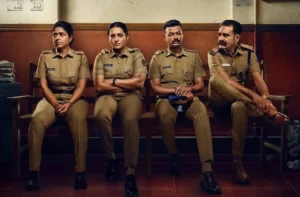
It’s one thing to make a biography or documentary on an over-exposed crime episode. It’s another to sprinkle it with cinematic liberties and hope it magically transforms into a chilling superstar saga. Jithin K. Jose’s debut feature Kalamkaval attempts the latter and ends up as an engaging yet deeply implausible effort that feels dystopian. Tragically so, because almost nothing in its setup or screenplay reflects the conservative, observant, and perpetually inquisitive social fabric of Kerala.
In the urban setup outside Kerala (where I currently live), I could live next to someone for five years and still exchange nothing more than a polite nod in the elevator. In a typical Malayali neighbourhood, where I grew up and still visit frequently, a family that moved in six months ago would know my birthday, place of work, mother’s maiden name, and possibly my blood group without ever having seen me. Staged in the latter setup, Kalamkaval is about a serial killer inspired by Cyanide Mohan, who flits along the Kerala–Tamil Nadu border areas to execute sinister crimes with a SIM card trick no one seems to catch. Apparently, it’s that simple for a clearly not-young family man.
(MILD SPOILERS BEGIN)
Mohan’s story has already been fictionalised more than once, and therefore, novelty is exactly what Jithin K. Jose’s screenplay lacks. In a bid to raise the stakes, he turns the killer Stanley Das (Mammootty) into a serving policeman. Investigating the case is Stanley’s famous colleague Jayakrishnan (Vinayakan). Delightfully enough, the able cop’s alias (Nathu) brings back fond nostalgia of Mammootty’s classic comedy Kanalkaattu.
What follows in Kalamkaval is also a logistical marvel. Stanley, despite being a full-time cop, husband, and father, finds enough free time to woo, date, travel with, and kill over 20 women across rural Kerala. This is a state where it is difficult to check into a hotel alone, let alone with unfamiliar adult women.

Stanley pulls it all off and still finds spare time to retreat into an abandoned dungeon (is it the same house we saw in Dies Irae?) to sketch his victims and concoct cyanide with alarming ease. Jithin K. Jose throws in a Drishyam 2-like complex twist by introducing a retired forensic expert whom Stanley contacts under a bizarre pretext to “expand his thinking.” There are no cameras, no witnesses, and astonishingly, no one remotely curious about this man’s activities. Not even his wife.
Even if one forgives Kalamkaval for its wild liberties, why do the trained cops never consider technology beyond faxes and sketch artists? Why is a forensic expert so careless that lethal details are casually handed out? Why does a crucial authority in a highly educated state never verify licenses before selling illegal substances? And why does Stanley never receive frantic calls from family or superiors every time he disappears? How can this dual existence work, first as a policeman who cannot afford invisibility, and second as a family man embedded in Kerala’s deeply intrusive domestic ecosystem?
ALSO READ: ‘Kurup’ review – Dulquer Salmaan shines in an ultra-glam fugitive drama
Add to this the extensive travel between the two neighbouring states, and Kalamkaval collapses under both logical and logistical scrutiny. Suddenly, I have renewed respect for the writing in Sookshmadarshini, which shows exactly how Malayali brains tick.
(MILD SPOILERS END)
Yes, Mammootty is a sumptuous treat as Stanley in Kalamkaval. But even with his carefully maintained appearance, it is difficult to believe how over 20+ women, regardless of loneliness, fall for his charm without leaving a trace behind. Not exactly a romantic star, he is also burdened with the question of how a middle-aged man (with visible signs of ageing) seduces conservative rural women into hotel rooms, convinces them to pop pills, and vanishes into thin air. Vinayakan revisits shades of his Oruthee performance, but it lands far less effectively here due to the absence of coherent writing. Here, the talented actor is given childish lines that compare killing rodents to committing homicides, in a mawkish attempt to establish the supposed thrill of killing.
Kalamkaval is also not a film that makes you jump out of your seat with technical brilliance. Mujeeb Majeed’s background score relentlessly leans on an ominous sound one might expect from bad horror films. It’s exhausting rather than unsettling. The cinematography by Faisal Ali and Charan C. Raj adds little creativity, while the production design (Shajie Naduvil) swings between overenthusiasm (Stanley’s lab and the lodge lobby) and complete indifference (everything else).
I began watching Kalamkaval after suspending disbelief from a coconut tree. Unfortunately, the film’s commitment to illogic kept shaking the trunk. Stanley is no Rodney Alcala, and Kerala is no California, where a family man in public service can casually operate as a dating-era serial killer while living in police quarters with zero privacy. And please do not come back with the “this is inspired by a real story” excuse now.
In essence, it takes a special kind of skill to downgrade Mammootty’s acting prowess. Jithin K. Jose’s poorly envisioned and amateurishly directed crime thriller Kalamkaval does not just go the extra mile. It drives straight off the edge.
VERDICT: ★★ (2 STARS)