Director Vivek B. Agrawal’s Bhai Tera Star Hai is a film that needs some context before you walk into the theatre. You can’t expect a standard narrative to unfold because there really isn’t one. And honestly, that’s the point. The whole thing plays out over a single night, so the absence of a typical plot is excusable. What the film needed wasn’t a groundbreaking storyline, but a clear purpose and a killer trailer. It partially succeeds on the former and misses the mark by a mile on the latter.
Then again, cutting a trailer for a film like this can’t be easy because it thrives almost entirely on its filmmaking quirks. Agrawal builds the film out of these strange little mini-chapters, following different groups of characters who keep crossing paths. A few of these threads really work, but others just end up getting lost in their own oddities.
Bhai Tera Star Hai packs in a large ensemble, which is both its biggest strength and its biggest flaw. The actors hold the fort, while Tribhuvan Babu Sadineni has the tougher task of keeping the camera flowing through completely different people and spaces.
Don’t go in expecting the polish of Adolescence in its fascination for long takes. Here, the approach feels more like a director having fun behind the camera than something that actually serves the story. That said, it’s still pretty amusing to watch until it turns exhausting.
On the topic of the urge to do things differently, Bhai Tera Star Hai is filled with ad film-like supers that can prove both innovative and distracting to an unassuming viewer.
Among the things that work, the dialogue writer is clearly having a field day. A self-referential gag about the leading man’s own film, Kisi Ka Bhai Kisi Ki Jaan, is one of the film’s funniest recurring gags. Some lines are so sharp that the real laugh hits three seconds after the moment has passed. In an era where mainstream Hindi comedy is still giving us stone-age setups like Welcome to the Jungle or Dhamaal 4, a line with actual wit feels like a big win. Filipa Pinho’s production design is another high point. For a film shot almost entirely on studio sets, the visual world feels surprisingly fresh and alive. That said, the characters are strangely colour-coordinated, which only adds to the confusion.
Another notable strength of Bhai Tera Star Hai lies in its central cast, who give their maximum to the concept and own it even when the screenplay doesn’t. It’s impossible to pick a favourite, but Chandan Roy Sanyal, Vivaan Bhathena and Niki Aneja Walia once again remind you how Bollywood hasn’t quite done justice to them.
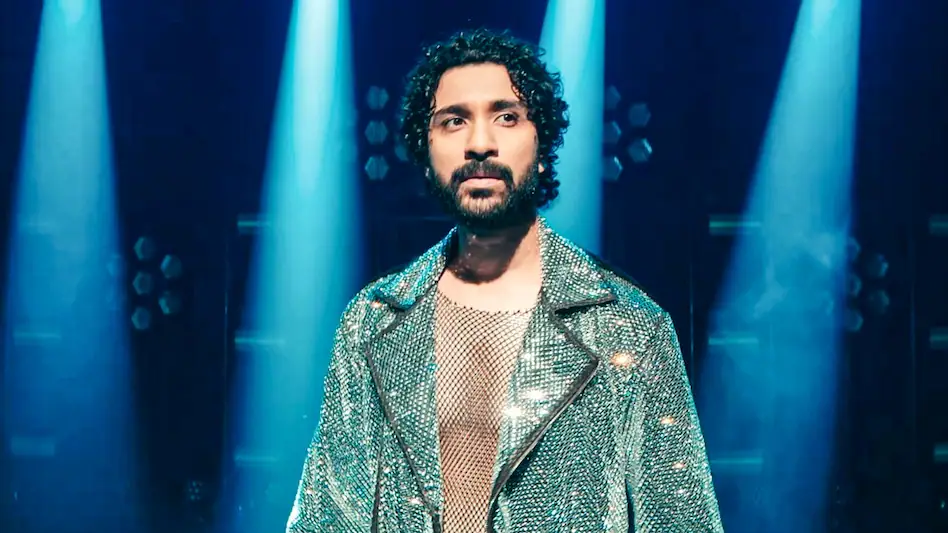
Raghav Juyal is technically the lead, but he leaves all typical main-character ego at the door and just goes for it with an uninhibited performance. Meanwhile, Vikalp Mehta, who gets called “Garibon ka Akshay Kumar” at one point, leans right into those familiar Khiladi-esque mannerisms and dialogue delivery.
Sanjay Kapoor is a total blast, and if you close your eyes, his delivery sounds shockingly like the late Rishi Kapoor – in a good way, that is. The women get plenty of room to play too, with Niharika NM and Barkha Singh’s good performances getting eclipsed by their similar styling. Tina Desai’s role required more meat, whereas Parvathy Omanakuttan exhibits good screen presence.
ALSO READ: ‘Happy Patel’ review – A collection of gags dressed up as a film
For all the talent on display and the technique backing it up, Bhai Tera Star Hai somehow falters where it matters the most: the writing. Agrawal frequently confuses eccentricity with depth. The film keeps throwing up colourful characters, funny situations and stylistic flourishes. Somewhere along the way, it forgets to make us care about them. For a film that’s fundamentally about relationships, it needed way more emotional setup for that multi-story climax to actually hit home.
It’s random, but I was just talking to a friend about Pedro Almodóvar right before the show began. And throughout Bhai Tera Star Hai, I kept thinking about Women on the Verge of a Nervous Breakdown. Not because they are similar films, but because both embrace the same kind of madness. Intersecting stories, heightened drama and organised chaos. The big difference? Almodóvar never forgets the heart of his story. Agrawal constantly loses track of it.
At its core, Bhai Tera Star Hai is a collection of mini-stories, some serious, some completely absurd, and its misleading title doesn’t have anything to do with the material. The screenplay gives almost equal weight to every character, but in its attempt to be radically different, the movie also seems weirdly eager to play it safe whenever it senses commercial risk. There’s no other reason why they’d play three back-to-back songs at the end with no context whatsoever.
Yes, you have to respect a Hindi film willing to take a swing this big. It’s ambitious, playful, and constantly trying to catch you off guard. I wish it trusted its heart as much as it trusted its style. Had those two met halfway, Bhai Tera Star Hai could have been something genuinely memorable.
VERDICT: ★★ 1/2
For more reviews of Bhai Tera Star Hai, head to the Film Critics Guild.