
A bizarre exotica circles India’s southern state of Keralam, encompassing its people, cinema, food, and heritage. Outside the state (excluding Bangalore, of course), it almost feels like a soft form of reverse racism. Sure, Keralam has the stats to back up the reputation: better education, sanitation, and a genuinely decent quality of life. Malayalam cinema has long ridden that wave, shaping this glowing image (the famous Kerala Model in many areas of public life) while turning out some of the best films in the country, a list Bethlehem Kudumba Unit seamlessly joins.
Girish A.D’s cinema is a marked departure in these respects. They come with no design to paint a curated or performatively progressive picture. The filmmaker’s auteur style is so intrinsically woven into Kerala’s distinctive culture that native Malayalis can best savour its humour. Like all of Girish’s works, Bethlehem Kudumba Unit avoids grandstanding or sloganeering for the state’s values. Instead, it steadfastly reminds us that we are all equal, bound by the same insecurities, daily issues, and frail egos.
Keralam’s residents may not routinely commit honour crimes, but accepting someone significantly younger, from a different religion, or outside one’s caste is rarely seamless.
In Angamaly, Justin (Nivin Pauly) has reached an age where his former batchmates have children old enough to spy on their fathers. Sporting a visible paunch, his decision to remain unmarried is no longer a subject of neighbourhood gossip. Justin has crossed that threshold. People have moved on, and life is comfortably dull until Ashley (Mamitha Baiju), thirteen years his junior, moves into the house next door with her family.
Sparks don’t fly instantly, though. For Justin, and everyone watching, any romantic dynamic feels implausible because of the decade-plus age gap. As local lad Glixon (Roshan Shanavas) tries his luck with Ashley, a chance laptop-repair incident triggers her curiosity. Justin is fundamentally different from the men she encountered back in her native Mundakkayam or here in Angamaly.

Before Justin can fully digest what his aunt, Kunjaunty (Bindu Panicker), hints about Ashley’s growing affinity towards him, his temperamental younger brother Joel (Sangeeth Prathap) starts making waves, first with his short film and later through his affair with a Hindu girl, Sayoojya (Parvathy Ayyappadas). The rest of Bethlehem Kudumba Unit tracks how Justin navigates the noise around him and subtly comes of age.
As is the hallmark of Girish A.D.’s filmography, authentic Malayali humour filled with a barrage of pop-culture references holds the narrative firmly together. While it initially resembles the story of an eccentric neighbourhood, it can easily reflect any corner of Kerala. Never a simplistic or linear tale, the movie avoids forcibly attaching a checklist of social issues to its central plot. Instead, Girish imparts lived-in textures to every element he weaves together: the passion for cinema, the Christian family congregations, the girls’ night outs, the biryani runs, rampant alcoholism, NRI cash cows, mischief-making uncles, and solemn promises made in the name of the Bible.
These familiar faces and persistent practices become the lived-in atmosphere surrounding Justin and Ashley’s otherwise resolvable conflict.
Between the central pair, the age gap itself is never the primary issue, nor is it a cliché “what will society think?” syndrome. Rather, they suffer through a situation specifically engineered by an external party. If Justin is long past his lover-boy era, Ashley is not written to rescue him. No character exists solely to transform another in Bethlehem Kudumba Unit. The couple understands that their sweetest moments were the ones they spent in each other’s company, even as the people around them make continuing that bond nearly impossible.
ALSO READ: ‘Thanneer Mathan Dinangal’ review – a flavourful rewind to high school bustle
Girish’s film is less about its ultimate destination, which can be spotted from a distance, and more about how intertwined lives operate. Even characters who appear for mere minutes are granted individuality. One glance at the neighbourhood’s famous Moreli Sisters confirms as much.
The film does not rest safely on character quirks alone. Girish ensures that the sequences are stitched together cohesively, the tension is maintained, and dramatic camera angles arrive whenever required. The mise-en-scène never degrades to television-serial visual standards, even when the backdrop could easily have pushed it in that direction. The production design (Ashik S.) ably serves the narrative by shunning synthetic, hyper-stylised textures, an element that previously irked me in Nivin’s otherwise breezy holiday venture, Sarvam Maya.
Briskly edited (Akash Joseph Varghese), Bethlehem Kudumba Unit is lovingly assembled with inventive transitions. Vishnu Vijay’s music, as is the case with Girish’s earlier films, is deployed purposefully to propel the plot, interspersed with key dramatic beats and dialogue. The cinematography (Ajmal Sabu), among other things, isn’t obscenely colour-graded, which is a relief in the rom-com genre.
The sound design (Sankaran A.S. and K.C. Sidharthan) captures precise audio cues amid chaotic, multi-character arguments. The film never loses its celebration of intimate close-ups and reaction shots. There are a couple of action set-pieces, too, and they never feel inserted to project a certain image of the leading man or as an easy way into the girl’s heart. The fights in Bethlehem Kudumba Unit are situational and loads of fun.
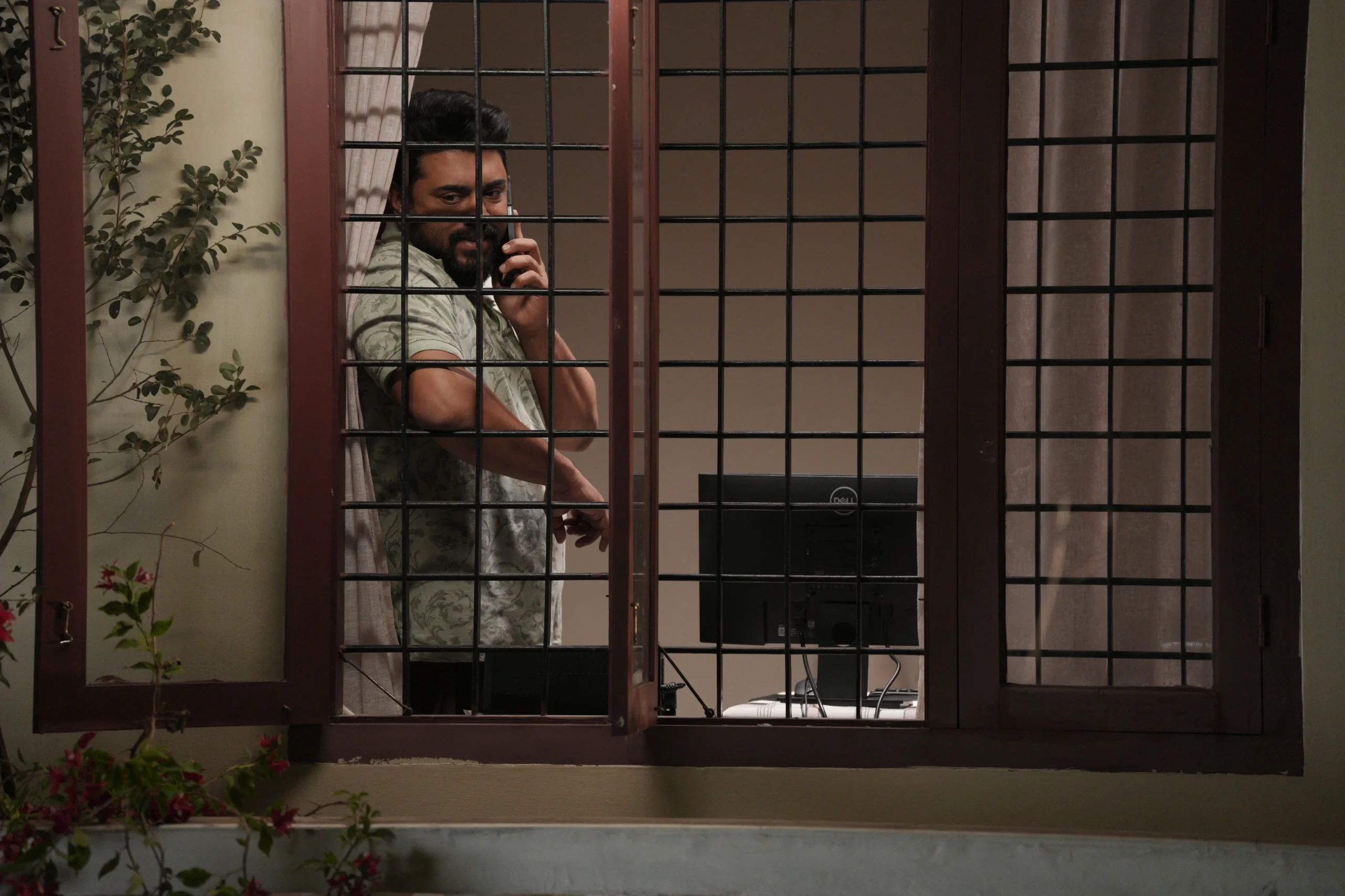
The ensemble cast feels handpicked, and the results are evident. Nivin Pauly is exceptional as Justin. The actor is at a career crossroads where his age and appearance place him in an interesting middle ground, neither too young nor too old, and Girish’s film gives him the perfect canvas to be vulnerable and brittle. There is an awkwardness to his performance that makes Justin feel like someone who has spent years watching life happen around him rather than participating in it.
Mamitha Baiju, falling in love with an older man for the second week in a row, is a lot more at home this time. Ashley is not a concept or an idea but a living, breathing girl who has her own opinions and dreams. She doesn’t exist to help or emancipate Justin from his trauma. They come together, go their separate ways, come together again, and throughout, they remain the individuals they were. This characterisation significantly helps Mamitha, who blooms as Ashley without being burdened by the usual traits used to “sell” a certain bubbly persona to us.
Sangeeth Prathap nails the angry younger brother routine, while the supporting ensemble has an absolute blast. Suresh Krishna, Shameer Khan, and Roshan Shanavas crack open scene after scene with effortless banter. Shyam Mohan and Vinay Forrt shine in their meta glories, evoking fond memories of Premalu and Premam, respectively. Srinda, Meenakshi Raveendran, and Vettukili Prakash, too, clinch their moments in a screenplay that doesn’t have a single badly penned character.
Bethlehem Kudumba Unit leaves you with much to think about in terms of the psychological underpinnings of Justin and Ashley’s bond. She is brought up in a dysfunctional home. He has latent trauma that never quite healed. Room No. 17 is Ashley’s refuge, and she is never quite at home in her own skin. The MP3 King of the early internet age, Justin looks on with quiet affection as she dusts off her cassette collection. She takes him to her old, weather-beaten house, glad for the journey they’ve taken.
In an age of social media posturing, pre-wedding photos and grand gestures, the fact that their only shared photo was taken accidentally by a traffic camera sums up a romance that is as resonant as it is beautiful.
VERDICT: ★★★★ 1/2
For more reviews of Bethlehem Kudumba Unit, visit the Film Critics Guild.