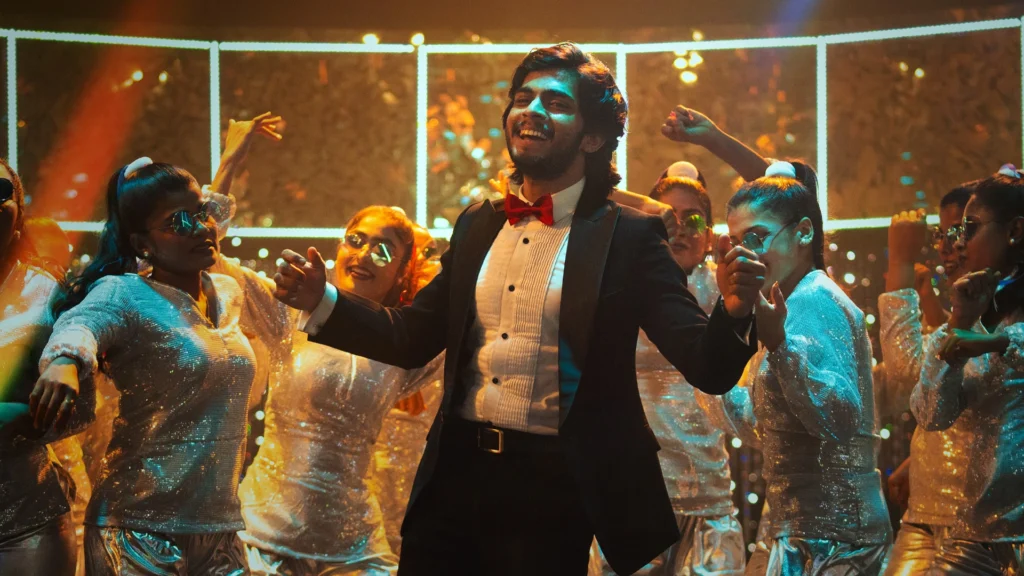
Everything is random, proclaims Abhinav Sunder Nayak in his gutsy second feature, Mollywood Times. It is the story of a brilliant yet salty filmmaker, Vineeth Madhavan (Naslen), who simply can’t catch a break. The reason is never as simplistic as a talented filmmaker threatening the mediocrity around him. Nayak’s narrative tears apart the glossy dream of making it big in the film industry with talent alone.
This very idea made me think of a street I walked down in Mumbai a decade ago. It was strangely full of young, glamorous people. They all looked hungry to be discovered in cafes or high-end gyms. “What is this lane?” I asked someone. “You don’t know? This is where all the strugglers live.”
The Anatomy of Ambition
In Mollywood Times, Vineeth is not a struggler. He had it in him the day he borrowed a 3.5-megapixel Sony Handycam from a VHS library owner-friend. He had it in him when his grandfather slipped into a coma shortly after the home premiere of his short film. Vineeth is someone who wants greatness, and he wants to set the bar high right from an era-defining feature debut.
In a film packed with quotable lines, I found myself thinking about those same strugglers I once saw and continue to see. Can their He-Man-like triceps and hourglass waistlines guarantee the kind of success Vineeth seeks? More importantly, are they prepared for the bitter truth? In an age of political correctness, not many are told whether they are merely mediocre or downright terrible. It takes a certain ability to read the room and pull the plug.
Mollywood Times, however, is never about giving up, and nobody is deluded about themselves. Vineeth knows he is gifted. The middling ones know where they stand. They are not awaiting an epiphany. Instead, they are trying their best not to end up in the losers’ paradise.
When Vineeth impulsively deletes his own work, the equally furious producer Fayaz (Appunni Sasi) responds by planting a new trap to end his career. “Mediocrity is the new greatness,” whispers a new pawn into Vineeth’s ear at an award function. His ambitions are far smaller.
Dismantling the Preambles of Success
Nayak keeps returning to this clash between greatness and mediocrity until even we begin to wonder whether Vineeth is chasing excellence or is trapped by his own idea of perfection. He does not want a pat on the back for trying. Nor does he chase sympathy points over a dead movie star. He wants recognition for his craft, something he has spent years chasing in isolation through joy, anxiety, frustration and recurring hopelessness.
Does the cinematic logic of good people receiving good things hold in reality? Can underdogs still expect a victory in the 21st century? Must good directors also be good human beings? Ramu Sunil’s rip-roaring screenplay quickly scoffs at such superstitions. After a heartburn, the holy sandalwood paste disappears from Vineeth’s forehead. The photograph of Goddess Saraswati is no longer seen beside his laptop. In what is perhaps the film’s most direct statement of intent, a whiteboard strikes out archaic film theories and replaces the preambles with far less comforting modern-day realities.
The Architecture of Anxiety
Before evolving into a film-within-a-film spectacle, Mollywood Times kicks off as a delightful retro piece. The reading and film-viewing culture of the ’90s, alongside the parenting styles and family dynamics of the 2000s, emerges with clarity. The research is so thorough that getting the period details right feels less like work and more like affection.
The firebrand cinematography (Viswajith Odukkathil), packed with close-ups, intimate zooms and circular pans, promises to strengthen Nayak’s potential as a future auteur. The quirky framing choices (editing by Nidhin Raj Arol and Nayak), coupled with the leading man’s ongoing narration (a device he previously employed in Mukundanunni Associates), ensure that the narrative rarely loses momentum despite its considerable runtime. Vishnu Govind’s sound design supplies plenty of chills in what is not a horror film, but a film about someone obsessed with horror.

Another treat for cinephiles in Mollywood Times is Nayak’s way of acknowledging his influences, like Scorsese, Kubrick, Shyamalan, and RGV, through lovingly curated props and fond dialogue. He also uses metaphors in the narrative, such as a shirt tucked in tightly as a symbol of success during one of Vineeth’s confrontations with Arjun Hariharan (Sangeeth Prathap), his arch rival.
Bonds Built in a Ruthless Ecosystem
Vineeth’s best friend, Sujithraj V. (Roshan Shanavas), is an important cog in the wheel who often gets the benefit of the doubt over his real effort due to his reservation privilege. At one point, he says, “I got claps for my identity,” a line that makes us wonder if he considers that moment a success or a failure.
Their friendship is among the film’s best-realised relationships. Vineeth can bluntly tell Sujith that his script is garbage. Still, beneath the harshness lies affection. He wants for his friend the same success he seeks for himself, one built on quality and individuality. In his own way, Vineeth’s belief that the audience deserves something better is established here.
Nayak balances this camaraderie with Vineeth’s love-hate relationship with Sachin Vaikom David (a delightful Sharaf U Dheen). The failed son of a celebrated author, he occupies the centre of the film’s mystery, along with his father and a novel called ‘Devil’s Island’. Nayak’s mood-building in the opening fifteen minutes, which introduces a school-going Sachin inside his father’s Victorian bungalow in Vagamon, is particularly slick.
While Sachin initially comes across as a comic figure, he gradually emerges as one of the film’s most human characters, helped greatly by the wonderfully absurd PTC series ‘Sachin’s Personal Tapes’. Nayak keeps planting Chekhov’s Guns throughout (it is also the title of Arjun’s award-winning short film). These little setups reward attentive viewers while giving everyone else a steady inflow of twists.
Performances Stripped of Comfort
Naslen is in stellar form as Vineeth, delivering what may well stand as the strongest showcase yet of his dramatic abilities. For an actor whose forte is supposed to be comedy and that instantly recognisable Aluva accent, he is given neither here. Vineeth’s perfectionism and irrationality keep him and the audience at a safe distance, even as we continue to root for his long-awaited breakthrough.
Sangeeth Prathap is at his best when he channels his signature ‘Amal Davis’ energy down a much darker road. You feel his menace even when he doesn’t show up. The belief that Arjun must be cooking up an action plan against Vineeth is enough to give the film a thriller-like tautness. The duo’s screen camaraderie feels natural, and the memories of Premalu never creep in, even when the characters spend most of Mollywood Times at loggerheads. Roshan Shanavas bags a meaty role that avoids the supportive-best-friend clichés, while Vineeth Sreenivasan is affable in a brief track that adds a layer of dark humour.
The Dangerous Space of Delusion and Luck
Ultimately, Mollywood Times underlines the importance of luck and the ability to play the game. Talent helps. Nepotism helps. Access helps. Beyond that, you’re only as good as your latest success story.
The cruelty of cinema, and perhaps anything connected to it, is that there is no report card. No grading system. No objective metric that separates genius from mediocrity. Somewhere between validation and rejection lies a chaotic zone where talent alone guarantees nothing.
While there are many Vineeths who relentlessly chase perfection, there are even more waiting for the phone call that would finally change their lives. And that is what makes Mollywood Times so unsettling. It is not a film about success or failure. It is about the terrifying possibility that nobody truly knows the difference. Not the filmmakers. Not the producers. Not even the audience that elevates artists to what Vineeth would call greatness.
VERDICT: ★★★★
Read more reviews of Mollywood Times by the Film Critics Guild HERE.