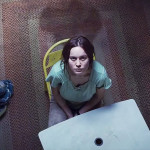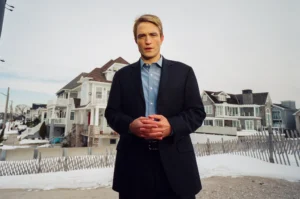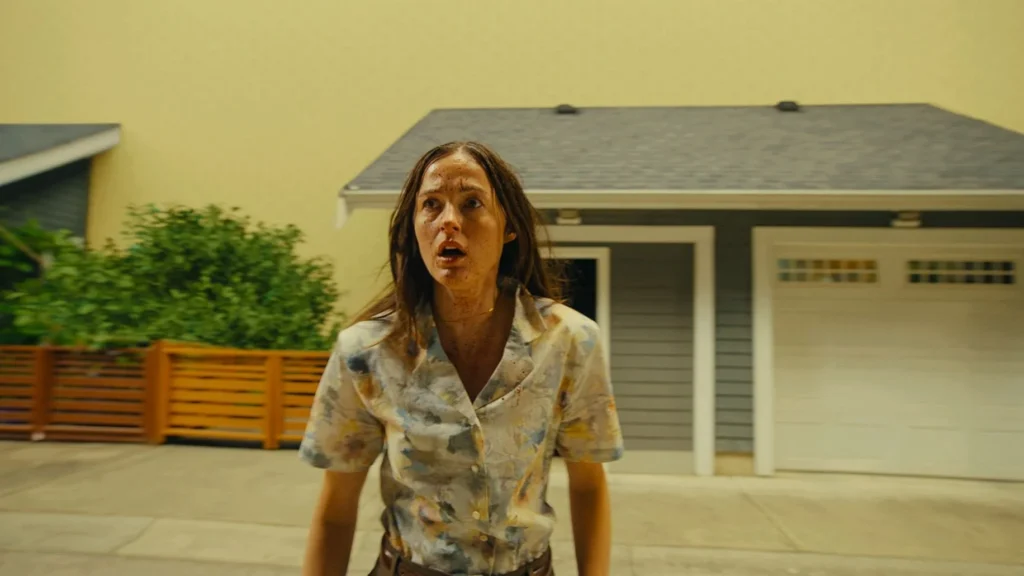
The landscape of filmmaking has changed. So has the language of horror. Once defined by grand big-screen experiences, some of the most exciting and innovative horror content now emerges on YouTube. A prime example is filmmaker Kane Parsons’s Backrooms, which took the U.S. and horror communities worldwide by storm. Defying the notion that creativity peaks with age, the 20-year-old director’s feature adaptation delivers relentless terror without the backing of a massive budget, proving that atmosphere and imagination can be far more unsettling than scale.
Set in 1990, Backrooms follows Clarke (Chiwetel Ejiofor), a failed architect who now runs the even more dubious Cap’n Clark’s Ottoman Empire, a vast furniture store fronted by a pirate mascot with a wooden leg. Seeking therapy, Clarke begins sessions with Mary (Renate Reinsve), who notices patterns in his aggression and gradually grows curious about his mysterious claims. By the film’s third act, she uncovers what Clarke, his colleague Kat, and Kat’s boyfriend Bobby have been through, much of which we have already witnessed through a series of unsettling grainy camera footage. This time, Mary becomes our eyes and ears inside the abyss.
What awaits Mary and us is what I’d call a production designer’s nightmare and a sound designer’s wet dream. Once she steps through the clandestine door hidden in the furniture store’s basement, genre conditioning leads us to expect video game-like precision, with creatures lurking around every corner and pursuing our protagonist at every turn. Backrooms is not that film. Its greatest trick is convincing us that the space itself is alive.
In that sense, Parsons’ film is an astonishing feat of visual design (Danny Vermette). It’s this massive, impossible expanse that somehow makes total sense visually, even while running on pure nightmare logic. Everything inside feels inexplicably real: the kind of forgotten objects, discarded structures and decaying spaces one might plausibly find in the back lot of a store like Clarke’s. You’ve got endless hallways folding into each other, rooms shifting around, and totally familiar spaces suddenly feeling completely alien.
Among the film’s most horrifying moments are the ones where the camera pans from room to room, top to bottom. There are no creatures in the frame, just differently structured, meticulously designed rooms in disarray.
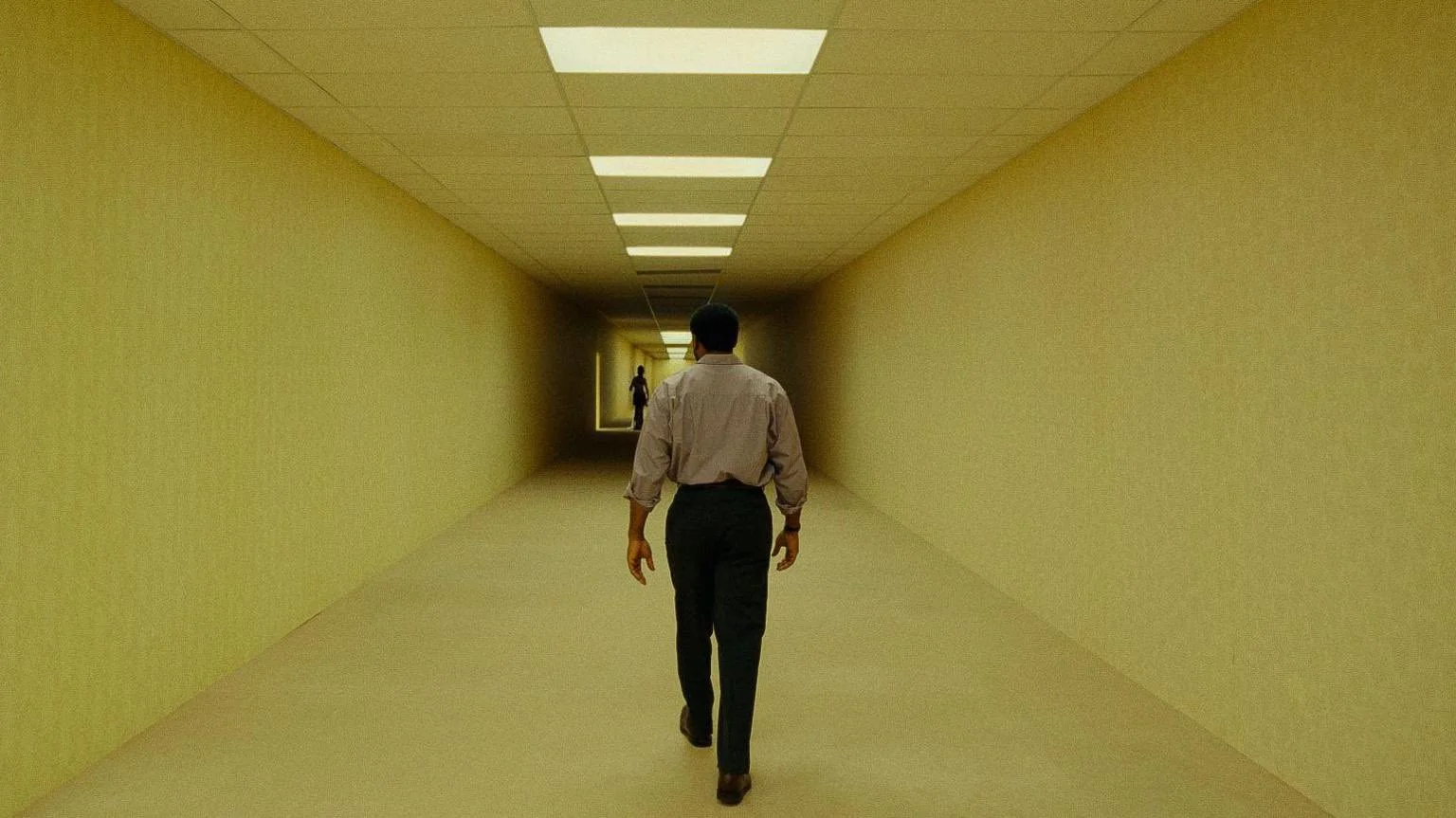
The sonic architecture (Eugenio Battaglia) does just as much work as the visuals, if not more. That muffled buzz of lights creates enough psychological dread as everything else does in the film. In a space like the one in Backrooms, a faint echo or a distant, anonymous shriek is enough to make your skin crawl.
There are faces. Yet even these entities aren’t overused. Their half-second glimpses mess with our minds in a way that’s far scarier than a prolonged reveal. Their awful, distorted cries and unusual appearances are designed to linger long after they’re gone, even if their screen time is sparse.
Yet little in Backrooms conforms to familiar horror rules. Before Mary can make sense of the sights and sounds in the backrooms, let alone chart an escape route, she uncovers another side of Clarke. He is anything but the ordinary client he first appeared to be.
From this point onward, Backrooms goes into overdrive, with Mary, Clarke, and a handful of other characters — some previously introduced through words or fleeting images — wandering through a chaotic labyrinth that gives the film its title. Is Parsons’ film a creature feature? Yes and no. Yes, because there are creatures. No, because they don’t deserve credit for most of the chills. The real terror lies in the atmosphere, the movement, the acoustics, and the very nature of the space itself.
Much of Backrooms functions without dialogue, deliberately steering clear of mandatory jump scares. Once the atmosphere is set, the film relies on its layers peeling back, allowing both the characters and the plot to be fully demystified. At the center is Mary, a protagonist burdened by a traumatic past, whom we anxiously wait to see galvanized. Thankfully, the buildup is far from taxing. We silently champion her as she traipses into that eerie space. Will Mary emerge as a warrior in the mould of Wonder Woman, or is Parsons steering her toward the spectral uncertainty of Personal Shopper?
ALSO READ: ‘Project Hail Mary’ review – A weirdly hopeful cosmic bromance
Renate Reinsve extends her spectacular multi-year streak with an utterly fearless performance. Mary isn’t easily rattled by the supernatural, which would have defeated the point of Backrooms. Instead, she actively seeks answers, even as they haunt her every step. Chiwetel Ejiofor is equally compelling, astutely balancing Clarke’s impulses and rages both inside and outside the terrifying rooms. Their dining hall standoff is masterful, marking the film’s peak acting showcase.
Even for a reluctant horror viewer, Backrooms is an easy film to appreciate. It is deeply satisfying to watch a narrative deconstruct the genre’s typical crowd-pleasing grammar. Kane Parsons’ feature debut fully eschews frightening nightscapes, cats, cannibals, and stock sound effects. The idea of the film might sound as boring as surveying hours of CCTV footage, yet the execution is such that it forces you to sit back and gasp with undivided attention. It’s every cinephile’s dream.
VERDICT: ★★★★
Read more reviews of Backrooms by the Film Critics Guild HERE.