How do we empathise with a force like the police? The last time I asked myself this, I was watching reels of police violence against Gen-Z protesters at Delhi’s Jantar Mantar. That scepticism lasted about thirty minutes, right until I spotted a traffic cop drenched in sweat while I sat comfortably in an AC vehicle, wearing sunglasses and two layers of sunscreen. Humanising lower-rank police officers in India is an uncomfortable exercise. Director Shahad’s investigative thriller Pradhama Drishtya Kuttakkar takes up that challenge, building a cat-and-mouse game around a group of cops hiding an accidental crime from a system that both empowers and oppresses them.
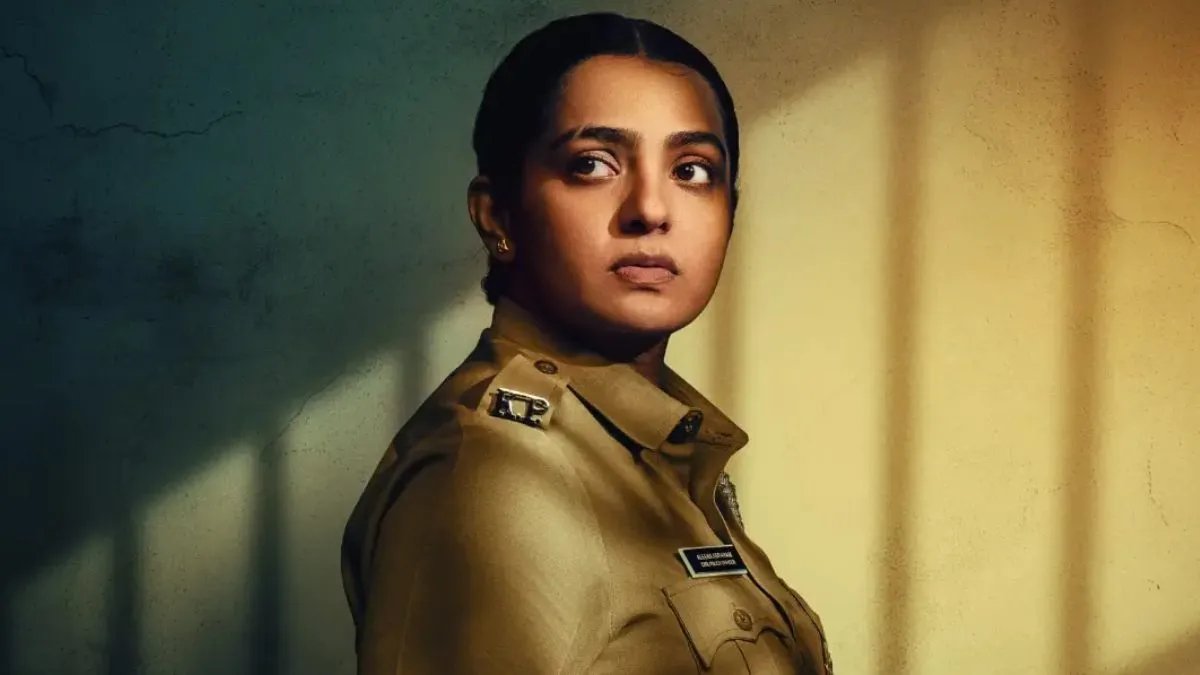
The film opens with Aleena (Parvathy), a young widow refusing a clerical job offered on compassionate grounds. “Like my Aby, I will join the force,” she says. Is it power, social standing, or her knack for connecting dots that pulls her towards a job that cost her husband his life? As Pradhama Drishtya Kuttakkar proceeds through its complex chapters, we get our answers.
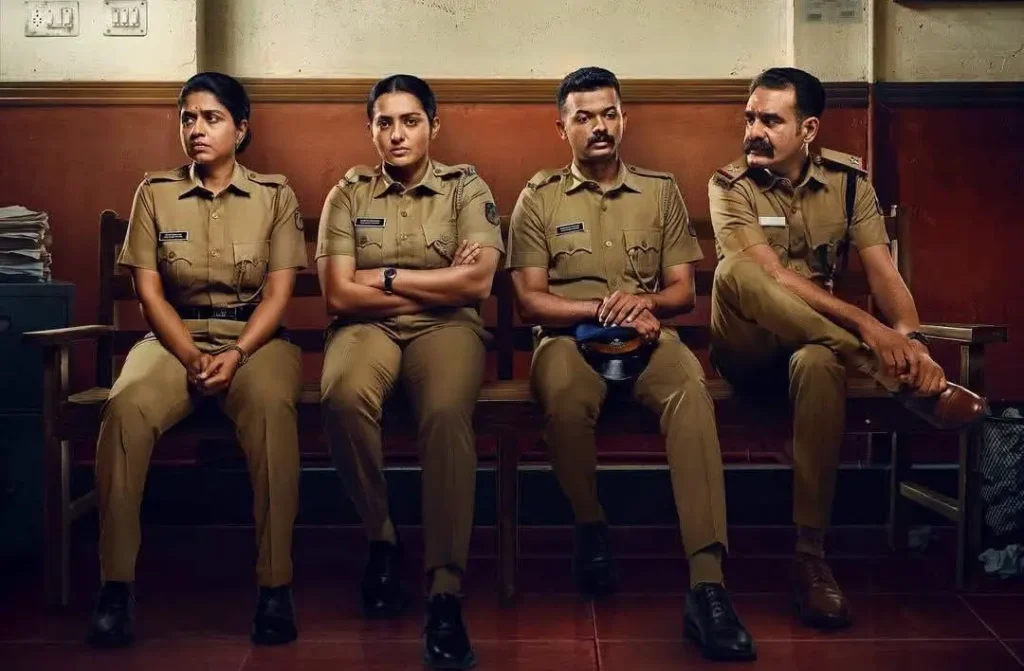
What exactly happens? A routine night shift at Nattakom Police Station goes sideways when Aleena, SHO Divya (Unnimaya Prasad), ASI Dasan (Sidharth Bharathan), and driver Sreenath (Mathew Thomas) end up in a deadly clash with an unexpected visitor. Who was the man? What was he hiding? The cops, our central protagonists, know their side of the story. But Pradhama Drishtya Kuttakkar has a different side to the visitor.
Enter Haris Meeran (Vijayaraghavan), a top cop and author of a crime memoir that Aleena is hooked on. While investigating a bigger mess around Kottayam, he stumbles upon the station’s secrets. The rest of the film unfolds as a clash between the hunter and the hunted: one backed by authority and respect, and four others driven by everyday problems and the desperation of making it to the next paycheque.
The screenplay by P.S. Subramanian and Vijesh Thottingal wants us to side with the hunted cops right from the beginning. Immediately after Aleena’s introduction, Pradhama Drishtya Kuttakkar dives into another case, building the context for what happens on the eventful night. The problem is that, when we look back, this sequence does not entirely convince because it exists only so that the four leads seek sympathy for their actions.
In its attempt to humanise cops, Pradhama Drishtya Kuttakkar is visibly partial. I had no trouble complying with that demand, but those who enjoy nitpicking the plot may have plenty to work with. The film repeatedly asks us to understand the cops’ circumstances before judging their actions. That is where its moral unease begins. How do we judge crimes when the circumstances differ but the outcome remains the same?
Shahad’s film is also a less melodramatic, more intellectually composed cousin of Drishyam. If Jeethu Joseph’s film, with all its merit, turned a common man into a superhero, Pradhama Drishtya Kuttakkar has no Georgekutty-like mastermind waiting to strut a hero walk. They’re ordinary officers trying to earn a living and survive the day without extra trouble. They may be tiny pawns in a flawed maze, but living inside it has taught them its loopholes, hierarchies and vicious cycles.
When Aleena confronts Haris Meeran, she speaks about the unequal system with confidence while quoting key excerpts from his own book. Meeran has spent years studying criminals, but has he ever considered that an ordinary cop might outthink him?
The final act relies heavily on the film’s technical craft, particularly when the screenplay’s predetermined stance begins to show its seams. Pradhama Drishtya Kuttakkar plants its clues carefully throughout. It is not entirely unpredictable, but Shahad understands how to extract tension from what we already know. Editor Chaman Chacko keeps the film moving with tight frames, while Jayadevan Chakkadath’s sound design creates an atmosphere where even silence can feel incriminating. The film understands that a police station can be more frightening when nobody is shouting.
The central performances keep this high-wire act anchored in Pradhama Drishtya Kuttakkar. Parvathy Thiruvothu skips the grandstanding entirely, letting Aleena’s intelligence drive the character. It is a sensitive, internalised performance that shoulders much of the film’s weight without ever announcing itself. Vijayaraghavan plays off her brilliantly as a veteran cop accustomed to unconditional deference. The moment when his confidence begins to slip is one of the film’s most satisfying payoffs.
Unnimaya Prasad is vulnerable as a cop who looks perpetually on the verge of tears. At one point, you see her in a broken state as a man walks in with a complaint. With the right quiver in her voice, she says, “Go inside and file it,” and you know she has understood her assignment just right.
Sidharth Bharathan brings a grounded weariness to Dasan. Pradhama Drishtya Kuttakkar over-explains Sreenath’s (Mathew Thomas) backstory when his rookie innocence was already enough. Mathew remains a treat to watch, nevertheless, and it is good to see him slowly explore strong dramatic themes.
ALSO READ: ‘Drishyam 3’ review – Georgekutty plans less, suffers more
Azees Nedumangad gets what Sahadevan was to Drishyam, but with less theatrics and more deep-seated menace, reminiscent of Girish AD’s bitter cop in Balan – The Boy. Vinay Forrt gets another chance to play to the gallery as CI Prathap Mohan and walks away with the laughs at every intended point.
Now let’s get back to the uncomfortable question with which I began. How far are we willing to soften our attitude towards cops?
Indian cinema has long romanticised police brutality as an occupational hazard. It often turns the uniform into a licence to dispense personal justice, a tendency that can feel particularly convenient in a country where justice is often delayed or denied. Pradhama Drishtya Kuttakkar strips the uniform of that heroism. Their actions may not always be righteous, but their reasons are recognisably real.
Shahad doesn’t ask us to cheer for his cops. He makes us watch them cross lines just to save their own skins. You understand their panic, and maybe you even want them to get away with it. But this isn’t Drishyam. It’s not a terrified family backed into a corner. And perhaps that is the film’s most unsettling lingering thought: the better we understand why someone crosses a line, the easier it gets to forget that they crossed it.
VERDICT: ★★★ 1/2
Read the reviews of Pradhama Drishtya Kuttakkar by the Film Critics Guild HERE.