*Spoiler warning: this review discusses major plot turns.*
Acceptance is a hard pill to swallow. Perhaps that is why “tolerance” survives in the lexicon of diversity. Here, the word feels almost offensive. Who are we to tolerate someone simply because they fall outside a dictionary definition of who they are supposed to be?
Early in Dorothy, Subbu (Sananth) quotes a line about gender discrimination being the worst form of bias. The film treats that not as a slogan but as a first cut. The binary comes first: male or female. Only after that hurdle do caste, class and the other divisions get their turn.
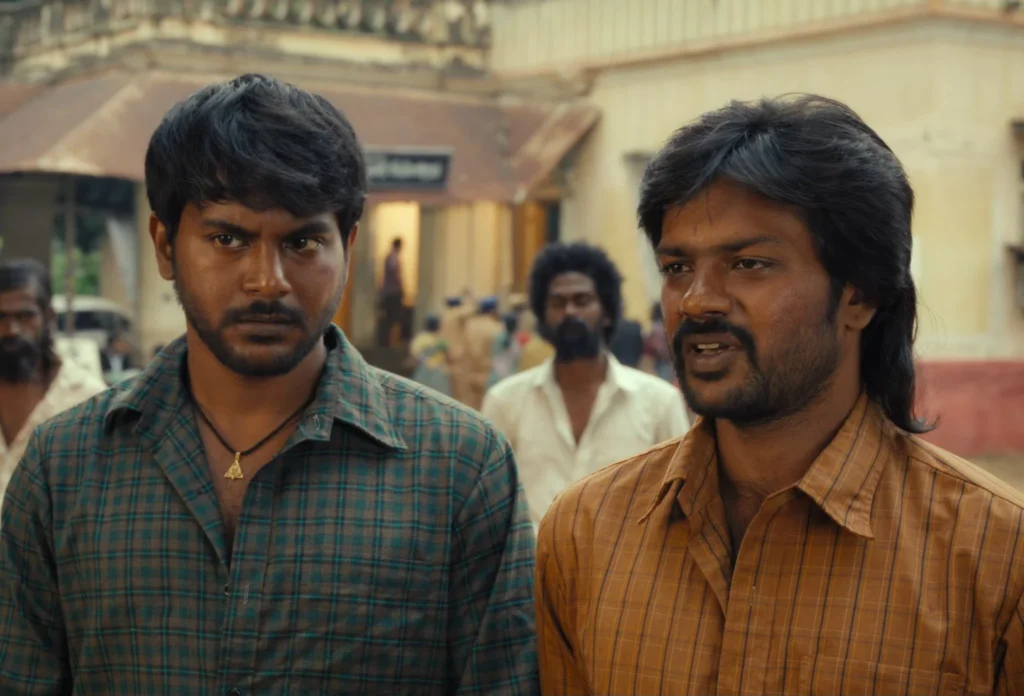
Karthik Subbaraj starts with those smaller divisions. When Subbu befriends Karthi (Rishikanth), a young boy from a lower-caste, lower-class family, the film looks ready to walk a familiar road. This is still a Subbaraj film, though, and it is not heading towards a hackneyed triangle, least of all one built around a woman named Dorothy (Keerthy Suresh).
Dorothy arrives in the second act as Subbu’s sister-in-law, and that is the film’s biggest leap of faith. Why would this dainty, graceful Malayali woman marry into a crude, violent household near Madurai? She is clearly a catalyst. The marriage itself never quite convinces, and Subbaraj doesn’t care that it doesn’t. What does convince is the bond she forms with Subbu. Just as the film seems ready to collapse into romance-as-usual, Subbaraj yanks the floor away.
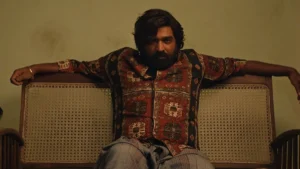
After a run of tragedies involving the women in his family, Subbu comes of age in the least expected way: she is a woman trapped in a man’s body. The question is no longer whether Subbu will find acceptance. It is how a toxic family and a straight best friend will live with the truth.

It is 1995, in a largely lawless pocket near Madurai, where the police are ornamental. In this world, honour sits above everything. Subbu’s father, Whistle Veeraiya (Muthukumar), is a moneylender written in pitch black, complete with an unnerving habit of whistling. The man would not look out of place as the engine of a Nagraj Manjule film. Veeraiya’s children are raised to become goons, and education barely exists, except in a delightful early stretch carried by superb child actors.
Be it as children or as adults, Subbu and Karthi’s friendship feels fresh for its time. We have seen plenty of films where a woman, a misunderstanding, greed or ideology comes between two thick bros. Not in Dorothy. Subbaraj employs recurring motifs (porotta and mutton, a French kiss from the Bollywood film Saagar, the refrain “Men must not cry,” and so on) to stitch those threads together without spelling out what they mean.
The shift that occurs with the big twist is still pretty jarring, and not because Subbu drops a bomb. It is because the change arrives too fast. Tender passages between Subbu and Dorothy are either cut in too early or saved for later flashbacks, so the new mannerisms land like thunder. The film only really hits home once you catch up with Subbu’s trauma. She has not changed on a whim. She has always been a woman on the inside. This is neither a costume put on for revenge nor an act of rebellion.
A brief altercation with a trans woman is clearly well-intentioned to build an arc. It still does not evoke the response Subbaraj seems to want. Her return later, however, is timed much better.
The final act is Dorothy‘s most peaceful stretch. Subbu is on a truck through Maharashtra with Karthi, who now has to see his closest friend in an entirely different light. Subbaraj treats Karthi’s dilemma with unusual care. You feel for Subbu. You also feel for Karthi, who suddenly has a great deal to process. The ending can give you the ick or make you burst with joy. It depends on whether you buy the evolution of these people, and of the space between them.
Subbaraj’s biggest dare is appetite. He wants Dorothy to be a classic Subbaraj swing, complete with grand dramatic highs. The film does not care whether any of it lines up with your ideas of friendship, love, family, gender or sexuality. Why should it? Its own characters are struggling to line up with those ideas too.
ALSO READ: ‘Sabar Bonda’ review – A loving tribute to gay life in India
As a result, Dorothy never functions as a simple emancipation exercise. It does not celebrate the third gender so much as it retains a popular, straight gaze on the community. The film keeps its trans characters within their own circles, and their blessings are even considered auspicious. The distance feels true to 1995 Madurai. Viewers looking for a more integrated portrait may not appreciate the choice. I did not mind it. Then again, someone like me is hardly the right person to weigh centuries of oppression.
Subbaraj also plays beautifully with music this time. Maestro Ilaiyaraaja blesses the frames with his unmistakable sound, giving greater authenticity to Dorothy’s retro setting. DOP Tirru, too, has great fun with the rustic backdrop: monochrome flashbacks, a faint sepia wash, an elaborate long take that stays quiet instead of showing off. The editing by Ganesh Siva gets sharper as the story heads towards its finale, although the early portions feel overextended and take too long to let the developments simmer.
It helps that Sananth and Rishikanth arrive without star armour. Both are relative newcomers, and both are excellent in roles that keep changing shape under them. Interestingly, they are named after the filmmaker himself. Keerthy Suresh is ethereal in a pivotal part that asks for less than she eventually gives it. Muthukumar, as Whistle Veeraiya, spills rage until the character becomes one of the more sickening villains in recent Indian cinema.
All of this feeds into what makes Dorothy such a distinct Subbaraj film. This is his bravest film. The directorial craft on display, for most of its runtime, is extraordinary. The world-building is immersive, and the screenplay is audacious even when it takes convenient turns. Whether conservatives, liberals or nitpickers approve is the least of its concerns. Perhaps that is the real point of a filmmaker who has reached the stage where he has to explain himself to no one but himself.
VERDICT: ★★★★
Read the reviews of Dorothy by the Film Critics Guild HERE.