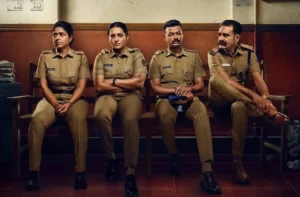
In recent years, Malayalam cinema has produced several police stories that look beyond their heroic surface. From the era of Suresh Gopi’s Bharath Chandran IPS, the template has shifted to more grounded portrayals, with filmmakers exploring the brutal, vulnerable, and helpless sides of police officers. Ratheena’s Paathirathri belongs to this newer breed, focusing equally on the personal lives of its cops. Set in Anakkara, a village in Kerala’s Idukki district, the film revolves around an unforeseen event that takes place at midnight.
Sub-Inspector Jancy Kurian (Navya Nair) and her subordinate Hareesh (Soubin Shahir) are not the friendliest of colleagues. Both, going through troubled marriages in their respective lives, have a lot to deal with. Besides that, their cop duties give them no rest. One night, the duo set out for their routine night patrolling, and something unforeseen happens, which turns their lives around. Now it’s time for Jancy and Hareesh to park their differences to save their lives, careers, and perhaps unearth a deadly culprit in the picture.
The strength of Paathirathri lies in the evolution of its protagonists. What begins as a cold, professional relationship gradually transforms as adversity brings Jancy and Hareesh closer. In what must be the film’s best scene, Jancy repeatedly calls Hareesh on the phone when the latter is winding his day up with a bottle of liquor. Perplexed and helpless, the woman shows up at his home, semi-drenched in rain, only so she could get consoled. It took me back to Soubin’s own breakdown in Kumbalangi Nights.
The unlikely bond that develops between the two made me think of how adulthood and its day-to-day grind often render many of us friendless. A good number of those who treat their spouses as friends tend to get disappointed or, worse, betrayed.
However, Paathirathri explores friendship only in passing. The screenplay attempts to juggle too many ideas, which becomes its biggest weakness. Ratheena’s film deals with three distinct kinds of marital discord. In one scene, Jancy is advised by a supposed mental health professional to have a child to fix her marital problems. Her logical retort ends the conversation, but later we see Hareesh struggling through a custody battle with his ex-wife.
Ratheena also wants her film to function as a police procedural. A Mardaani-like chase sequence is inserted to establish Jancy’s physical agility, although it serves no purpose in the plot. The film presents an array of cops — the good, the bad, and the morally ambiguous. At one point, a female officer yells at her superior about an unrepaired bathroom. Yet, Paathirathri is not exactly a slice-of-life drama about the everyday lives of police officers. Even as professionals, Jancy and Hareesh come across as neither particularly efficient nor entirely ethical in handling the crisis, despite being good people at heart.
The film also tries to address a multitude of social issues, big and small — investigative journalism, adultery, interfaith love, drug abuse, mental health struggles, and land stewardship. It even flirts with philosophy, inserting lines that sound lifted from literary prose. Why? This way, whenever the focus drifts to these side threads, the central narrative weakens. It also feels as though the writer (Shaji Maraad) knows the primary villain is an underwhelming entity, so a final twist is introduced to compensate. The development is not illogical, but never as surprising as the makers believe it is.
In a film of this genre, a disturbing incident should hit with force, as it did in Drishyam. In Paathirathri, the key event unfolds too casually, failing to convey its full emotional impact, even with the actors’ best efforts. Many plot points, therefore, feel passive and diluted.

Navya and Soubin are both strong performers, and they make it very easy for us to root for the leads. With well-defined arcs, the duo drives our interest levels in the film. Navya, in her second innings, has become a pro at projecting tension and confusion on screen. She makes Jancy a believable, vulnerable woman caught in the crossfire of duty and despair. Soubin is equally impressive as the embittered cop, playing his selfish streak with conviction. Together, they make for a compelling pair.
The supporting cast does what is required. Malayalam cinema’s beloved comedians Harishree Ashokan and Indrans are good in serious roles. Ashokan, especially, feels fresh attempting new genres. Ann Augustine and Sunny Wayne have substantial roles on paper, though their characters Yasmin and Ansaar are not particularly convincing. Athmiya Rajan gets a far better deal, and she delivers an excellent performance.
Pooja Mohanraj is delightful in a brief appearance, while Shabareesh Varma’s Felix is melodramatic in spirit, and his passive-aggressive ways are frustrating. Why didn’t he simply have a word with his busy wife instead of spouting philosophy and those thumbs-up emojis on WhatsApp? Achyuth Kumar appears in a standard police role, which he breezes through comfortably.
Ratheena’s screenplay has several inconsistencies, and her direction mirrors the same flaws. Strangely enough, she fills the narrative with too many songs (by Jakes Bejoy), which feel inorganic in a thriller film. The original score, however, is stellar and adds excitement to the suspenseful bits. The filmmaker also has a tendency to over-explain key events, which gets grating in the flashback portions. In 2025, we do not need so much exposition of what actually happened. While it’s primarily a writing anomaly, the track around a hallucinating youngster is too ridiculous to exist in a film like Paathirathri.
Still, Ratheena ensures the film never becomes dull. The slow-burn rhythm works well in shaping its characters, particularly the leads. Paathirathri is an engaging watch that could have been truly outstanding with tighter writing and more focus on its central narrative. In her next outing, one hopes Ratheena retains her passion for the craft but with greater trust in her audience.
Rating: ★★★