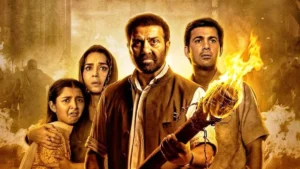
Vishal Bhardwaj’s cinematic universes can be wildly imaginative. They are the kind where two warring sisters, desperate to escape each other’s sight, end up marrying two brothers by accident. Historically, however, the Indian film industry’s version of audacity usually involves a hero incinerating a factory and sauntering away in slow motion while digital fumes billow behind him. This “mass” template is now more common than a childbirth scene, or a Muslim protagonist shown as an ordinary office worker instead of a kohl-eyed gangster. Trying to join both aspects of their respective universes, O’Romeo uses Bhardwaj’s brand of weirdness and masala movie flamboyance to create a confused mixture with no emotion and limited punch.
Set in 1995 Bombay, still reeling from the Babri Masjid aftermath, the film posits an era where the underworld is suddenly fractured by religious identity. Navigating this landscape is Ustra, a premier hitman (Shahid Kapoor), who is coddled by his grandmother and a loyal entourage. He frequently collaborates with IB officer Khan (Nana Patekar), while also sleeping with a new woman every day and dancing as if possessed by Michael Jackson’s spirit. It is a good and financially stable life, powered by Ustra’s superhuman talent for dodging bullets and killing like a maniac.
To establish his dominance, the narrative opens with a derivative brawl inside a cinema hall. This “wannabe-Animal” sequence is almost parodic, as goons patiently wait their turn in a unique cinematic quota system to be dispatched by the lone assassin. It is here that the film begins to feel significantly longer than its actual runtime; it is not necessarily boring, but it is indulgent, resembling a student who asks for extra answer sheets just to reiterate irrelevant details.
Once the hero gets his promised introduction, O’Romeo brings in Afsha (Triptii Dimri), who is far more interesting and the true fulcrum of the plot. A woman out to avenge four powerful men in the system, she requests that Ustra take up her contract, but he laughs it off and declines. Afsha does not give up. She tries, fails, and occasionally lifts the film from slipping into an abyss of familiar images.

Afsha is also where Bhardwaj’s screenplay fumbles. The filmmaker, or perhaps the financiers, clearly knows the current trends, so O’Romeo spends a disproportionate amount of time hovering around Ustra. To set the context for Afsha’s revenge, it shows a brief montage that is over before you can peek at your phone for a few seconds. She has a passionate and short-lived love story to tell us. Ustra has none, except his fleeting dances with a bar girl (Disha Patani appears in a couple of peppy item numbers).
Afsha has a musical legacy that could have been developed to attach her to another key character. Instead, Bhardwaj gives us frame after frame of Kapoor in a futile attempt to graduate him into a ‘Romeo’, which he never fully becomes.
The result of this treatment is that O’Romeo has all the ingredients, but the mixture is not always tasty. It has a coherent story, yet no potent emotions that tear your heart apart. Even an otherwise bizarre Tere Ishk Mein had a couple of those. The action sequences score a two on ten on adrenaline levels. They are just there, something we watch while munching popcorn, never once flinching.
ALSO READ: ‘Khufiya’ review – About moms who love hard and spy harder
The logistical choices are equally baffling, such as Jalal (Avinash Tiwary) appearing mid-film in Spain to play matador to a raging bull. If the objective was scale or exotica, it feels dated in an era where audiences are no longer mesmerized by European backdrops for the sake of it. What it then does with its long list of established actors, hired either for nostalgia or relevance, is curious. There is Aroona Irani, the prima donna of Bollywood item songs, as a mentor to a house full of dancing girls. She even gets to shake a leg in the bouncy Paan Ki Dukaan, and we do not look at anyone else.
Bhardwaj twists Farida Jalal’s screen image into that of a cuss-mouthed granny who sleeps right outside while her grandson has rather loud ‘fun’ with not one, but two sex workers. Tamannaah and Vikrant Massey play roles that are key to the plot but are seldom interesting, purely because of the writing, or the lack of it.
Bhardwaj’s imagination of Afsha is that of one of those virginal heroines from the ’80s potboilers. She is someone who sits in a canoe and sings, “Sau saal se soye na the, tere hi liye to…” So, it feels violating when our ruffian hero asks threateningly, “Soyegi mere saath?” As for Ustra, now tired of bedding strange women, he suddenly wants this normalcy. He is one step away from telling her, “Afsha, dupatta theek karo.”

By the third act, an edgy Inspector Pathare (a brilliant Rahul Deshpande) and a capable Afsha nearly swallow the leading man (and everybody else) with their original characterization. One begins to wish the film would pivot entirely into a feminist thriller, abandoning its eccentric male lead for a narrative titled O’Juliet. And needless to add, Triptii Dimri is fantastic as Afsha. Avinash Tiwary, too, is menacing as the elusive villain.
This is not to say Shahid Kapoor is not good in O’Romeo. He is mind-blowing, if I must use the adjective. But this is not the screenplay where he can justify those pelvic thrusts almost as much as Madhuri Dixit in “Dhak Dhak”. When a character is not fully alive on paper, no amount of effort by the actor can create the impact it seeks.
While the music and Gulzar’s clever lyrics provide a much-needed grace note, a romance that fails to moisten the eyes is ultimately a failure of the genre; so is mindless violence minus the blood rush. In attempting to inject his signature sass into a generic template, Bhardwaj has delivered a confused affair. You do not particularly mind it while the show is on, only to find the entire experience evaporated by the time you reach the cinema’s exit gate. Go figure.
VERDICT: ★★ 1/2