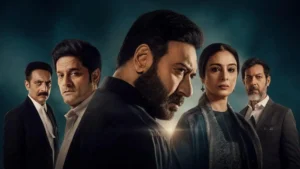
India and Pakistan are neighbours, and much like how things work in our colonies and housing complexes, we are always more curious about what happens next door. Our fascination with a distant relative doing well is not very different from the interest many Indians showed in Zohran Mamdani’s victory in New York. Dhurandhar taps into this instinct, which makes its obsession with Pakistani politics immediately relatable.
Pakistan’s activities, especially the extremist ones, have historically brushed directly against India. Aditya Dhar uses these shared touchpoints of language, culture, art, and sport to craft a story that feels rooted in reality yet remains thoroughly cinematic and engaging.
Amusingly, Dhurandhar is not a typically triggering film by commercial Bollywood standards. While a couple of overly violent stretches may warrant closing one’s eyes, baiting is minimal, such as one instance where a terrorist refers to Ajit Sanyal’s (Madhavan) religion. Dhar’s astute decision to split the narrative into distinct chapters with intertitles provides a crucial structure for the nearly 212-minute runtime. This compact, superbly edited (Shivkumar V. Panicker) flow of events makes it arguably the most watchable ‘long’ film in recent memory.
Dhurandhar begins in India around the 1999 Kandahar plane hijack and moves through the 2001 Indian Parliament attack. India’s intelligence agencies then devise an infiltration plan to enter Pakistan’s closely linked network of politics and organised crime. This is where Hamza Ali Mazari (Ranveer Singh) comes in. He is tasked with entering the circle of Rehman Dakait (Akshaye Khanna), a powerful gangster and political aspirant who would eventually launch the People’s Aman Committee in Karachi’s Lyari.
A significant portion of Dhurandhar focuses on Hamza winning Rehman’s trust. Dhar places the Azad Balochistan movement parallel to India’s political view of Pakistan. In one telling sequence, water in a school in a Baloch province is poisoned by ISIS, killing children. Minutes later, Rehman (a Baloch himself) inaugurates a water project in a posh Karachi neighbourhood. This narrative choice equates the community’s long-standing anger over negligence with India’s fury over infiltration and interference. Now, this is a perspective the audience easily accepts thanks to the earnest pragmatism Ranveer Singh injects into his Baloch identity.

Despite that, Dhurandhar never becomes the superstar vehicle we fear it would. The only punchy line our leading man gets is the one referencing Sunny Deol film titles: “Ghayal hoon, isliye ghatak hoon,” which does not make much sense anyway. For sheer theatricality, we must wait for SP Chaudhary Aslam (Sanjay Dutt) to enter the scene. Described as the love child of a devil and a Djinn, the man receives a spectacular introduction, instantly establishing him as a violent, foul-mouthed force hell-bent on destroying Rehman’s empire.
Dhurandhar’s historical fiction template is a content goldmine for commercial cinema in today’s political scenario. The horror of 26/11 is etched into India’s collective memory, not as war or disaster but as something brutally deliberate. In one of the film’s strongest moments, Hamza watches the live coverage while those around him celebrate. He stands frozen, sweat rolling down his face, reflecting the instinctive anguish of someone raised on’Jana Gana Mana’ and the pride of the Indian tri-colour.
That said, Dhar steers clear of polemics and keeps Hamza’s politics intentionally ambiguous. His ongoing interactions with figures like Rehman, Uzair Baloch, Ilyas Kashmiri, and local arms dealers ensure that the threat to India never fades. Dhurandhar‘s strength lies in allowing him to operate in this grey zone without overexplaining his psychology, except in a standout moment with Mohammad Aalam, played by the unrecognisably brilliant Gaurav Gera. To quote something I overheard from a (positively) baffled viewer: “Is that Nandu from Jassi? Man, that’s insane.”
Speaking of Gera, Mukesh Chhabra hits another casting high note with Rakesh Bedi (who suspiciously resembles Tiku Talsania in that moustached look), as the manipulative Jameel Jamali, who shines from the first scene to the last. While a light hangover of Bedi’s comedic tendencies is felt, it works in favour of making the character quirky. Danish Pandor gets a lot of screen time essaying Rehman’s brother Uzair, and he is pitch-perfect. R. Madhavan, too, gets a mighty transformation in a role inspired by bureaucrat Ajit Doval. Preetisheel Singh Dsouza, the character and prosthetic designer, does a superb job with their characteristic looks, far removed from their off-screen personas.
Coming to the key cast, it’s a given that Ranveer Singh would deliver. The actor’s commitment to an arduous film like Dhurandhar is a testament to his performance, despite the improbably excessive hair on his head and face. What surprises is the re-emergence of the ‘quiet’ Ranveer, a version we loved in Lootera. The film gives him very few lines to work with, and Hamza spills explosive ideas and truths only when prompted. The film’s reliance on silent strategies and mind games contrasts nicely with the flamboyant Ranveer Singh we know, cementing Hamza as one of his finest performances to date.
ALSO READ: ‘Khufiya’ review – About moms who love hard and spy harder
Akshaye Khanna sparkles as Rehman. Even when defeated, his villainy is such that we never feel like he’s going to lose the game. Khanna’s cool demeanour and knowing smile are perfectly suited for Rehman’s menace, which is evident the moment he is seated on his “takht.” If Sanjay Dutt excels in something that comes to him like breathing, Arjun Rampal’s classic underplaying is an asset to making Major Iqbal a vile figure. Sara Arjun is a natural in her adult debut as Jamali’s rebellious daughter who would rather date a daredevil than marry a “burger bachcha”. In smaller roles, Saumya Tandon and Manav Gohil put in a neat show.
In Dhurandhar, if Dhar’s systematized screenplay is good enough to watch the film as a taut crime series with a topsy-turvy story, the film gets maximum support from an unexpectedly glowing soundtrack. The retro recreations are infectious, whereas the original songs are in sync with the tricky era, genre and place.
The cinematography (Vikash Nowlakha), sound design (Bishwadeep Chatterjee) and re-recording mix (Justin Jose K) also stand out, inviting clarity to a chaotic film that’s dense with a variety of images and sounds. The action choreography (Aejaz Gulab, Sea Young Oh, Yannick Ben, Ramazan Bulut) is imaginative despite the heavy gore, adding thrill to the proceedings not just for genre loyalists but also for general audiences. The production design by Saini S. Johray is equally noteworthy as it smoothly tracks the film’s visual evolution across more than a decade.
Dhurandhar closes with India’s strategy and Hamza’s execution of it deep inside enemy territory. While not visibly jingoistic, Dhar does not hesitate to quietly slip in a pro-Right Wing message defending demonetization. He also takes clear digs at the indifferent governance, particularly in Uttar Pradesh. Should a creator make such polarizing points, even subtly? Maybe not, but this deliberate stance still makes us curious to see how he plans to complete the arc in the final installment.
Among Dhurandhar‘s limitations, a civilian perspective on either side of the border is absent, as well as the missing viewpoint of Pakistani intelligence. It makes the narrative slightly unidimensional. Even so, it does not diminish the curious and textured world Dhar creates. It often feels like a mini–Vishal Bhardwaj universe inhabited by characters with the cinematic DNA of those in Ram Gopal Varma’s classics. Its notable exposition and meticulous detailing may contribute to the film’s considerable length. Still, for those of us who binge an entire season of a series in one sitting, it is an effortless ride.
Rating: ★★★★
For more reviews by the Film Critics Guild, click here.