The startling side of Sidhartha Siva’s Varthamanam is that, for most of its runtime, it does not feel like fiction. What the film attempts to portray is a series of stark realities that we see around us, watch on television, read in newspapers, and follow on social media, which makes it a hugely relevant film in contemporary India. But films often sink under the weight of their ambition. Varthamanam, although well-intentioned, is a screenwriting and storytelling misfire.
Set in a campus modelled on New Delhi’s Jawaharlal Nehru University, the film opens around the time Faiza (Parvathy Thiruvothu) joins as a junior research fellow. High on protests and political activism, the student communities on campus operate on various philosophies. Be it communists, Dalit activists, centrists, or religious extremists, we get a slice of each in Siva’s film. Soon after joining the course, Faiza is drawn into a group of like-minded friends who may not exactly share her political leanings but are staunch critics of the fascist narrative in present-day Indian society. Faiza is also constantly piqued by a Hindu extremist group, whereas a pro-Muslim group (which operates on similar values as the former) wants her to attend religious conventions so she feels safe in an alien city.
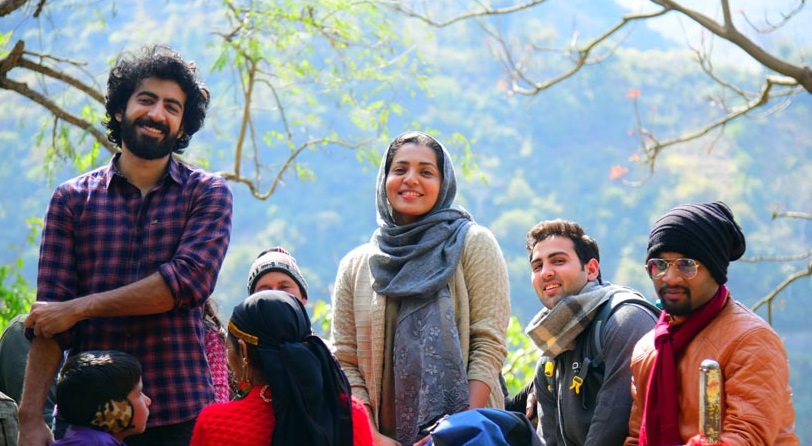
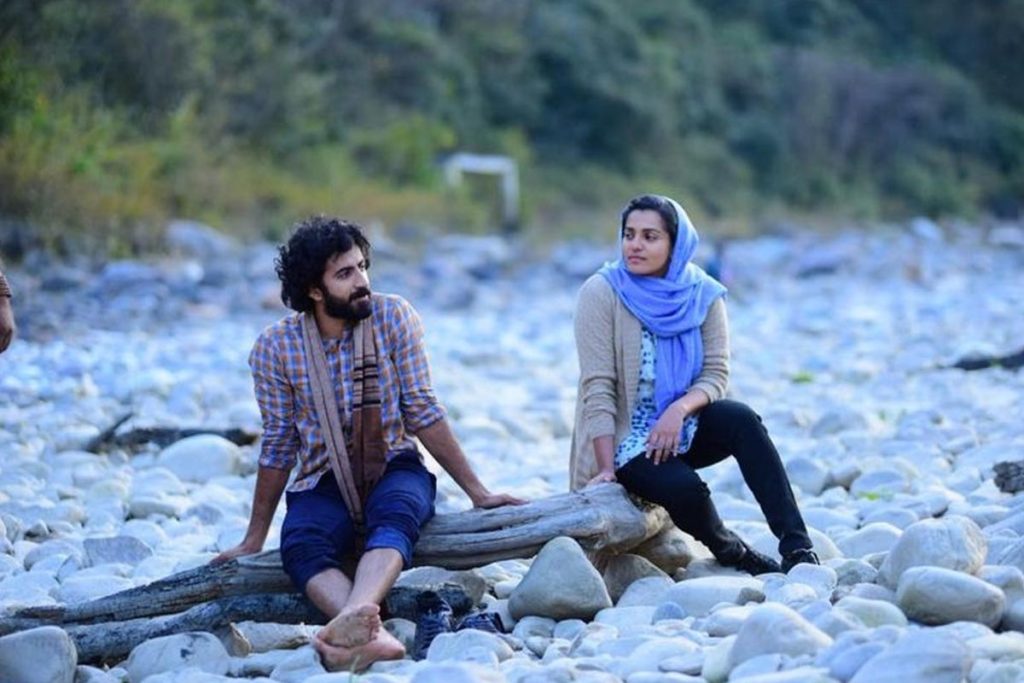
From a distance, Varthamanam presents a fascinating matrix. It is not necessarily a film about full-fledged college politics. There are no elections, and we see no major campus brawls. Ideological differences are acknowledged quietly, with tension brimming all around, and common causes uniting students from dissimilar backgrounds. If Amal (Roshan Mathew) is a fierce Communist, Faiza believes in Nehruvian politics. They boldly raise their voices when their Dalit friends from Andhra Pradesh and Uttarakhand face discrimination and violence. Making their group diverse (and somewhat fun) are a couple of other Malayalis and a Rajput lad from Rajasthan who has rejected upper-caste privileges.
If there is anything that the film (written by politician Aryadan Shoukath) gets right, it is the intent to make a statement against fascism. However, Varthamanam becomes so exhausted in this process that it fails to draw definitive character arcs, interpersonal relationships, or a coherent narrative structure to keep us involved. The pacing is utterly uneven. At times, unimportant stretches are given excessive screen time, whereas crucial junctures in the screenplay are wrapped up within minutes.
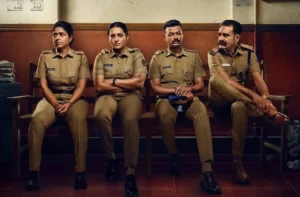
If Faiza’s side-track with her local guardian is meant to be comic relief, neither are the scenes funny nor do they add value to the central plot. As a visual spectacle, I quite enjoyed the friends’ journey to Uttarakhand (to attend a wedding), but this longish episode does not serve as a convincing buildup to the twist that emerges later. On the contrary, powerful scenes such as Faiza’s outburst at a fascist TV reporter are dismissed in a matter of seconds. We never get a glimpse of the allegedly anti-national play her group is rehearsing. Faiza’s interrogation scenes are too black-and-white to make much sense, even if we accept the reality that the police force is an oppressive body. Another crucial aspect the film bizarrely skips is social media, which is where the majority of repressive, brainwashed elements thrive. It only fleetingly mentions Faiza’s progressive posts on Facebook, and that’s about it.
ALSO READ: Kochavva Paulo Ayyappa Coelho (KPAC) review – For dreamers, seekers, and believers
Faiza and her friends’ equation with Professor Satheesh Pothuval (Siddique, dependable as ever) is also not explored to its full potential. The only scene that makes a strong impact is one where Pothuval faces threats from certain right-wing bigwigs. I could also empathize with the bond between Faiza and her grandfather, a freedom fighter (MK Raina, compelling). Otherwise, the characters, their emotions, and relationships fail to evolve in Varthamanam.
The otherwise dependable Parvathy Thiruvothu is overly staid as Faiza. It feels as if the actor wanted to air her opinions at various decibel levels, which is fair if we view her as an individual outside the film setup, but I could not empathize with Faiza at any point. The same applies to Roshan Mathew’s Amal, who is catalytic at best. The writer does not seem interested in giving his part any real depth or layers worth pondering.
At the risk of sounding centrist, Sidhartha Siva’s film refuses to offer perspective. I do not mean to say that a war of words between opposing parties would have made Varthamanam more exciting. Yet, some background or a series of visual cues to establish the antagonists and their conditioned minds would have been more enlightening than the film’s one-sided and overly expository writing. By the time Siva ends the film with an over-the-top theatre performance, I could only lament the massive opportunity that was lost, despite a dependable cast and crew at his disposal.
Rating: ★★