Indian folklore is full of mythical beings. Some shapeshift, some have terrifying fangs, some are into blood-sucking, and almost all of them fly. In some mythology-linked stories, these beings that once appeared in novels and comics are now popular again as superheroes, following in the footsteps of their Western counterparts. In Aditya Sarpotdar’s Thamma, the creature community in focus is of the vetaals who reside deep within the jungles. They have a large army of both good and evil individuals who are sworn to either protect or destroy the human race.
Thamma is no Kantara, and as the template goes for the Maddock Horror Comedy Universe, a common man must enter the maze with loads of modern-day humour. An unassuming media reporter, Alok Goel (Ayushmann Khurrana), is the pawn this time, and he predictably falls for a mystical vetaal woman, Tadaka (Rashmika Mandanna), who saves his life.
Before we know it, Thamma brings Tadaka to the city, where she’s rechristened with a city-friendly name, Taarika (by Alok, of course). This stretch is when the writers (Niren Bhatt, Suresh Mathew and Arun Falara) pack the narrative with maximum humour and dollops of horror. Paresh Rawal, who plays Alok’s ever-doubting father, gets the best dialogues and is the film’s most interesting character. It is surprising, considering Thamma has many creatures, supervillains, et al.
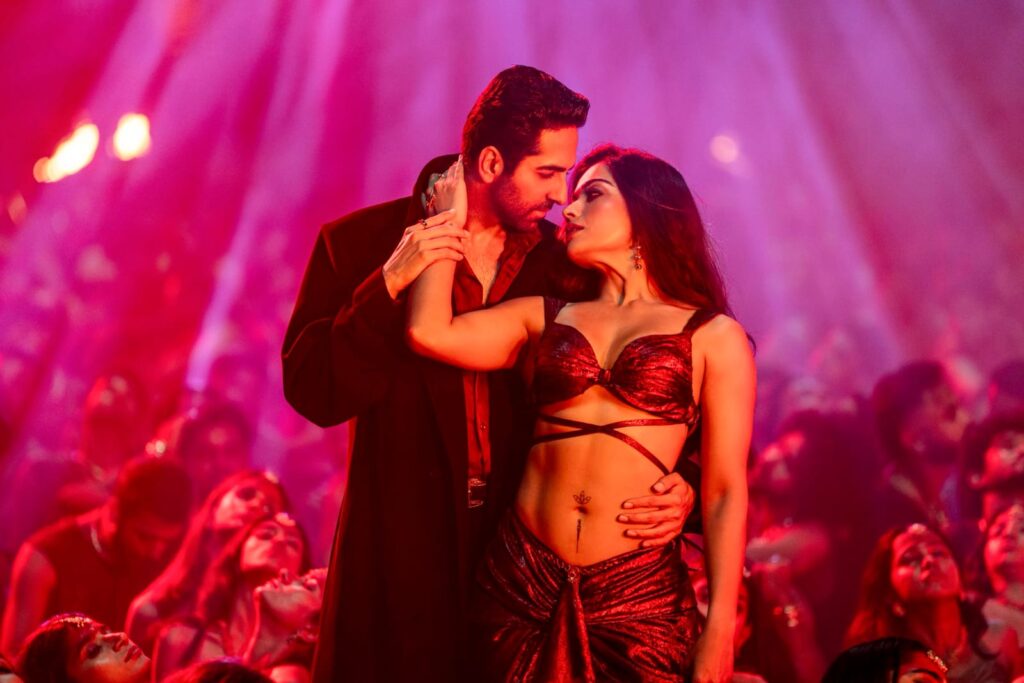
Soon, the film takes us from a regular club to a not-so-regular one, where Malaika Arora and Nora Fatehi, respectively, appear in a couple of decent item numbers (Sachin-Jigar’s background score is mind-blowing). We encounter the predictable Jana (Abhishek Banerjee) crossover, leading to a monumental inter-MHCU universe fight over “blood” to satiate the hunger for full and ultimate power. It’s all mid, and the film never reaches its potential even though the proceedings remain engaging.
Thamma treats the romance between Alok and Tadaka a bit too casually. We can see the actors try really (read it in upper case) hard, but the material simply won’t raise goosebumps. We’d rather watch the suspicious father and the unassuming mother (Geeta Aggarwal Sharma) pry into their activities – simply because they are more interestingly written.
Sarpotdar’s film soon does the expected – the leading man undergoes a change, the couple returns to the jungles, and we reach the penultimate face-off. The prime antagonist in Thamma is the English-loving Yakshasan, whom Nawazuddin Siddiqui plays with a lot of attitude. It isn’t really an exciting villain on paper, in the sense that you don’t fear his menace. The comical streaks of Yakshasan naturally overshadow his villainy. Between him and Alok, the film becomes a bit too light for the seriousness it tends to pack within.
Ayushmann Khurrana enacts Alok as if his life depended on it (which is also the case in the film). The actor’s performance is such that he delivers an 11 when he was merely asked to give a 6 on 10. Rashmika Mandanna is rock-solid as she brings in the right kind of magic and fun into being a mythical creature. My only grouse is against her costume designer, who seems obsessed with low-cut blouses that wouldn’t let her catch a break from looking “hot.” Why?
ALSO READ: ‘Bhediya’ review – Amar Kaushik creates a riotous creature comedy
Speaking of the universe within Maddock, Thamma isn’t particularly different from some of its other origin stories, such as Bhediya. Where Sarpotdar’s film struggles is in finding a larger purpose. The idea that vetaals would rather protect the human race than suck their blood is too generic to have a far-reaching impact. In Stree, for instance, the women’s empowerment angle is so specific that you leave the hall with a profound afterthought, which is missing in Thamma.
While I wouldn’t really complain about Thamma’s technical prowess, I am unhappy that the makers increased Bhediya’s size to that of a micro-Godzilla. The VFX is largely neat, especially compared to the recent embarrassment that War 2 was. The musical numbers are aptly placed, although a proper romantic track could have elevated its central love story, which is projected as intense and two-sided.
Also, Sarpotdar’s film does not fully make sense in a period where Lokah Chapter 1: Chandra has already come and made waves, telling an identical story. Unlike that film, Thamma doesn’t give its heroine much agency, and it expects its weakling hero to be in charge. It is a set template, we know, but there are better ways to twist the setup, which we have seen (and loved) in Dominic Arun’s Malayalam film. By comparing similarly staged scenes in both films, where a gang of men chases the women, we can feel the difference in impact, especially when analyzing the leading men’s responses to the unfolding events.
This way, Thamma, while delivering decent entertainment as a big Diwali release, could have been far more effective if it didn’t have the burden of a certain universe. It’s one thing to belong to a community of supernatural creatures, and quite another to brand almost everything inside it.
Rating: ★★★