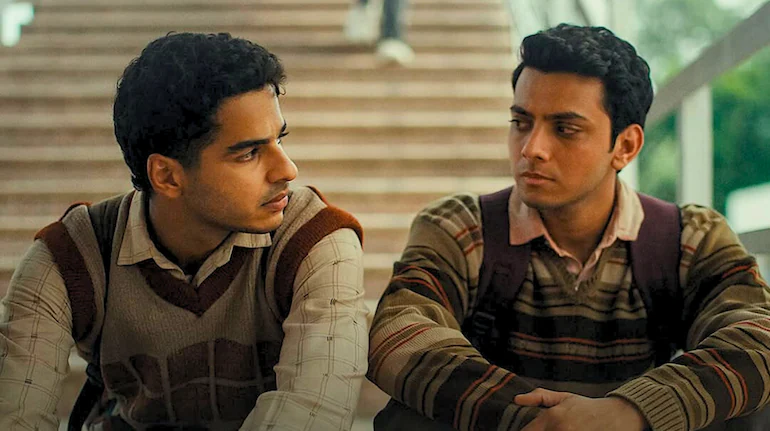
There’s a long stretch, or one that feels long, in Neeraj Ghaywan’s Homebound, where the leading men, Shoaib (Ishaan Khatter) and Chandan (Vishal Jethwa), aren’t talking to each other. They’ve fought; one hit the other over a competitive exam result where millions appeared for a thousand odd vacancies. Shoaib is Muslim, Chandan is Dalit, both from the working class with zero privileges. And once the men reunite, it is as if sunshine returns to the film. That is the power of screen friendships, I guess. Thanks to my newfound obsession with Sholay, I could not help drawing an unlikely parallel: this duo is the Jai–Veeru of our times.
That said, Ghaywan’s protagonists are not the badasses those iconic screen legends were. They have stomachs to feed, and discrimination is an everyday occurrence. I have sat at dinner tables where the upper caste would discuss Dalit issues, citing how “they” are just like “us,” with a few elite Muslims nodding in agreement. These are ears deaf to years of systemic bias and eyes blind to everything that happens beyond their circles. When Homebound speaks to that very same stratum of society, it’s clear why its storytelling is sometimes intentionally expository.
Neeraj Ghaywan’s screenplay (dialogues co-written by Varun Grover and Shreedhar Dubey) spells things out in words. The radicalized Hindu person’s urge to label a Muslim man as a Pakistani is shown. A casteist upper-caste man’s audacity to discomfort a young man for his Dalit identity is crystal clear. An incident at a school where parents disregard the Constitution of India lashes our faces. It is all laid out, spoken in words, and acted with the right expressions.
Homebound’s opening stretch revolves around a test that is crucial to both friends. Shoaib and Chandan’s bond is born in the village. It is the kind unadulterated by social media and its vile attempts to divide and rule. We know it would stand the test of time. The exam, like the COVID-19 pandemic, which surfaces later, is a systemic barrier that can ruin any friendship. Shoaib and Chandan are roughly the same age and equally marginalized. How can one be better than the other? In a minor complaint, I wondered if Ghaywan ever considered having them talk it out: “What if you were to get it, and not me?” Would they have dealt with life better then?
Homebound also insists on higher education. Through Chandan’s love interest, Sudha (Janhvi Kapoor), the film insists that he must become the change he wishes to see. The young girl, brought up in a concrete house by a government employee father, enjoys privileges Chandan lacks. If her family is proud Ambedkarites, many like Chandan and Shoaib would happily merge into the crowd with a make-believe upper-caste surname or a Hindu first name. For a worldview that often questions what is worse in India, being Dalit or being Muslim, Ghaywan’s film places you in a Catch-22.
Soon, without you asking for it, Homebound takes you to the traumatic COVID-19 lockdown phase. The trauma here is not about gyms shutting down or N95 masks ruining makeup. These are real pains – physical, psychological, and emotional. Ghaywan chronicles the horrifying exodus of migrant workers from industrialized areas to their hometowns in the heartlands, some on foot and at the cost of their lives. A hypothetical quip from a dinner table discussion I might have would be: “Did you say they used mobile phones? They should have called an Uber InterCity. My aunt travelled to Pune like that.” Never mind.
Through Ghaywan’s lens, the lockdown does not look dystopian. To Shoaib and Chandan, the “new normal” was an extension of their already difficult lives. They know they will not leave each other’s hands in adversity. Whether it is sharing the last drops from a pickle jar or a beating from a vile policeman. I smiled when Chandan joked that Shoaib could have taken the beatings on his butt cheeks, a natural shock absorber. Little did they know of the journey that lay ahead, just as we viewers did not. That’s when Homebound‘s original score begins to pound like our own heartbeat. The scorching sun seems to escape the screen to give us a sunburn.
At no point did I spot the central players as people who ever existed outside the setup we see in the film. For all the talk on nepotism, Ishaan Khatter’s hair-raising performance comes without an iota of inhibition. I spent some time trying to pick a standout moment by him – sometimes it’s a quiet glance and, at others, it’s a monologue. The fact is, there is no such single instance. Homebound is not that kind of a film, and Khatter’s approach does not feel like he was seeking applause. If this audacity comes from his lineage, I would say I like it very much.
ALSO READ: ‘Dhadak 2’ review – A film on casteism that confronts your denial
Vishal Jethwa, whom we haven’t seen as much of Khatter, is astonishing, and nothing like his earlier turns in Mardaani 2 or Salaam Venky. Despite the world Chandan belongs to, there’s a glint of innocence in his eyes. It is partly a hope that his efforts can change his family’s poor conditions. It is also an attraction for Sudha, which I am thankful Ghaywan didn’t neglect in a film as serious as Homebound. From the way I look at it, Jethwa gives Chandan love first, extends it to those around him, and fully inhabits the character. The effect is felt constantly, and my affection for him only grew with each passing minute.
In his screenplay, based on a New York Times essay by Basharat Peer, Neeraj Ghaywan gives his actors the kind of material they might get once or twice in their lifetime. It is not as though we lack cinema on caste issues. In most cases, they lack a lived-in perspective. They rile you up with facts, but the material itself is not angry. Ghaywan, I could feel, is an angry man. He will not let excuses come near him if they defend inequalities he feels strongly about. Homebound’s screenplay draws fuel from a filmmaker who knows his frames, his cuts, and his colours, but is also a storm within.
It is impossible to categorize Ghaywan’s artistry. Is Homebound one of those artsy films meant only for festival audiences? Shyam Benegal and Mrinal Sen have made films with a similar DNA, so what do we make of that? It is funded by one of Bollywood’s glitziest houses, Dharma Productions, though by the wing Somen Mishra looks after. Is it commercial enough for you? It stars social media pin-ups Ishaan Khatter and Janhvi Kapoor, who do not flaunt their chiselled bodies. Is face value still a thing in Bollywood? And yet, Homebound is not boring, even without songs. It makes you question your idea of patriotism and identity. You may not be one of those despicable folks at the dinner table, but you might still be someone who listens and does nothing.
Homebound is for you, for your silence, and for millions who must have a place in mainstream Indian cinema.
Rating: ★★★★★