Much like several of Hollywood’s musician biopics, India’s sports biographies are interchangeable. In the majority of these stories, poverty or sexism (if the subject is female) becomes the pertinent roadblock, and the protagonist emerges triumphant, with nationalistic elements thrown in for extra effect. Amole Gupte’s biopic on India’s ace badminton player Saina Nehwal is an exception, at least on the surface.
Saina has no poverty angle to be glorified beyond limits. There is a fleeting dialogue suggesting gender bias (with a bizarre Sachin Tendulkar comparison), but with no actual consequence. At various points, I wondered: what does Saina pique on? What is the conflict? Where are the mega roadblocks one assumes from a film of this genre? Mind you, I’m all for a docu-drama mode of storytelling, but this film doesn’t belong in that space. Gupte’s film features a robust theme song that echoes now and then, oddly in a male voice: “Main parinda kyun banoon, mujhe aasman banna hai…”
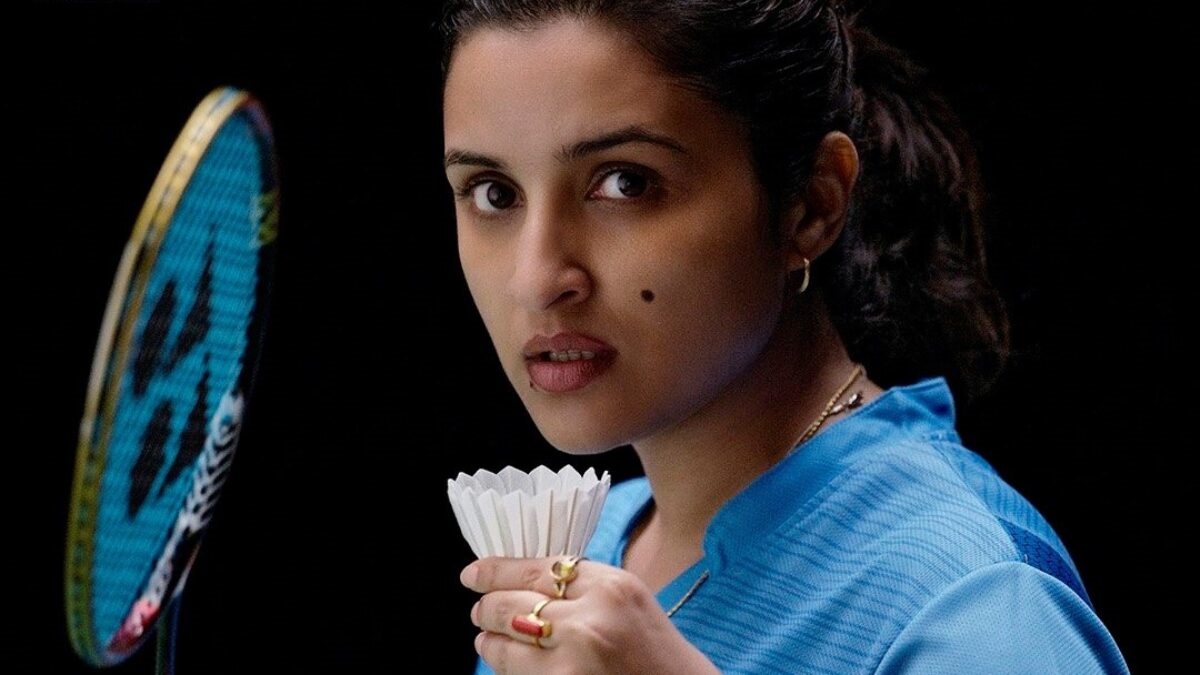
Parineeti Chopra is Saina. She carries off Saina Nehwal’s simplicity and daughter-of-the-soil vigour with grace. So much so that I didn’t mind the mole on her face, which showed up in all possible sizes. It’s equally a joy to watch Meghna Malik as her spirited mother, Usha Rani. Malik gets the tone of the film best. When she says, “Saina Nehwal hai tu,” we are reminded of what we’ve signed up to watch.
The film creates a tiff of sorts between Saina and her coach Rajan (a terrific Manav Kaul). Strangely enough, the angle proves counterproductive to the story, as it’s hard to detest the unemotional, disciplinarian coach even if the film wants us to. Key confrontations between Saina and Rajan are staged so weakly that the player comes off as immature and unrelenting, while the coach makes his motto clear with a simple statement about the hours he’s invested in her. I don’t remember the last time I found myself rooting for a hypothetical villain, and mind you, this isn’t Joker I’m reviewing.
The film’s temperament can be gauged from Saina Nehwal’s statement in the end credits: “We do not need Beti Bachao, Beti Padhao.” It has been smooth sailing for this gifted sportsperson. Supportive parents, financial stability, great coaches, a decent support system, and a good education, she never really had to face serious hurdles, at least as per the film. The only time Saina left me thunderstruck was when a bike hits Nehwal’s mother a few days before her first international championship. “This is the time for prayers,” says her father, to which she replies, “I am going to do just that,” and heads straight to practice.
Amole Gupte’s film is certainly watchable for the most part. It’s just that Saina lacks the much-needed magic. Perhaps the story in itself doesn’t contain the vibe to be placed on a showy, blockbuster canvas. The emotional wattage in the screenplay feels forced, and the music (by Amaal Malik) oscillates between generic motivation and excessive sentimentality. The love story is devoid of actual moments, even though the actors share decent chemistry. Saina does have a couple of friends, but the vanilla-flavoured ice cream she keeps binging on is a bigger emotional catalyst than they are.
For a film that operates on simplistic tropes galore, Saina entertains in parts but never truly involves us as a biopic chronicling Nehwal’s ascent to the top.
Rating: ★★ 1/2
Saina is now streaming on Amazon Prime Video.