Remakes of Indian films from one language to another are passé. Especially now, when access is cheap and curiosity is not: good subtitles, bad dubs, and a streaming menu that no longer pretends geography is destiny. Retelling a story in another industry is no longer an act of generosity. It is, more often, a confession. Mumbai still leans on that confession. Dated templates, a drought of original nerve, and the convenient fantasy that a southern hit plus two north-facing stars equals a new film.
The latest to be swept into that current are Pushkar and Gayatri, invited to rehash their own Vikram Vedha with “minor tweaks.” The surprise is not that they said yes. The surprise is that the film, at its best, behaves like it still has something to prove.
Set primarily in Lucknow, Kanpur and the adjoining moral weather, the film opens with top cop Vikram (Saif Ali Khan) orchestrating a mass encounter. People die. An unarmed man is among them. A false narrative is cooked so the paperwork can sleep at night. Forever clad in white, Vikram treats extra-judicial killing as civic hygiene: moss off the yard, rot off the street. He is in the profession out of passion, not accident. His father, also a cop, died prematurely in service.
The relationship does not sound warm. Vikram still wants the life, minus the abuse, perhaps. At home there is Priya (Radhika Apte, pleasant and unshowy), a lawyer who understands the man better than the film sometimes does. At work there is Abbas (Satyadeep Mishra), a cop of similar rank, and Deepak (Manuj Sharma, charming in a part that could have been wallpaper).
Then Vedha Betal arrives, and Vikram Vedha finally remembers why it exists.
Hrithik Roshan’s Vedha is the ghost the department has been netting for years with no luck. The first twenty minutes manufacture so much hoopla around this superhuman rumour that it is almost impossible not to hoot when the man finally walks in. He does not get dragged. He struts into a police station and surrenders. Roshan’s style quotient is, as always, on point. What baffles is the institutional limpness around him: a station full of armed men who cannot even delay a bail long enough to look like they tried. That helplessness is either a joke Vikram Vedha is in on, or a joke it does not notice. Either way, it lands.
Vedha is not here to confess. He is here to duel. “Ek kahaani sunayein?” he asks, and Vikram is pulled into the first of those story capsules that made the original hum. Family. Emotion. A sibling (Rohit Saraf, miscast, a grown-up echo of the child in Kaho Naa… Pyaar Hai) and a peculiar gesture of brotherly affection that is cute until you realise the film is only visiting the cliché, not rewriting it. Then Vedha asks the conscientious cop a logical question, and the floor drops. That drop still works. It is the film’s best trick: not twist for twist’s sake, but a moral trap sprung with a storyteller’s grin.
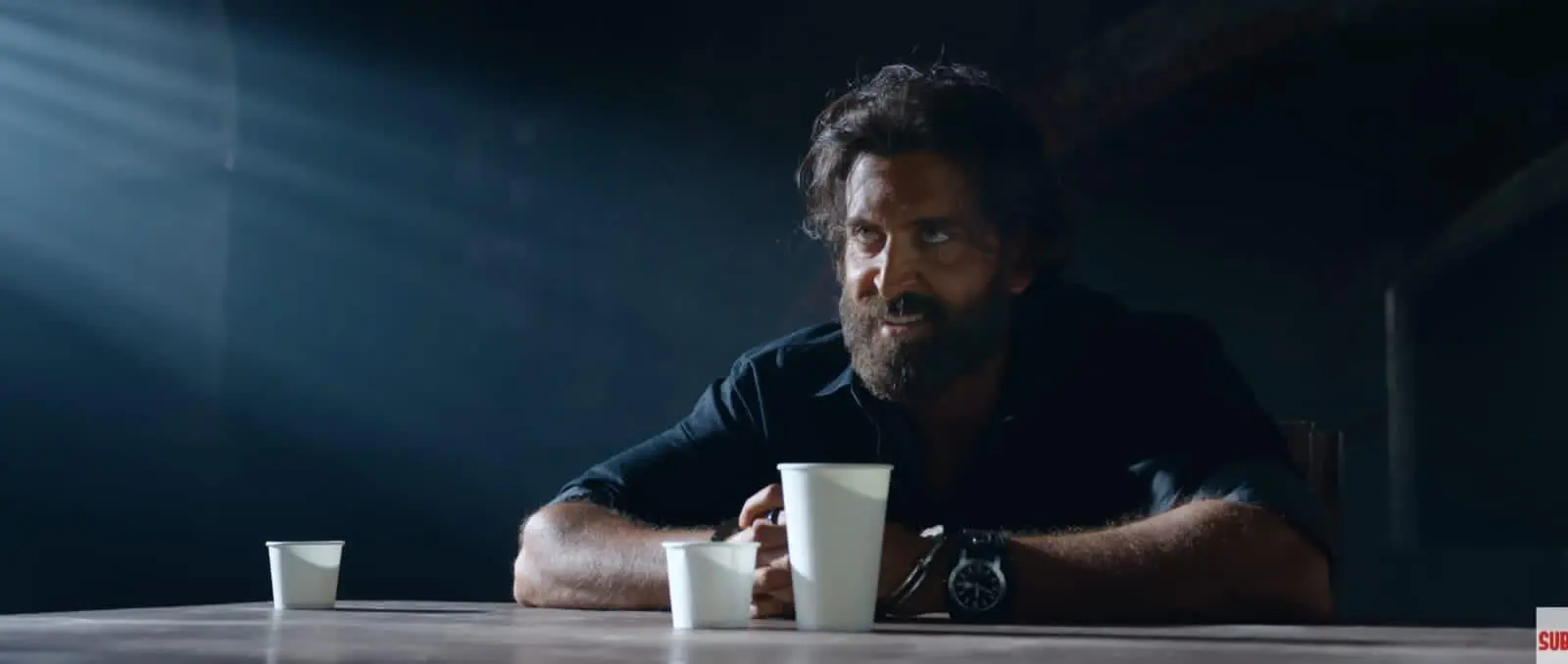
Pushkar and Gayatri keep the Vikram-versus-Vedha structure and, to their credit, do not sand it into a generic cat-and-mouse. The allegories are either spoon-fed (Vikram-Betal, announced like a chapter title) or too obvious (paper cups; the father’s bike with a missing part). What they do get right is texture. The original’s porotta and mutton kulambu become Lucknow’s kulcha nihari, not paneer butter masala served to soothe the easily offended. That choice sounds small. It is not. It tells you the remake is at least interested in place, not just in market.
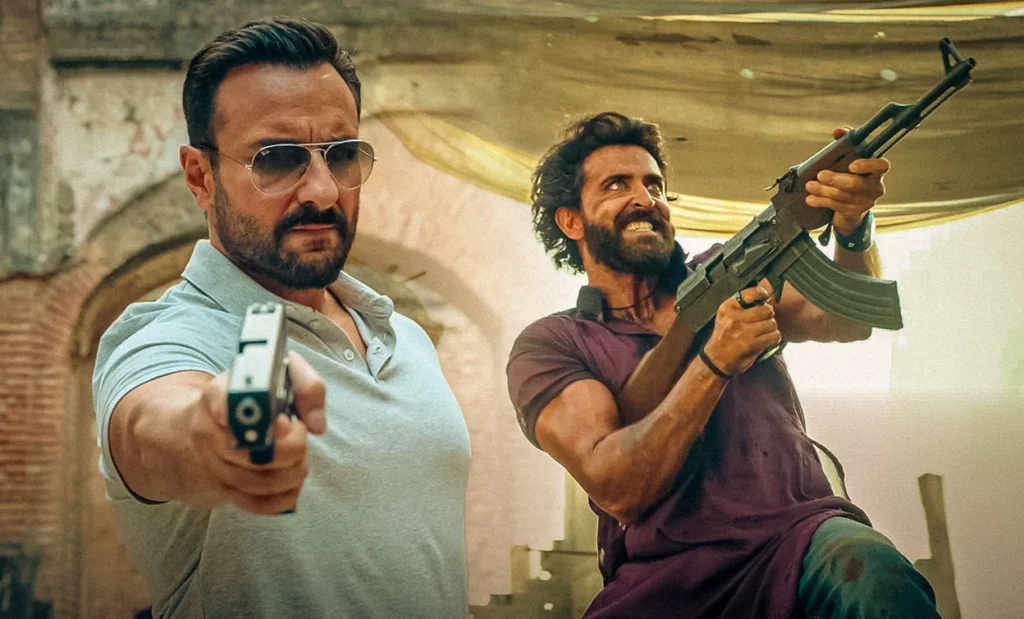
The second time around, they have built a massier machine. Voltage up, star wattage up. Roshan’s magnetic superstar aura melts the screen like lava; Khan’s intense, brooding reserve gives it something to burn against. I did not quite buy their private lives — Vedha with his brother, Vikram with his wife — but with each other the two men simply breathe fire. Late in the film, after another piece of the puzzle clicks, they glance at each other for a second. That look is the argument for the remake. Not the budget. Not the dialect coach. That look.
The writing gets convenient toward the climax. You can feel the plot being folded so the final confrontations arrive on time. What saves it is the conflict between the leads, which stays believable even when the scaffolding creaks. Vikram’s morality thins with every event, and the costume design, to its credit, keeps receipts: white to off-white to beige to grey. Vedha is not asked to perform vulnerability as a speech. He does it in action, which is why Vikram Vedha still functions as a commercial actioner instead of a sermon in leather.
Hrithik Roshan is everything this register wants from him: handsome, dangerous, dialect in the mouth, greys on the clothes and in the code. His stare would extinguish a candle. Saif Ali Khan takes the less showy part and still scorches the frame — an improvement, frankly, on Madhavan’s original register, which was excellent in a different key. Khan’s sophisticated speech, cut with a smatter of Uttar Pradesh lingo, has a flavour Vikram Vedha needs. Sharib Hashmi, as Vedha’s aide, gets a solid part and reminds you that Hindi mainstream keeps underusing him for no good reason.
ALSO READ: ‘War’ review – For the love of Hrithik Roshan and breathtaking cinematography
The original score by Sam C. S., broadly carried over, is elementary. Vishal–Shekhar’s songs do not work. In what universe is it fair to a galaxy of Hrithik Roshan fans to watch their idol dance to an utterly mediocre “Alcoholia”? P. S. Vinod’s camera, cut with snap by Richard Kevin A., is the craft element that never slums it: it understands heat, dust, night, and the particular arrogance of men who think they are the law. The dialogues by Benazir Ali Fida and Manoj Muntashir are among Vikram Vedha’s actual highlights — not because they are quotable on demand, but because they let the two philosophies scrape instead of speechifying.
Vikram Vedha, although a remake, stems from the heart of India rather than from a pitch deck. The soul was extracted from a film rooted in the south, but the politics are not provincial. Pushkar and Gayatri neither eulogise the cop as a generic saviour nor flatten the anti-hero into a victim of circumstances. It is two men with adjacent value systems, trapped in a country of corruption, aggression and greed, taking turns deciding who gets to be the storyteller. That is enough. It does not need to be more original than it is. It needs to be alive. For long stretches, it is.
A worthy re-enactment, then: not necessary, but not bankrupt either. See it for the localisation that occasionally respects the map, and for two stars who remember that mythology only works when the bodies in the frame believe it. On a side note, it was heartening to watch a hypermasculine superstar saga attempt to normalise queer life without a press note. Vikram asks his young subordinate, almost in passing, “Any girlfriend or boyfriend?” Inclusivity does not always need a speech. Sometimes it needs a line that does not flinch.
Rating: ★★★½
Vikram Vedha is now streaming on Jio Hotstar.