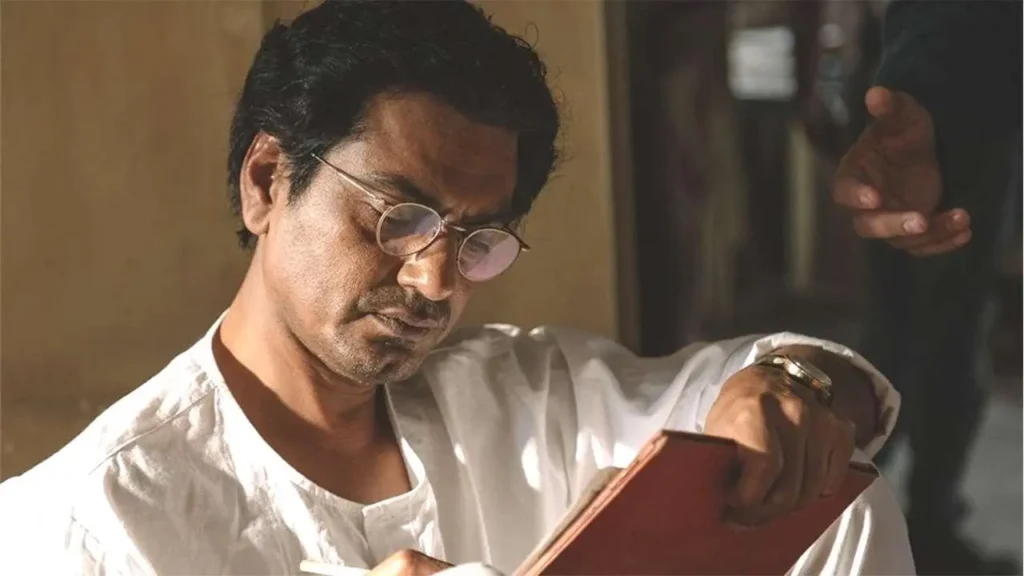
Saadat Hasan Manto’s life was already a film. Bombay studios, Progressive Writers, cheap whisky, worse publishers, Partition, obscenity trials, a talent for making enemies and a greater talent for telling the truth about them. The problem was never material. It was selection. Nandita Das chooses the years after 1947, when Manto (Nawazuddin Siddiqui) is in Lahore, broke, facing obscenity cases and trying to write as if a country had not been torn in half beneath him. The choice is defensible. It is also the one that most efficiently subtracts the man.
“Main to chalta phirta Bambai hoon,” he says, and the line should have been the film’s warning. Bombay was not a backdrop for Manto. It was a method: studios by day, arguments by night, Filmistan and Bombay Talkies, actors who wanted flattery and a writer who refused to give it. He could call Nargis plain, needle Ashok Kumar, and describe Sitara Devi in language designed to end dinner parties. That refusal to please was not a side effect of his work. It was the work.
Das compresses those years into shards. A communal flare-up helps push him out; the rest is aftermath. Lahore, at least, is where the film finds its one true subject. Streets are repainted into a new nationality. Familiar shops acquire a new suspicion. The expensive cigarettes become cheap ones. Money stops being a joke and becomes the plot. Manto’s prose darkens with the city: less swagger, more wreckage, the human joke turning sour. When a story lands him in court for obscenity, Das finally stages the only conflict that matters to her: an artist who will not sand himself down for a censorious public.
The stories within the film are the gamble. “Thanda Gosht” belongs to the movie’s grim weather. The opening tale floats free of it. “Toba Tek Singh”, held for last, is richer than the film has taught a newcomer to read. For those who already know Manto, these inserts are recognition. For those who do not, they are footnotes projected at feature length. Das keeps reminding us that the subject is important. She is less interested in making him dangerous.
That is the miss. Manto was never merely a symbol of Partition pain. He was a personality who happened to live through it. The film studies his friendship with Shyam (Tahir Raj Bhasin) with care, then leaves the rest of his world undernourished. Ismat Chughtai and the Progressive Writers’ circle could have given the picture argument, rivalry, gossip, a mind in company. Instead, we get a rotation of predatory producers and tight-fisted publishers. Historically accurate. Dramatically the same scene wearing different clothes.
Shashank Arora’s Shaad Amritsari is a function. Bhasin’s Shyam is better when the film stops arranging him. Rajshree Deshpande and Rasika Dugal do more with less because they are allowed to be people rather than positions.
ALSO READ: ‘Thackeray’ review – an exquisitely photographed biopic that plays safe
Nawazuddin Siddiqui is playing a larger film than the one around him. He does not do the accent-and-waistcoat impersonation. He gets the contradiction: vanity and beggary in the same sentence, wit that curdles into spite, a comic faith in his own genius that poverty cannot quite kill. Manto’s insolence, in this performance, is not style. It is how he stays upright. Even when Das’s camera settles into a documentary hush — watch the decline, do not theatricalise it — Siddiqui keeps offering the unruly man the script keeps postponing. The craft matches the hush: measured, handsome, a little airless. Seriousness is not the same as life.
The film is most moving when Partition is not explained but felt as private dislocation: a man can cross a new border and spend the rest of his life looking for the person he was before it. Then the suffering swallows the portrait. We are asked, repeatedly, to admire Manto’s importance. We are given too few scenes in which he is simply impossible, funny and free.
There is a contradiction in making a film about Manto while declining, scene after scene, to be as badly behaved as he was. Das has affection and conscience. What she will not risk is vitality. As a study of post-Partition narrowing, Manto is sincere and sometimes piercing. As an introduction to a writer who could wound a room and then put the wound on the page, it is cautious. You leave with respect for the filmmaker, gratitude for Siddiqui, and the sense that the real Manto picture — the Bombay one, the rude one — is still unmade.
Rating: ★★★
Manto is now streaming on Netflix.