“You are so pretty. You could be a girl.”
“You left the child with that imbecile and forgot your responsibilities.”
Shutu (Vikrant Massey) hears these words a lot in his everyday life. He is shy and moody, but never in a sexy way. Shutu’s older cousin says he needs to get tougher and start looking after his mother, whereas his wife believes he is sensitive and needs some help. Shutu’s grandma has her own set of ideas, too. How can the guy be fixed? Most people have something to say about Shutu’s ways, and they aren’t afraid to say it. A Death in the Gunj, which is Konkona Sensharma’s first film as a director, takes place in Bihar’s McCluskieganj in 1978.
The film’s resemblance to Aparna Sen’s 36 Chowringhee Lane is not simply about the time period it is set in. Dejection is a recurring motif in both. Aparna Sen’s Ms. Violet Stoneham had seen her life pass by, the orbit of which was anything but pleasant. Her dreary existence was not a choice and all she desired was a tint of happiness, a little laughter. She, however, did not seek any of it. It came to her. Konkona’s Shutu is surrounded by elements that assert his glaring inadequacies. His skill set, demeanour and looks do not match ideal standards. Then again, he is neither inert to emotions nor particularly eccentric. He is different, wading his way through a complex world.
Not just in its title, death finds numerous mentions as the film proceeds. Shutu is shown to be vulnerable in every instance, be it the planchette prank, a dead insect or a fleeting visit to the graveyard. Somewhere, he believes that death denotes peace, a better abode far away from a tiring, mundane life. We also hear mentions of local hunting scenes as well as the grandfather’s prized rifle, with Om Puri being classic Om Puri. Every object in Sensharma’s frames serves a definite purpose. So do animals. There are plenty of them, from a puppy to a frog and even a fox. Sensharma’s writing is vivid, with sharp attention to detail. Be it the lonely passages, the state of pets at the Bakshis’ home in Calcutta, the Anglo-Indian lady’s deceased child or the way Shutu finds safety in his father’s sweater, the film thrives on tiny details that are often anecdotal. Even Bonnie’s (Tillotama Shome) delicious-sounding Bengali mutton curry that absorbs all flavours from not-so-finely chopped potatoes could be a clever metaphor.
ALSO READ: ‘Dolly Kitty Aur Woh Chamakte Sitare’ review – a compassionate ode to India’s working class heroines
Regardless of how Shutu remains the pivot of Sensharma’s story, we do notice the ensemble cast and their mild idiosyncrasies. Ranvir Shorey’s Vikram Chaudhary is the quintessential loud, insecure, in-your-face macho man who would not leave a chance to terrorise the weakling. Gulshan Devaiah’s Nandu, bound by traditional family expectations, is facing a boy-man crisis and often feels the need to prove the “lad” in him. Jim Sarbh’s Brian, who drops by often, is no less a rogue. They endure jokes on “family jewels” and chastity belts with equal spirit as they include their tribal domestic helps in an aggressive game of kabaddi. It is not as if any of these men are distressingly evil. They all have their points to prove, driven by misplaced entitlement and a lack of empathy. The languid and the frail, by default, are left to cultivate fortitude to survive their energies. Devaiah is terrific in the scene where he forcefully instructs Shutu on how to reverse the family car.
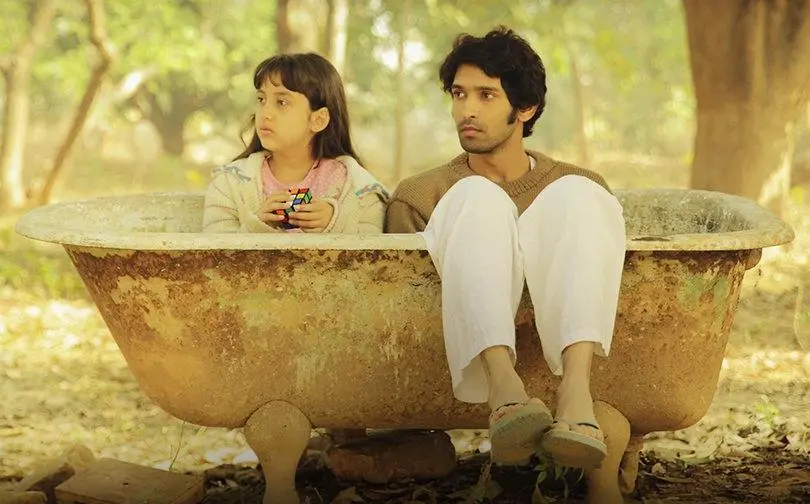
Sensharma’s women are more sensitive to Shutu’s needs, barring the selfish Mimi (Kalki Koechlin). Post a brief romantic encounter, Shutu feels she could be his emotional anchor, only to discover that she has different plans. The young Tani (Arya Sharma), without overdoing the child actor bit, is curious in good measure in Shutu’s world of severe self-doubt. He finds solace in her company as they rest lazily in an abandoned bathtub in the backyard. She critiques his drawings, to which he reciprocates by appreciating her eight-line poem. Shutu’s worried grandmother, played by a fabulous Tanuja, veils his failures from the rest of the family until a moment of discord erupts. There is embarrassment, seclusion and inevitable disillusionment, most of it resulting from actions that were far from intentional. All they see is a young man in his prime not living up to their idea of “manning up”. Most of Shutu’s relationships with women in the film meet rather unpleasant closures, while his bond, or the absence of it, with men does not. Because women did care, and Shutu knew it.
ALSO READ: The 10 Best Bollywood Films of 2017
McCluskieganj is not a surreal picture-postcard beauty. Among other things, Sensharma and hill stations remind one of Titli, except that there is no mist here. While cinematographer Sirsha Ray’s outdoor frames are atmospheric as expected, it is the measured pandemonium of the stuffy interiors that appeals more. The night when the power goes off or the crowded New Year party where a new bride becomes the centre of attention, the compositions are cinematic yet fluid. A lot of it can be attributed to the apt production design by Siddharth Sirohi. Sagar Desai’s score is zingy and accentuates the characters and their uneven temperaments. One only wishes Sensharma’s dialogues had less of a complementary twang. Likewise, the climax does not propel the way it ideally should. Nevertheless, her grip over the material, some terrific storyboarding and focused execution ensure that these oddities do not linger, leaving behind a heavy sigh as you exit.
As much as the film projects Sensharma’s directorial abilities, it also works as a showreel for Vikrant Massey’s histrionics. Even as he clumsily sits with his legs pressed together or rolls the motorbike through the courtyard, Massey proves he is a tremendous talent. Fortunately, filmmakers are offering him lead roles. Sensharma, on her part, makes full use of the slowly blurring lines between commercial and experimental cinema.
The film has all the intrigue of a chilling thriller without relying on loud music. Some frames linger for an extra second or two, reminding one of European cinema. What may seem like an outburst-driven dysfunctional family drama, where each character is headed for a revelation, eventually turns into something far more restrained. It recalls the mood of filmmakers like Xavier Dolan and Hirokazu Koreeda. A perceptive, fly-on-the-wall account of an ordinary family vacation gone kaput, the film remains confidently mellow. Not that we expected anything less from you, Konkona. Legacy, as they say.
A Death In The Gunj is now streaming on Amazon Prime.