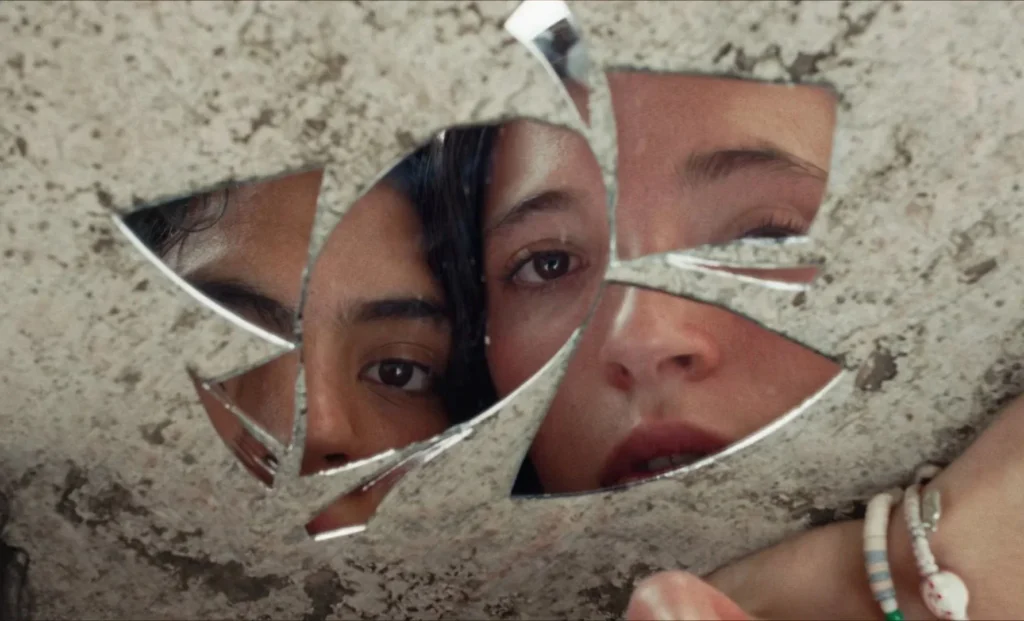
How vulnerable is it to be female in 2026? A girl could simply be walking down the street, only for it to become the site that might alter her life forever. The more intimate the surroundings get, the greater the risk she must constantly negotiate. Sad Girlz, Fernanda Tovar’s Spanish feature, screened at the 2026 Tribeca Festival, unfolds in what appears to be an equal space – a swimming facility where youngsters train for an important tournament in Brazil. Still, equality remains the last thing truly practiced there.
Sad Girlz follows two teenage swimmers, Maestra and Paula, whose friendship is tested after a party leads to a life-altering incident for Paula. She becomes a victim of sexual violence. At just sixteen, Paula finds herself unable to articulate the crucial “no”, a silence the perpetrator conveniently interprets as entitlement. When Maestra learns what has happened, she struggles to process the weight of it herself. Given the bond they share, the trauma is not Paula’s alone. Where does one go from here? Why should Maestra carry guilt for something she could not prevent? Can any amount of performative positivity truly help Paula begin to heal?
Writer-director Tovar approaches Sad Girlz with admirable clarity of vision. The film presents life entirely through the emotional and lived realities of young women. In one of its most devastating scenes, Maestra is questioned by her coach – a woman herself – where she nearly reveals the reason behind her increasingly unusual behaviour. What begins as concern quickly turns into silence the moment the coach senses what lies beneath. She cannot afford professional jeopardy.
ALSO READ: ‘Deepfake’ chronicles the vibrant alleys of modern loneliness | TRIBECA REVIEW
Nor does she want the girls’ future to be ruined for what must be an accepted norm. Although a very small character, the coach becomes the film’s unexpected conscience. The woman wants the girls (and boys) in her batch to have a single-minded focus towards clinching that coveted opportunity, which just got down as the funding has gone to soccer – a sport they never win at. Sad Girlz sprinkles its storyline with many small or big symbols of patriarchy, where silence is a woman’s biggest virtue. The psychological downward spiral of both talented swimmers is shown with dexterity through Tovar’s observant writing. The film, remarkable, avoids giving us a larger male perspective. Yes, men do exist in the ecosystem but the systemic and unfixable nature of the issue, which many might treat as trivial, stands explored through a female lens alone.
Men exist within this ecosystem, certainly, but the film understands that the larger issue here is deeply ingrained. Instead of looking at its tricky subject through a lens of justice, the film explores various ideas through a female lens, giving Sad Girlz a vital layer of empathy.
The film rejects the flashy, high-energy visuals you’d expect from a sports drama. DOP Rosa Hadit Hernández opts for tight close-ups, low lighting, and tense pauses to heighten the tension around its uncomfortable topic. The script, too, mirrors this visual isolation. Maestra and Paul do not have the courage or bandwidth to talk through their fears, so the dialogue stays raw and fragmented. This way, Sad Girlz forces an unblinking look at consent and institutional privilege.
Rocio Guzmán is excellent as Maestra, letting anger, helplessness, and quiet frustration simmer beneath the surface without leaning on overtly dramatic moments. Equally impressive is Darana Álvarez as Paula, who internalizes trauma with striking restraint. The emotional equation between the two girls is written with such precision that Paula’s line to her friend – “Don’t make me win” – lands with heartbreaking weight.
The finale of Sad Girlz arrives without conventional catharsis, entirely in keeping with the film’s refusal to chase easy resolutions. Somewhere, directly or otherwise, it reflects a difficult social truth – women are often forced to choose which battles they can afford to fight. What endures above all is sisterhood, while patriarchy continues to wait for its next opportunity.