“Burn, cool, unload, reload,” commandant Rudolph (Christian Friedel) explains the specifics of the Auschwitz concentration camp machinery. Call it sheer mechanics or the callousness he has for the value of human life, The Zone of Interest, directed by Jonathan Glazer, makes us feel grateful for having left behind a horrifying chapter in history that the Nazis wrote in indelible ink of blood.
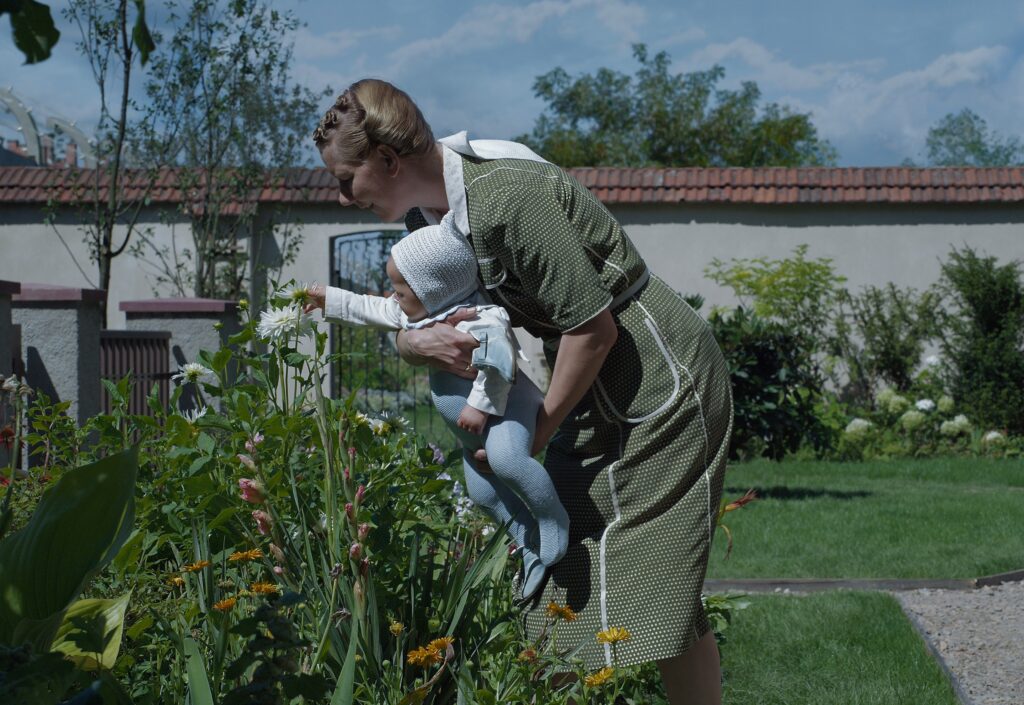
The interesting side of Glazer’s (who returns after a 10-year hiatus) film is that its violence is constantly implied. It runs in the background like a river that flows. It’s amusing if we analyze the Holocaust’s impact on the Höss family. One look at the garden and the greenhouse that Hedwig (Sandra Hüller) lovingly nurtures, and we know they are living the life of their dreams.
At least, she is. Officer Rudolph, a proud patriot, scores high on Hitler’s list of performers. This situation creates a war within the family – Rudolph is eligible for a promotion and a transfer to Berlin. Hedwig, whose decade-plus hard work to make the home what it is, will go awash in what must be a huge career turnaround for her husband.
“They’d have to drag me out of here,” declares Hedwig, and we could only think of the events that unfolded at the Auschwitz concentration camp, located right across her compound wall. There are endless screams of people of all ages, furnaces that emit copious amounts of smoke, and shots fired from guns and other undescribed weapons. DOP Łukasz Żal’s frames are such that they relentlessly give us the larger picture. While the Höss children happily play in the yard, the horrifying image of the camp in the frame leaves us uneasy. As Hedwig chats away with her kin, the fear that clouds her unpaid Jewish domestic workers remains equally conspicuous. The cries at the human slaughterhouse are trivial background noise, like the birds that chirp or the horse carriages that neigh and creak. This way, The Zone of Interest lenses the Nazi view of occurrences that looks at the atrocities without an iota of sympathy. It is their definition of patriotism, and the process is to cull the weeds out for a world that benefits them greatly.
ALSO READ: Films at IFFI Goa 2023: The Average, The Good and The Very Best
In a couple of instances, Glazer takes a diversion to animated stretches where a girl is up to her business, such as picking apples and pears – the message of which contrasts starkly with the unfeeling image of Rudolph and Hedwig’s domestic woes.
The Zone of Interest is a technical marvel of the top order. The music (Mica Levi) and sound design (Johnnie Burn) play a mammoth role in making Glazer’s film what it is. The soundscape creates a definitive rhythm with the screenplay and the frames (noticeably wide, with many distant, cold, and angular shots), leaving us gutted to the core.
The lead performers, Friedel and Hüller, fully aware of the film’s moody setting and heartless temperament, do not attempt to sweep you off your feet by excessive projection. The screenplay, with minimal lines, is such that it leaves Rudolph and Hedwig rather subdued beings despite the terror that they directly or indirectly orchestrate. The Zone of Interest does not intend to humanize its people in any manner, but the actors make sure that their respective characters do appear rational in their demands.
Screened at the 54th International Film Festival of India, Goa, Goa, Jonathan Glazer’s is an original, devastating portrait of a giant human tragedy, the aftereffects of which would never be undone. The film’s tactful use of implied violence reminded me of Vittorio De Sica’s mastery in the 1970 classic The Garden of the Finzi-Continis. Glazer, who abridges his source material (The Zone of Interest by Martin Amis), delivers the year’s most heartbreaking piece of cinema that a lot of us didn’t see coming our way.
Rating: ★★★★ 1/2
The Zone of Interest is now streaming on Amazon Prime.