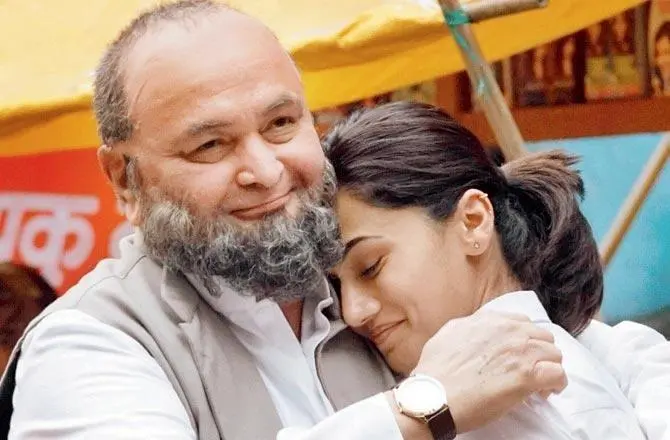
Quite early in Anubhav Sinha’s Mulk, we see a celebration taking place in a Muslim household. It is the lead protagonist Murad Ali Mohammed’s (Rishi Kapoor) birthday, and the function has several of his Hindu well-wishers in attendance. We see a middle-aged lady being offered food by one of the hosts, which she politely refuses, only to later remark, “Singing and dancing are fine, but how can I eat anything from their house?” The film’s central theme is this “normalized” prejudice against Muslims, where proximity to them comes with a hint of caution. It is always the battle of “us” versus “them.” And the catchword here is terrorism.
Set in Banaras, the immediate premise revolves around Murad’s family when one of its young members, Shahid (Prateik Babbar, effective), gets embroiled in terrorist activity. The family soon becomes the center of attention, with media flashlights trained on them and friendly neighbors turning hostile. Forming an interesting element in the narrative is the Hindu daughter-in-law of the household, Aarti (Taapsee Pannu), who also happens to be their lawyer.
Sinha’s screenplay, for starters, is direct. It leaves no room for subtext or understated ways of putting its points across. Mulk offers little respite as it exposes one social reality after another with noteworthy objectivity. To point out one example, the investigating officer (Rajat Kapoor, first-rate), who is a Muslim himself, fumbles at the very concept of terrorism and is easily more prejudiced against members of his own religion than anybody else.
Mulk effectively propagates how the “good Muslim versus bad Muslim” debate sets aside a necessary sense of humanity. Even though several of its characters are by design, Mulk succeeds in interlacing them with the plot. The weakest link in the enterprise, however, is the prosecution lawyer Santosh Anand, who is severely one-note and looks straight out of the ’90s. Ashutosh Rana’s loud interpretation of the character only adds to the problem.
READ MORE: ‘Thappad’ review – Taapsee-starrer tells us to re-evaluate the way we treat women
On the writing front, there are a handful of angles that look a little too contrived to be convincing. For instance, Bilal (an excellent Manoj Pahwa) borrowing money from his relatives in Pakistan is an ill-conceived plot point. The bitter equation shared by the brothers (Kapoor and Pahwa), again, is not established well before the story takes unruly turns. We see a traumatized Bilal repeatedly echoing the same line while claiming his innocence, which is too theatrical for a film like Mulk.
What pushes the envelope for the film is an hour of powerful courtroom sequences. Not the kind to involve startling revelations, these portions rely heavily on monologues. In moments where she could have easily gone overboard, Taapsee Pannu carries herself like a veteran and delivers a bravura performance.
Equally remarkable is Kumud Mishra as the stern judge, even though one wishes he had more to add to the proceedings. Rishi Kapoor, too, does not let Murad become a whiny old man. He lends heart and layers to his part as a doting father, husband and, more importantly, a law-abiding citizen. He emotes like magic in the scene where he refuses to accept his nephew’s corpse, knowing that he has betrayed the nation.
While deconstructing Islamophobia, Mulk also throws light on the possibility of a more inclusive society where members of all faiths coexist in peace. The existence of a Hindu daughter-in-law does not threaten Murad’s family. The presence of a Hindu place of worship in the same lane as theirs is no point of concern either. It is only when the underlying bigotry is exposed in court through interpretations of the Quran and casually assumed statistics that the film comes into its own.
The investigating officer carries out an encounter on the terrorist when he could easily have arrested him. This might have been an intrinsic act of cleansing for him, essentially born out of his own prejudice against the community he belonged to.
Mulk also rightfully chronicles the gullible nature of today’s youngsters and how religion can effectively be used to manufacture hate, making way for a society that is increasingly divisive. The brief commentary on saffron terrorism is another noteworthy touch, further broadening the conversation around what terrorism actually stands for.
Rating: ★★★ 1/2
Mulk is now streaming on ZEE5.





1 thought on “‘Mulk’ review – A gripping courtroom battle against bigotry”
Comments are closed.