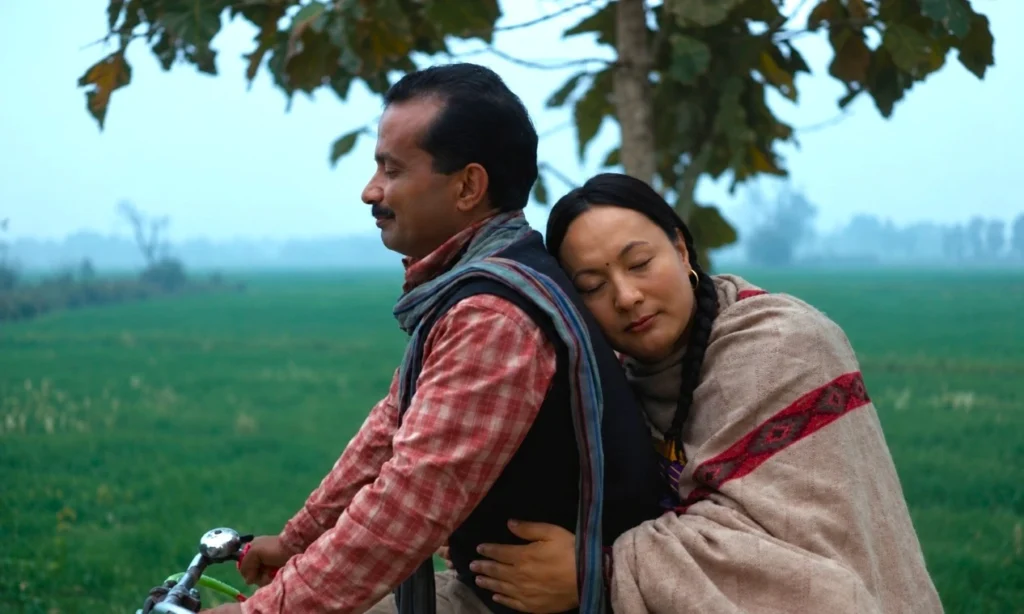
What if the wild elephants were the least of their worries? In Abinash Bikram Shah’s Elephants in the Fog, a small community of transgender women lives in a Nepalese village on the fringes of a jungle inhabited by wild elephants. The setting is straight out of a storybook, although there is little that is idyllic about the lives of its inhabitants. Shah juxtaposes the unpredictability of nature with the more familiar cruelties of human beings. In a world governed by superstitions, prejudices and deeply entrenched social hierarchies, one wonders if the women would lead considerably happier lives were the elephants all they had to fear.
Set in Nepal’s Thori village, Elephants in the Fog follows Pirati (Pushpa Thing Lama), a mother figure to several members of the Kinnar community, with the blessings of their local head, Guru Mata (Umesha Pandey). At the heart of the story is Pirati’s maternal affection for Apsara (Aliz Ghimire), one of the youngest members of the household, who goes missing one night. Meanwhile, Pirati is pursuing a clandestine relationship with a local man, much to the disapproval of her clan. As the search for Apsara progresses, the very circumstances that brought these women together begin to complicate their lives further.
One of the most interesting aspects of Shah’s screenplay is how organically social prejudice informs the suspense. The villagers observe certain social courtesies in their interactions with the Kinnars, although their tolerance seldom extends beyond that. As Apsara’s disappearance draws the local police and the more ‘respectable’ families of the village into the picture, we begin to understand the nature of this coexistence. Much of Pirati’s struggle involves getting people outside her community to recognise the gravity of Apsara’s disappearance. The tension in these passages owes as much to the indifference of those around her as it does to the mystery surrounding the missing girl.
Shah is equally interested in familial relationships – those that Apsara shares with her birth family and Pirati with her chosen family. Pirati’s visit to Apsara’s former home is among Elephants in the Fog’s most distressing passages, revealing the extent to which prejudices against transgender individuals permeate even the most intimate of human relationships. There is a particularly bitter irony here, considering the significance popularly attributed to the blessings and curses of the Kinnars in the subcontinent. A community believed to possess the ability to influence the fortunes of others has remarkably little say in its own.
ALSO READ: ‘Coward’ Finds Courage in the Audacity to Love | IFFI Review
The dynamics within the Kinnar household are equally intriguing. Its members live by a stringent moral code under the supervision of Guru Mata. We do not see them engaging in sex work or seeking alms, and romantic relationships are forbidden. Their adherence to these rules, however, does little to alter their social standing. Pirati’s romance acquires greater poignancy in this context. Having assumed the responsibility of providing a home and a sense of belonging to several women, she finds herself having to seek their approval for something as personal as falling in love. Shah is sensitive to the circumstances that make chosen families indispensable to queer individuals, but he is also willing to examine the complexities of living within one.
Pushpa Thing Lama is brilliant as she conveys the contradictions inherent in Pirati’s existence. The authority with which she presides over her household means precious little once she steps outside it. Her affection for Apsara and her desire for intimacy are central to our understanding of the woman, and it is to Shah’s credit that neither is treated as secondary to the politics of her gender identity. Pirati is allowed the emotional complexities that cinema so readily affords its cisgender protagonists. Therein lies much of the beauty of Lama’s characterisation.
Shah textures his screenplay with local myths and an assortment of disparate characters, fashioning a magnificent suspense drama out of what is essentially a search for a missing person. The cinematography, production design and soundscape give the village a distinct character, with the proximity of the jungle lending an air of unease to its everyday rhythms. The elephants are an interesting presence in a film where human beings are themselves vulnerable to the vagaries of nature, yet remain fiercely invested in preserving the inequalities among them. Shah allows the tension to accumulate gradually before unleashing it with considerable ferocity in the finale.
Nepal’s official submission for the 2027 Academy Awards, Elephants in the Fog is a politically astute film made by a writer-director with an equally assured understanding of genre. By the time Pirati’s quest reaches its conclusion, the mystery of Apsara’s disappearance has made way for a far more unsettling question: what does it mean to disappear from a world that has barely acknowledged your existence in the first place?
VERDICT: ★★★★ 1/2
Watch the trailer of Elephants in the Fog HERE.