What constitutes courage in the middle of a war? The readiness to lay down your life for your country or the audacity to be yourself in a world that regards your very identity as a sign of weakness? Belgian filmmaker Lukas Dhont, whose previous films Girl and Close dealt so perceptively with the politics of identity and masculinity, finds himself on equally fraught terrain in Coward.
Set in 1916, in the midst of the First World War, the film follows two men – one flamboyant, the other reticent – who find passion, love and release in each other. At a time when lives are at stake, the articulation of their desires is perhaps more taboo than their existence.
Coward isn’t merely a film about two men arranging clandestine encounters to explore their sexualities. We have seen that narrative play out time and again. What interests Dhont is how the two men, constantly ridiculed for their perceived lack of machismo, become entertainers within the military unit, keeping up the spirits of their injured and supposedly braver counterparts. The irony is hardly lost on us. The very qualities for which these men are ostracised make them indispensable to the morale of their fellow soldiers.
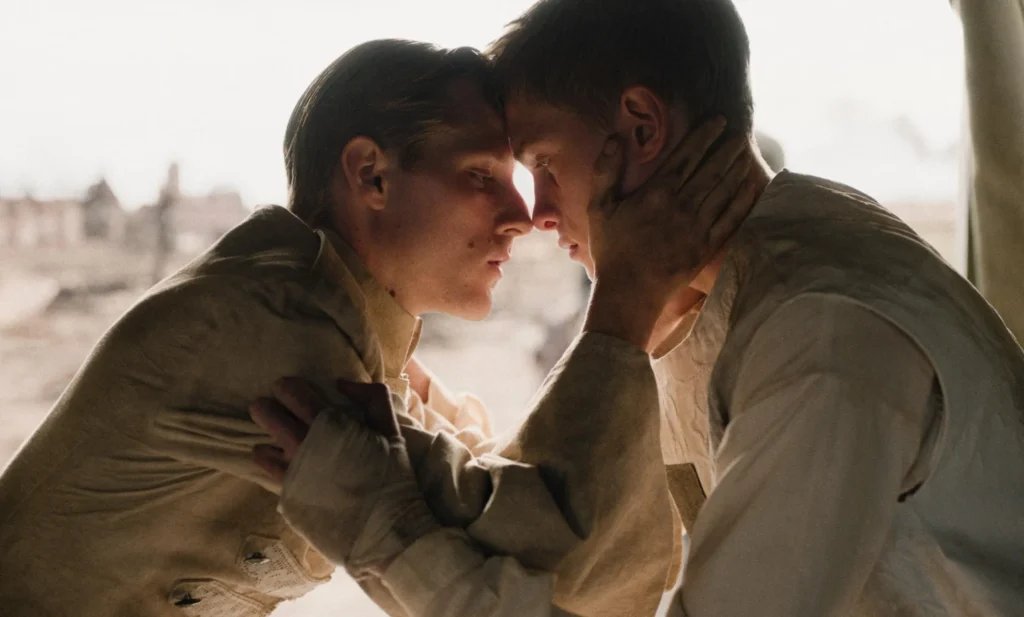
Francis (Valentin Campagne), a bespoke tailor by profession, is a charmer who takes naturally to dressing up as a woman. The reticent Pierre (Emmanuel Macchia) is captivated by his artistry rather than amused by it, as the other men are, and falls in love. Francis does, too, albeit with a greater awareness of where they are – on the warfront, in an era particularly unkind to the love they wish to share.
In one of their intimate moments, Pierre insists that they move to the mountains, find a cabin and live a life of bliss. It’s a very Brokeback Mountain-like proposition, made all the more endearing by the fire-and-ice chemistry between the leads. Francis, considerably bolder in his sartorial choices and uninhibited in his penchant for entertaining, remains sceptical. I found this contradiction in their personalities particularly fascinating. The man who is seemingly more comfortable in his own skin is also the more pragmatic about their future. Pierre, for all his reticence, is the one who dares to imagine a life beyond the war.
Dhont’s film revels in its dramatic screenwriting, which knows when to pierce us with an evocative, almost poetic line and when to let silence take over. The soundscape waltzes dangerously between the gunfire of the battlefield and the whispers of the lovers. Perhaps the most striking departure from the conventional war film template is Coward’s conscious dissociation from patriotism.
Neither man seems particularly invested in the idea of a nation, and their need to prove their worth stems from a deeply personal place. Dhont is more interested in what the military institution does to these men than in what the war demands of them as citizens. This allows the filmmaker considerable freedom in exploring their intimacy.
Coward’s finest portions are those in which Francis performs and Pierre looks on, his gaze oceans apart from the mocking looks of his fellow soldiers. There is something rather beautiful about a man finding himself desirable in the very guise that makes him an object of ridicule to others. Dhont and cinematographer Frank van den Eeden make excellent use of Pierre’s face, alternating between close-ups and fleeting glances.
In one particularly telling scene, an officer grabs hold of Francis during a performance, prompting a firm yet restrained reaction from Pierre. The scene acquires its tension from the fact that even an instinctive gesture of affection or protectiveness could give Pierre away. For me, this is where the love story fully takes shape.
It is also through these performances that the irony of the film’s title comes into sharper focus. Francis has the nerve to appear before a room full of soldiers in a woman’s attire, fully aware of their prejudices. Pierre’s courage manifests itself differently, in his refusal to accept the limitations imposed on their relationship.
Neither conforms to the military’s definition of bravery. Yet, between the elaborately choreographed performances and the stolen glances, Dhont makes a persuasive case for their own understanding of it. Eventually, we realise that the war of greater consequence to these men is the one raging within them – particularly within Pierre, who struggles to reconcile his desires with the reality that the world has already scripted for him.
Much of Coward’s appeal lies in the acting prowess of its leads, and it helps that Campagne and Macchia bring such contrasting temperaments to Coward. Campagne has a wonderfully animated face with eyes that sparkle, lending Francis a charm that makes Pierre’s fascination with him entirely understandable. Macchia, on the other hand, works with a far more internalised register.
The chemistry between the two is as palpable in their disagreements as it is in their moments of intimacy. Even when Francis is at his most theatrical I’d often find myself looking at Macchia. There’s a real depth of feeling in the actor’s face, particularly in those moments when Pierre simply can’t afford to show any.
The climax that Dhont comes up with is probably a bit too much for its time, quite fairy-tale in nature. There’s a certain romantic idealism about it which I think would be at odds with the actual historical reality that Coward so carefully establishes. I can’t think of any other ending that would be more emotionally satisfying. In a world where we’ve seen so many queer period pieces where tragedy is the only way to be historically accurate, Dhont’s decision to give his lovers a happy ending is a real breath of fresh air.
Is it necessary for a queer romance to end in tragedy to be authentic to the period? Because the final scene is absolutely in keeping with the film’s emotional, occasionally melodramatic, tone. It’s an ending that gives you hope. Still, it also leaves you with a very painful aftertaste in the form of the sheer number of queer people in that period who must have been denied the simple possibility of just existing as themselves, let alone the possibility of a life together.
VERDICT: ★★★★
Watch the trailer of Lukas Dhont’s Coward HERE.