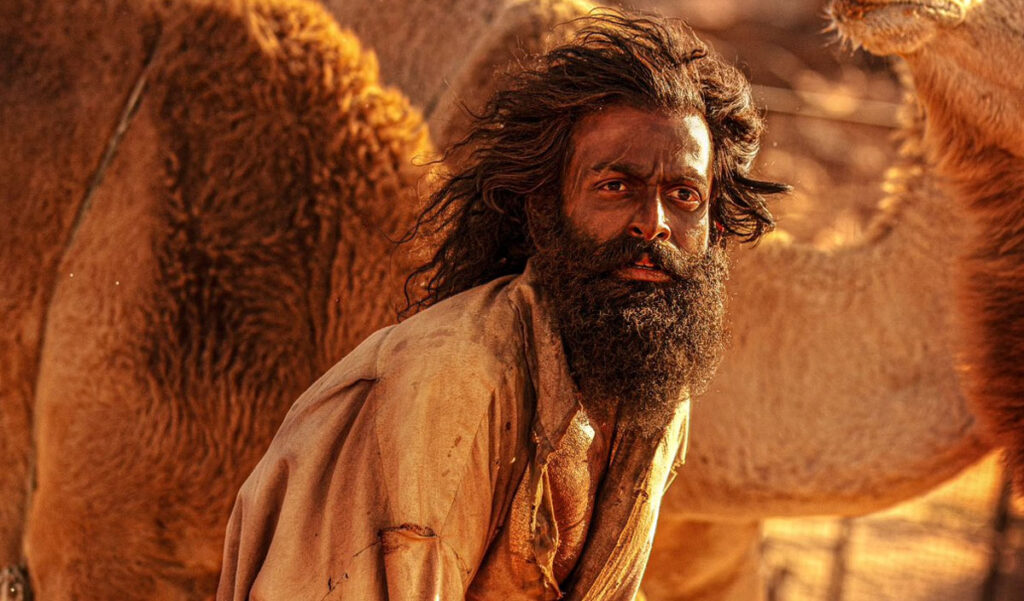
Filmmaker Blessy famously exhibits a gifted talent. He maneuvers through the most complex emotions without a dot of melodrama. Many of these lingering moments revel in their ambivalence, so the viewers often react differently to them. Aadujeevitham (The Goat Life), which is his return after 11 years, brims with the same quality.
With Prithviraj Sukumaran in the lead, Aadujeevitham is based on Benyamin’s eponymous book. It follows the real-life ordeals of a Malayali man in 1990s Saudi Arabia. Najeeb (Prithviraj) is a poor laborer from Kerala who mortgages to ensure a better life for his family by working in the Middle East.
In Saudi Arabia, Najeeb is instantly trafficked. Unfamiliar with languages other than Malayalam, he lands in the middle of a barren desert. In no time, Najeeb becomes a slave to his Arab bosses, who deny him necessities and cut him completely off from the outside world. In his new occupation, Najeeb is primarily a shepherd. To a Malayali man who has never seen a sheep or a camel before, the job is never easy. His attempts to interact with others bear no fruit.
Aadujeevitham does not come with a twisted plotline. Najeeb’s story of resilience is all about nuances, not surprises. To relieve us from the story’s inherent dreariness, the filmmaker intersperses the first two acts with flashback episodes. If the yellow-tinted portions set in the desert exude sweltering heat (cinematography by Sunil K.S.), the greenery surrounding Kerala’s backwaters is an oasis to the eyes. The transitions are smoothly woven (editing by A. Sreekar Prasad) to draw quick and staggering parallels.
When the flashback opens, Najeeb is shown digging soil from a streambed. Hailing from a village with water in abundance, we observe the man’s sweet dalliances with his wife Sainu (Amala Paul), where they swim like swans. Before he sets out, Najeeb enjoys his mother’s (Shobha Mohan) tasty mutton recipe and ensures his pregnant spouse will have its soup frequently. So many of these motifs recur later in the film—and tragically so. In Saudi Arabia, surrounded by brown dunes, Najeeb longs to enjoy a palmful of water. Goats and sheep become his companions. Aadujeevitham, in this manner, dichotomizes the elements surrounding its leading man.

Produced as a Malayalam film, The Goat Life is a universal story. It is multilingual with dialogues in Malayalam, Arabic, Hindi, and a few words in English. It’s based in India and Saudi Arabia, with principal characters from multiple races. Aadujeevitham is a film you could watch sans subtitles without missing major details. This quality of Blessy’s film can also be attributed to the filmmaker’s ability to give the viewers a fly-on-the-wall experience. The wide frames of expansive deserts feel as intimate as the quiet moment where Najeeb shivers in silence while sipping water from the sheep’s pit. The film’s language, in most parts, is as alien to us as it is to the protagonist and his goats. There is monotony in the color palette, poignancy in the sounds (Resul Pookutty), and a heightening uneventfulness in the man’s activities. Aadujeevitham overwhelms us, so we root for the man to find a way out.
ALSO READ: ‘L2: Empuraan’ review – Prithviraj’s brave film screams for brevity
As it glides towards the fourth act, The Goat Life gets quieter and more spiritual. Aided by A.R. Rahman’s stunning original score, the soundscape and the images are magnetic enough to warrant no dialogues and overt expressions. Blessy never conceals the spiritual intonations in his writing. It only becomes more prominent as Najeeb meets principal characters who are no less than godly figures.
It would have been startling if Aadujeevitham were not to become Prithviraj Sukumaran’s finest performance to date. It skyrockets the actor into the league of the greats as he puts together an intense, hugely humbling act aided wonderfully by Blessy’s masterly screenplay. The physical transformation is astounding. Be it the scene where Najeeb takes a bath or the interval dot where his appearance begins to resemble the animals he rears, the actor gives his flesh and blood to Najeeb. K.R. Gokul excels as Hakeem—a somewhat familiar Blessy character who will break your heart. One with an invisible halo over his head, Jimmy Jean-Louis (who also co-produces the film) is a superb pillar of support to Prithviraj.
The Goat Life is a triumphant effort by its leading man, who appears in every running frame. I would be passé enough to attribute the feat to Blessy’s time-tested knack for extracting the best out of his actors. Interestingly, the greatest takeaway from his technique is neither the craft on display nor his skill to let his actor shape-shift. Blessy’s cinema contains the potential to humble you. The people in them and their emotions become your own. Their joys, griefs, and battles become yours. Take the cute passage from his debut film Kazhcha, where the children watch a tearjerker film during a song sequence. It made us sob and smile without the writer doctoring our reactions. Aadujeevitham, too, gives us similar moments in abundance. So abstractly emotional are some, I observed how a group clapped, a few shed copious tears, and others heaved massive sighs, at the same time. The Goat Life has the filmmaker’s stamp all through, making it the masterpiece we wished it would be.
Rating: ★★★★ 1/2
Aadujeevitham (The Goat Life) is now streaming on Netflix.